Updated on 2 October 2026. Here are the five AI training programmes companies ask us for most, role by role, with what we actually do in them and the teams we have already trained.
In 2026, almost all your teams have already opened ChatGPT, Claude or Copilot. 😅
The question is what to do with them on Monday morning, on their own files, without sending sensitive data where it should not go.
Generic training answers this poorly, because a salesperson and an HR director have neither the same tasks nor the same risks.
Here are the five training programmes our clients ask for most, and how to choose yours 👇
In brief
- Good AI training starts from the tasks of a role. The tool comes next.
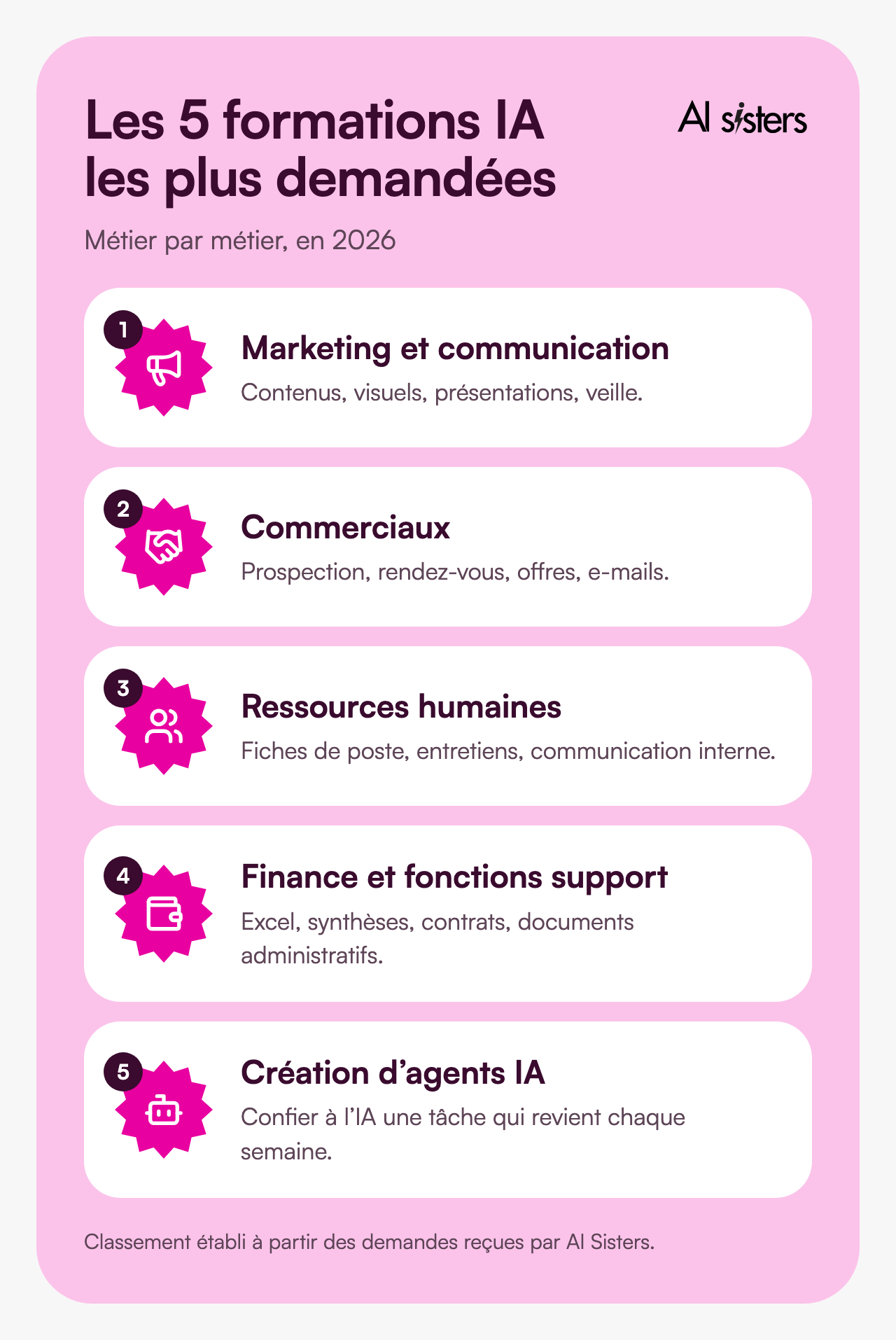
- The five most requested: marketing, sales, HR, finance and support functions, and building AI agents.
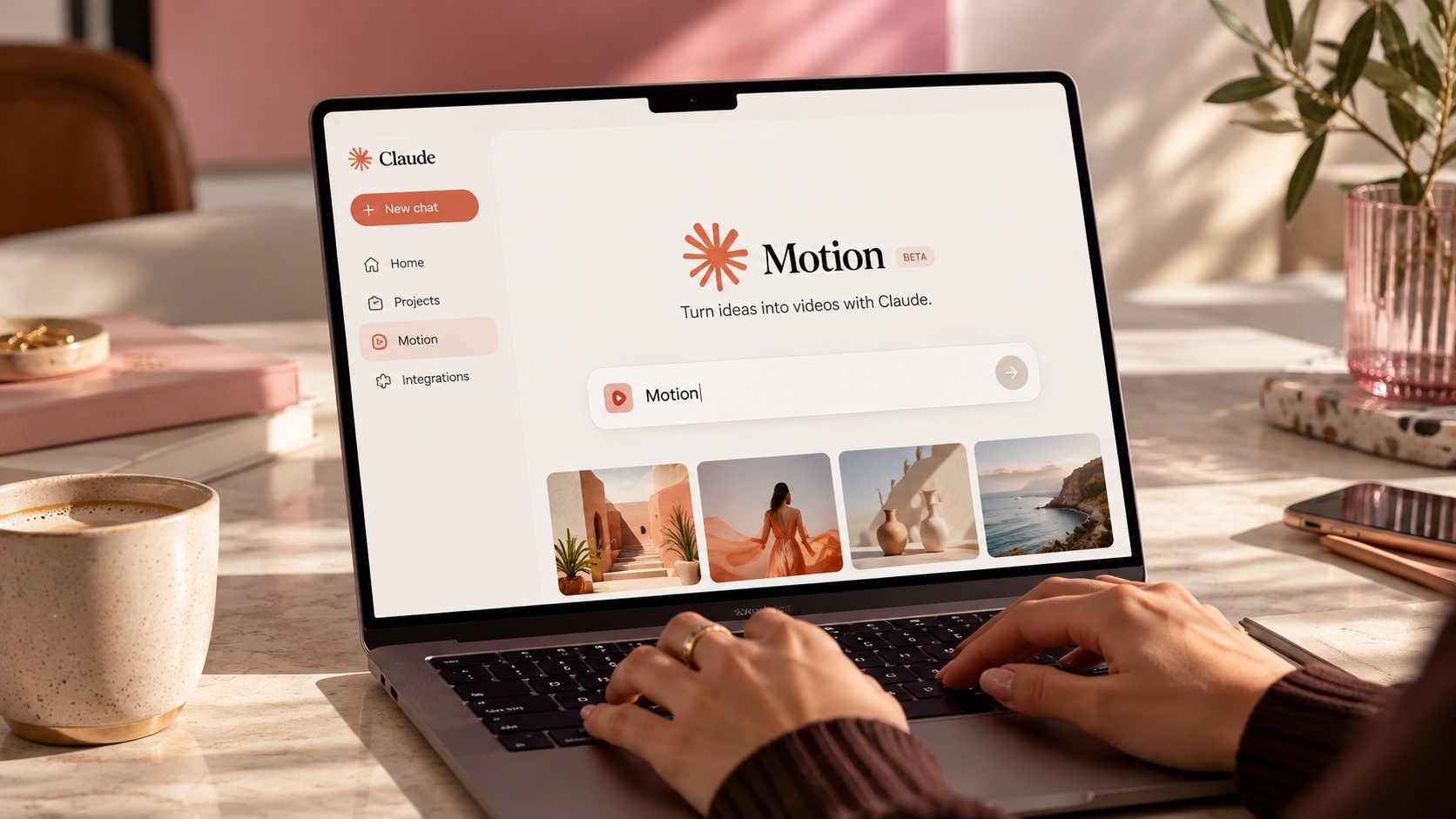
- The tools have changed in a year. Claude makes slides, ChatGPT works in Excel, Copilot creates agents: 2025 programmes are already dated.
- The data question comes before the technology, especially in HR, finance and legal.
- The format matters as much as the content: show, workshop, Promptathon or Agentathon, depending on whether you want AI awareness or output.
- Training can be funded and measured. OPCO (French training funds), skills development plan, and metrics set before you start.
Also read
Discover our other articles to go further on corporate AI training:
What makes good AI training in 2026
Successful AI training is judged on one thing only: what your teams do differently three weeks later.
In our sessions, this means use cases taken from the team's daily work, practised on the tools the company actually authorises. Added to this is a clear rule on data: what can go into which tool.
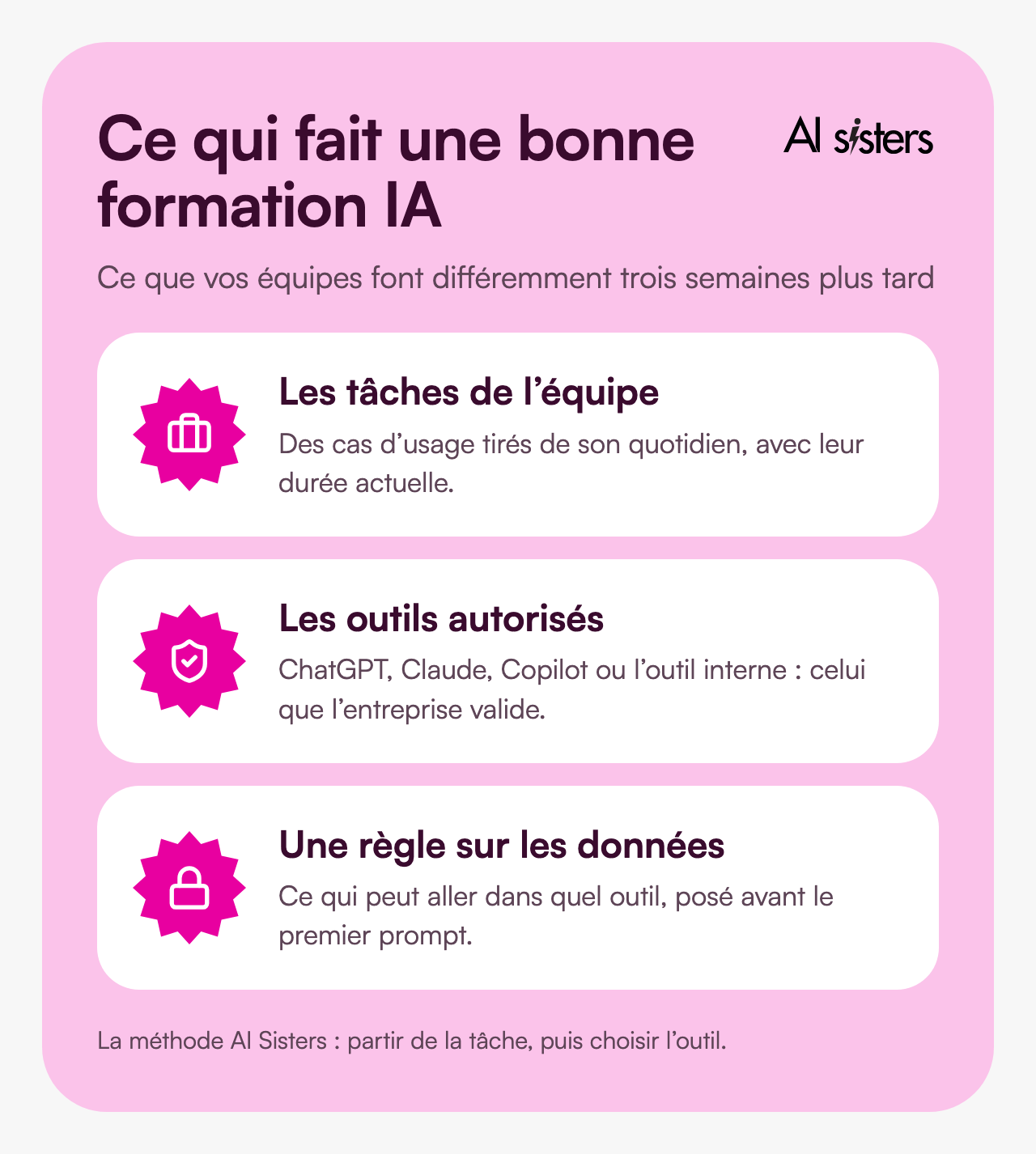
This is the principle of our role-based approach to training: we start from the task, then choose the tool.
💡 To understand: learning AI without use cases is like learning Excel without a spreadsheet to fill in. You remember the menus, not the reflexes.
1. AI training for marketing and communications
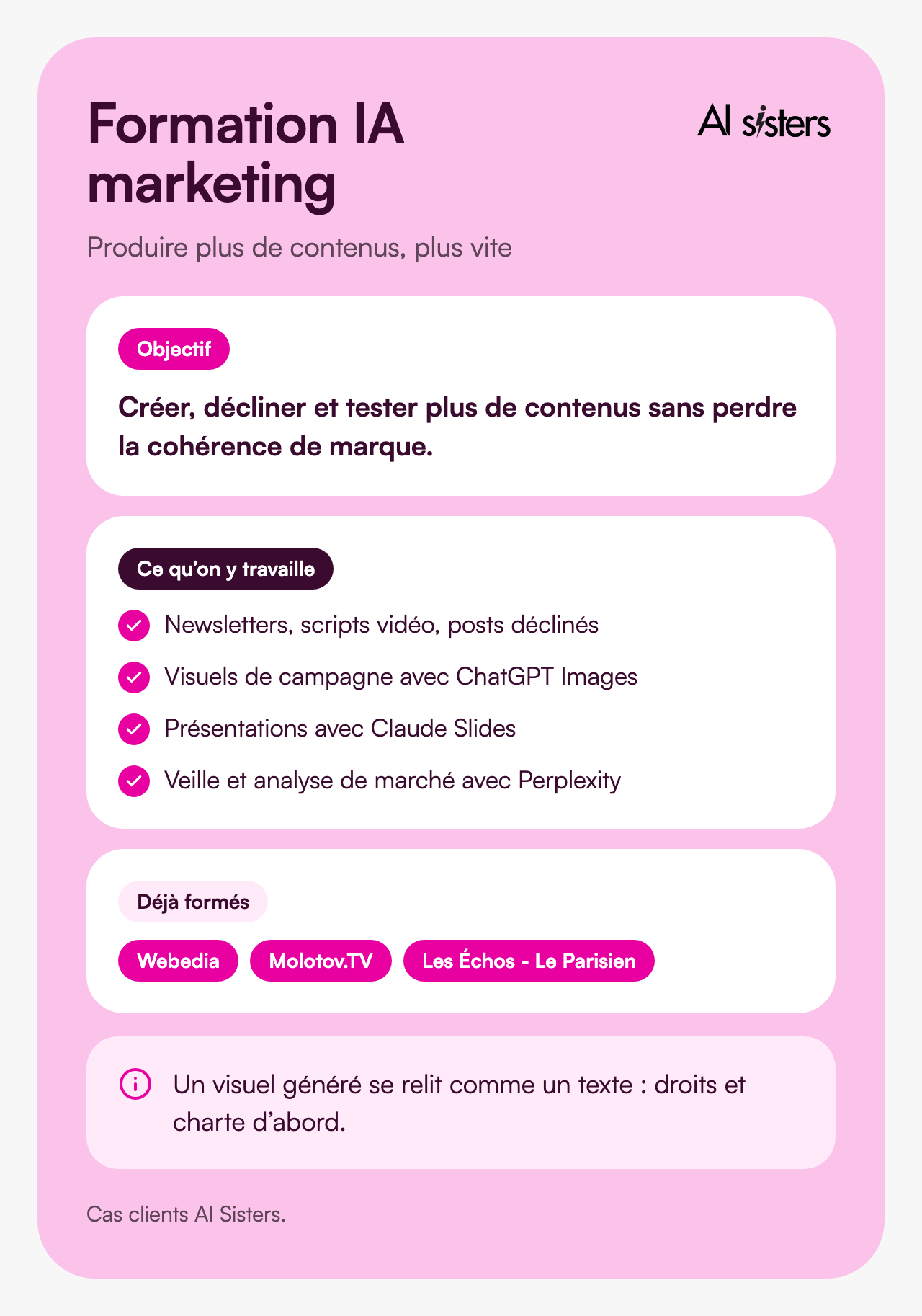
Marketing is often the first team to train, because the gain is visible straight away: more content, faster, with more variants to test.
What we work on:
newsletters, video scripts and posts adapted into several formats; campaign visuals with ChatGPT Images 2.5; presentations generated with Claude Slides; monitoring and market analysis with Perplexity.
Already trained:
the teams at Webedia, in separate workshops for pre-sales, sales and operations. The marketing and editorial teams at Molotov.TV, in small groups after a general talk. And Les Échos - Le Parisien, trained directly on MaIA, the LVMH group's secure internal AI tool.
Watch out for:
image rights and brand consistency. A generated visual needs proofreading just like a text.
2. AI training for sales teams
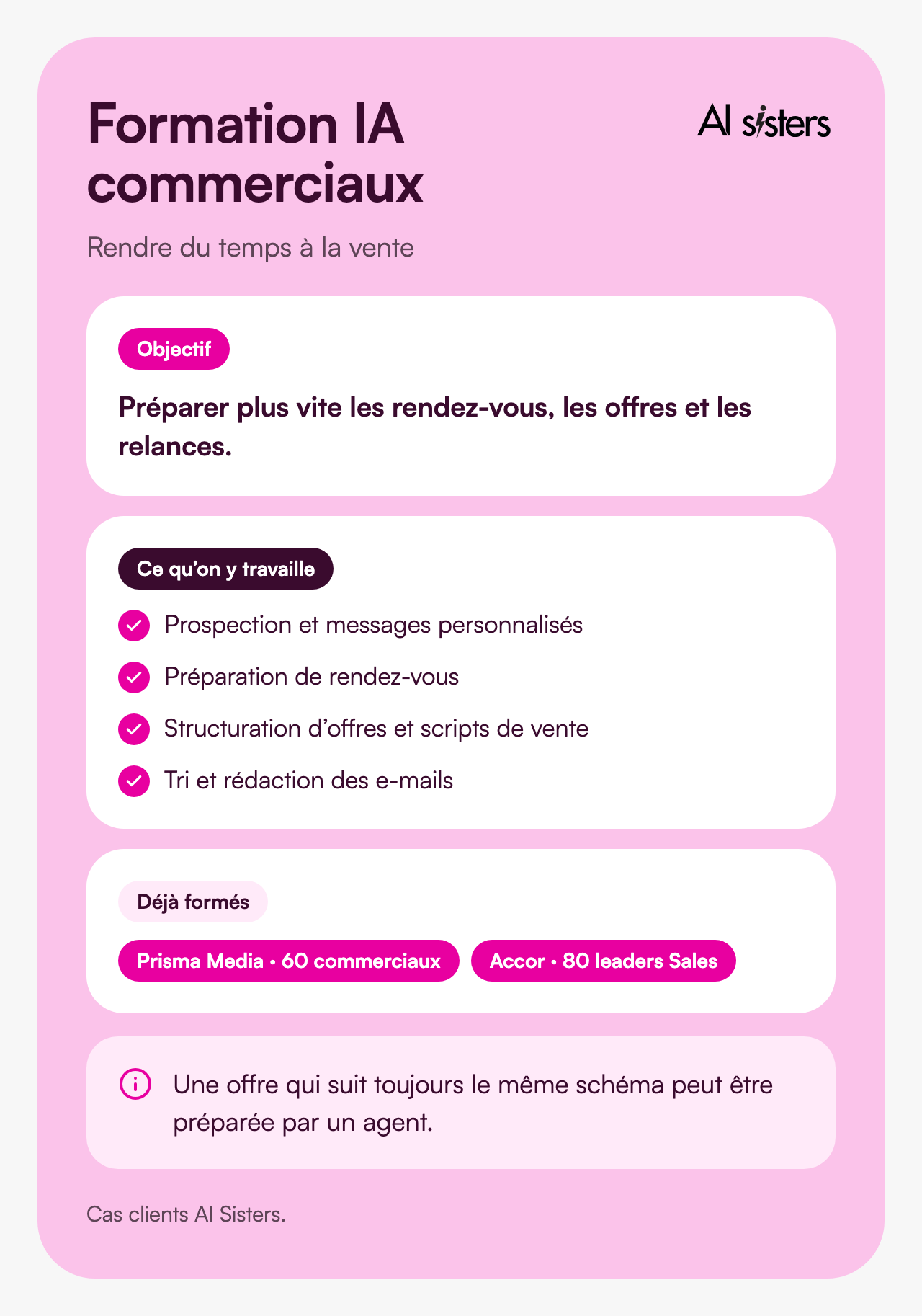
For a salesperson, AI is first a preparation tool: for the meeting, the offer, the follow-up. That is time given back to selling itself.
What we work on:
prospecting and personalised messages; preparing meetings from an account's public information; structuring offers and sales scripts; sorting and writing emails, with Claude in Outlook.
Already trained:
60 salespeople at Prisma Media, in one day alternating teaching in the morning and practice in the afternoon. And 80 Sales leaders at Accor Luxury & Lifestyle, brought together for a four-day seminar in Cancún.
To go further:
when the sales proposal always follows the same pattern, an agent can prepare the first draft. We describe an engagement of this kind in our large-account case study.
Discover our AI training & book a call
Explore our training modules and choose, with us, the one that best meets your AI needs.
📚 See our AI training 📞 Book a discovery call
3. AI training for human resources
HR has very writing-heavy tasks, which makes them well suited to AI. But HR also handles the company's most sensitive data: pay, appraisals, employee relations.
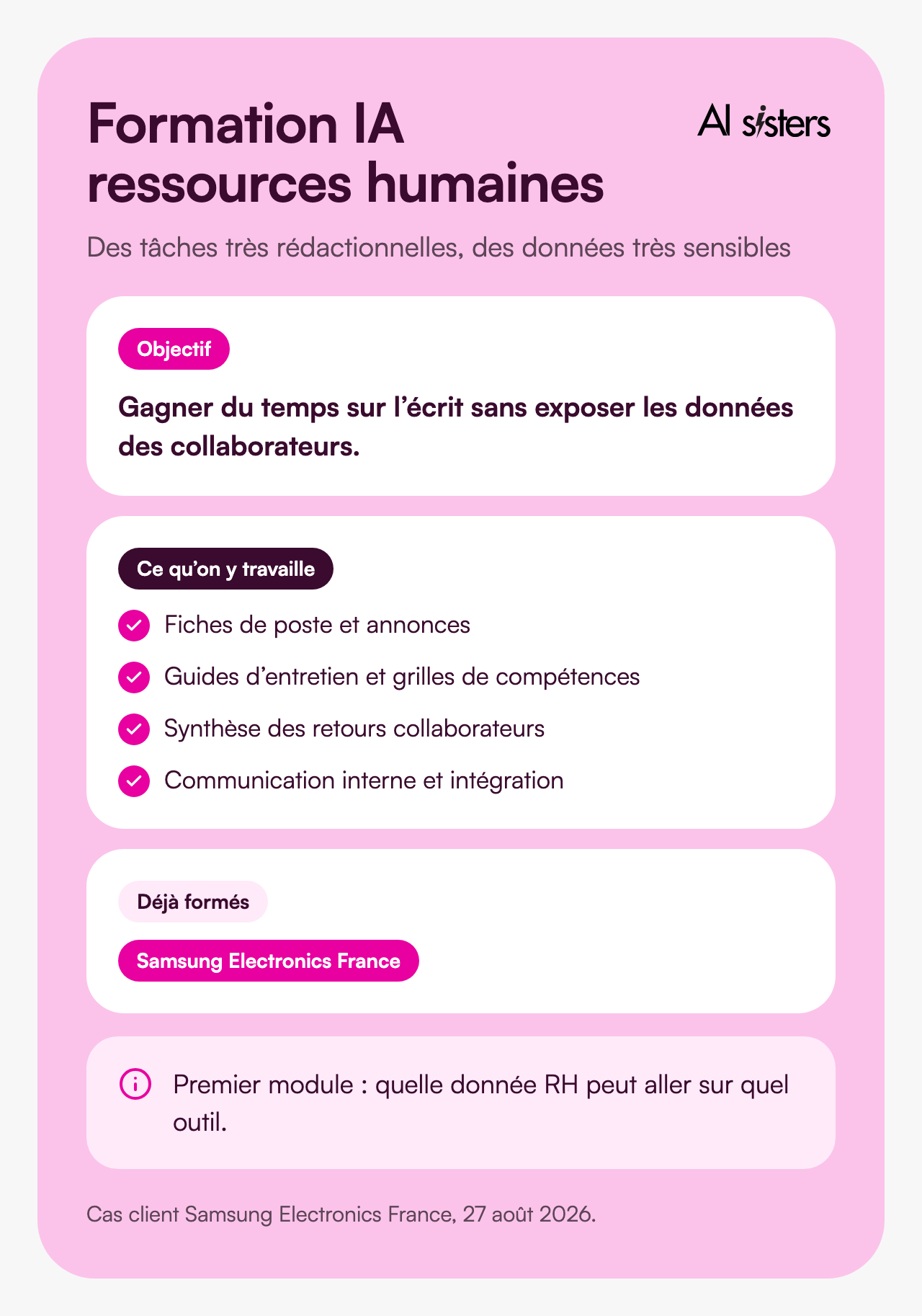
What we work on:
job descriptions and adverts; interview guides and skills grids; summarising employee feedback; internal communications and onboarding journeys.
The first module:
knowing which HR data can go into which tool. We cover it before a single prompt.
Already trained:
the HR teams at Samsung Electronics France, on 27 August 2026, over one morning: method, advanced prompting, then a three-round Promptathon based on a typical week for an HR team.
If you are leading the rollout on the HR side, our guide to training your teams in ChatGPT and the page dedicated to HR teams explain the approach.
4. AI training for finance and support functions
Finance, legal, facilities: these are the teams that gain most on repetitive tasks, and the ones that demand the most rigour.

What we work on:
data analysis in Excel with AI; summaries, variance analysis and presentation materials; reviewing contracts and clauses; minutes and administrative documents.
Already trained:
80 Finance employees at Ipsen, from all over Europe, during a two-hour kick-off in Brussels. The legal, finance and property management teams at SFL, on cases such as reviewing commercial lease clauses. And 130 employees of the Institut Français, in a talk at the Théâtre des Abbesses.
Watch out for:
AI rephrases well but calculates badly. Figures are checked in the spreadsheet, not in the conversation.
5. Training in building AI agents
This is the training that has grown most in a year. After asking AI questions, teams want to hand it a task that comes back every week.
What we work on:
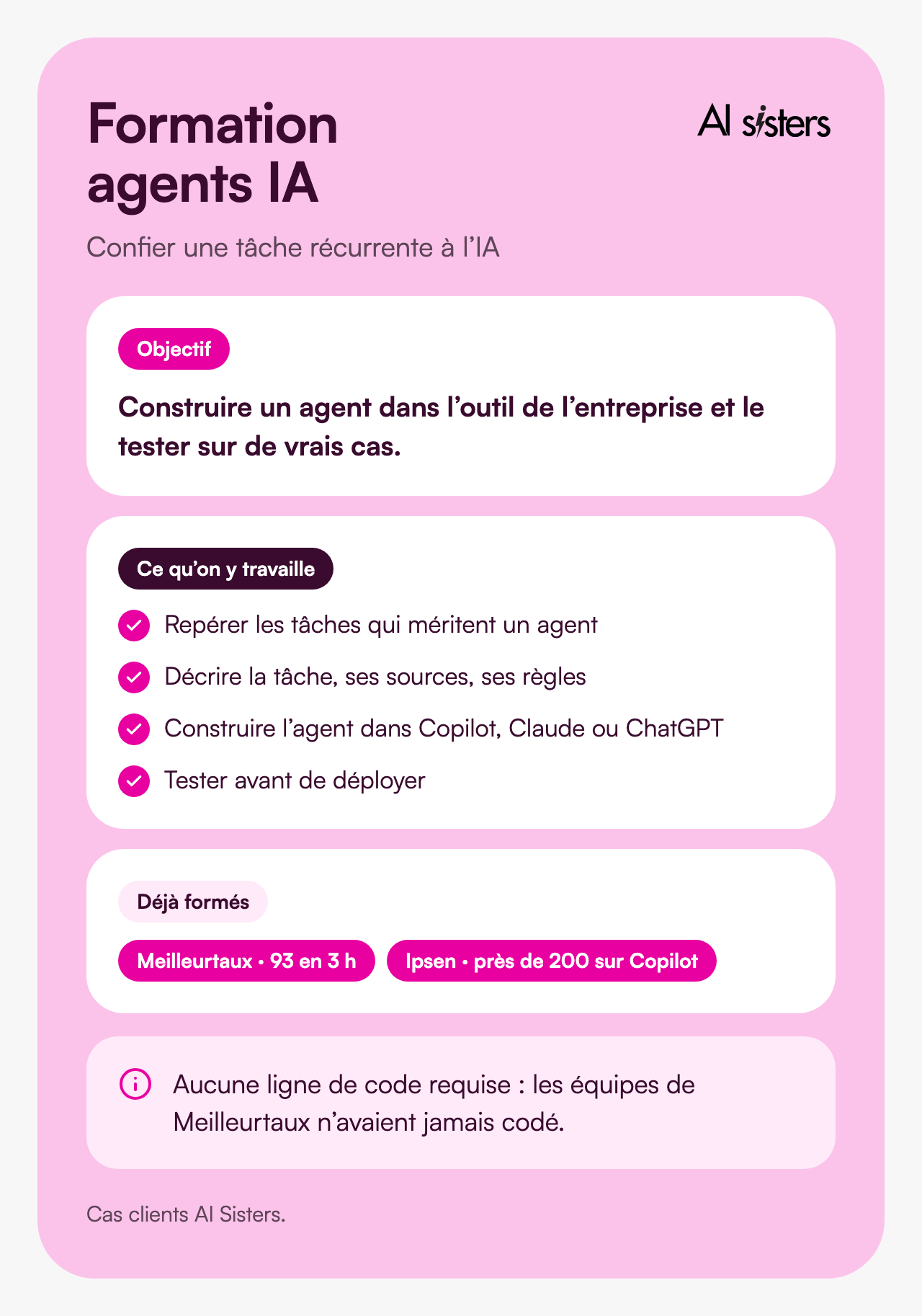
spotting the tasks that deserve an agent; describing the task, its sources and its rules; building the agent in the company's tool (Copilot, Claude or ChatGPT); testing it on real cases before rolling it out. Our guide to building an AI agent sets out the method.
Already trained:
93 Meilleurtaux employees, who had never coded, built their agents in 14 teams during a three-hour Agentathon. At Ipsen, nearly 200 employees did the same on Copilot, in one afternoon.
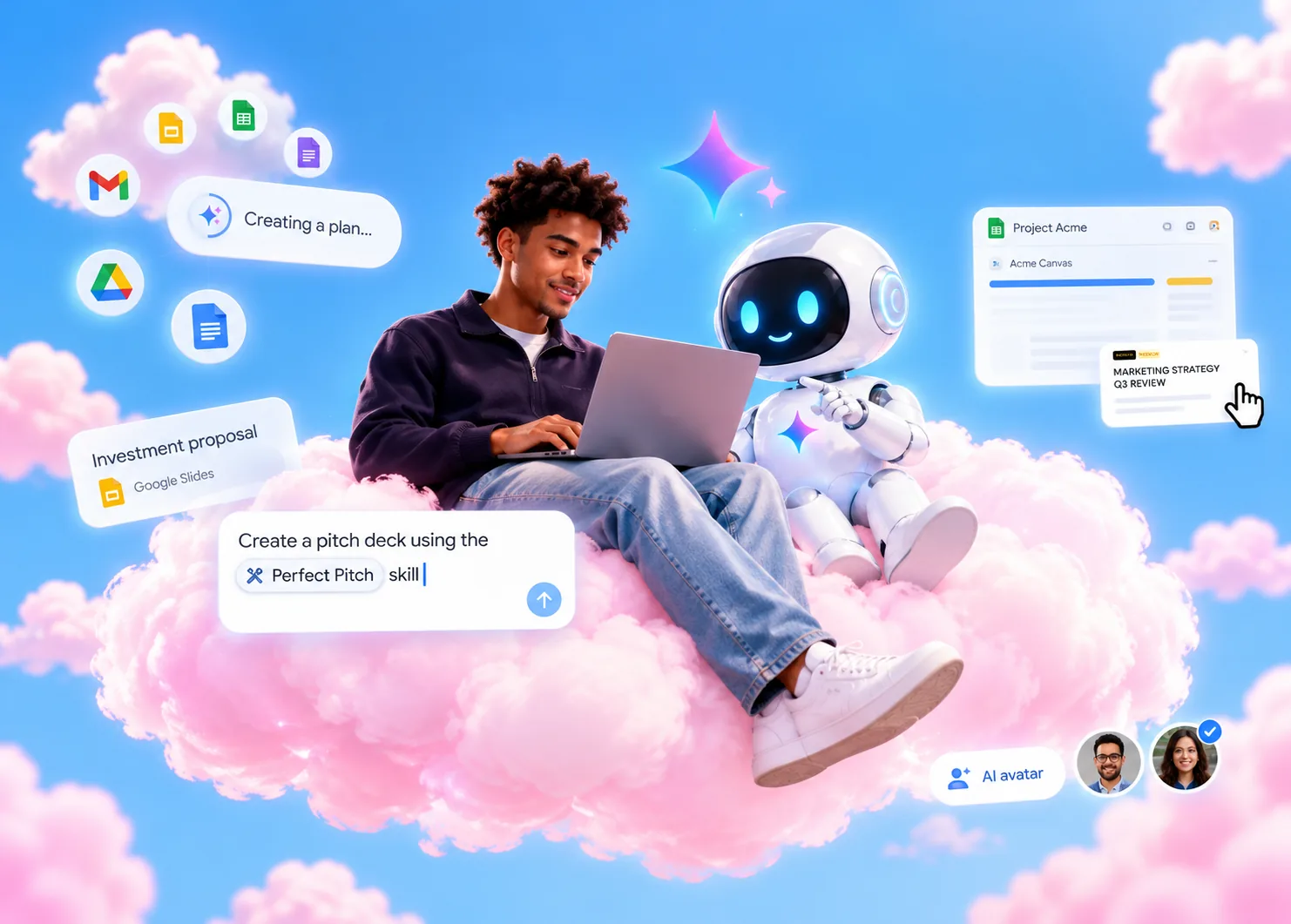
With the new Copilot and its Autopilot tab or Claude Skills, this skill is now within reach of business teams.
💡 To understand: an assistant answers when you talk to it. An agent does the work on its own, every week, according to rules you have written. The training is mainly about learning to write those rules.
Book your 30-minute call now
A no-obligation conversation to build your AI training around your tools.
👉 Tell us about your AI project 👈
Show, workshop, Promptathon or Agentathon: which format to choose
The same content does not have the same effect in every format. It all depends on what you are looking for: discovery, practice or output.
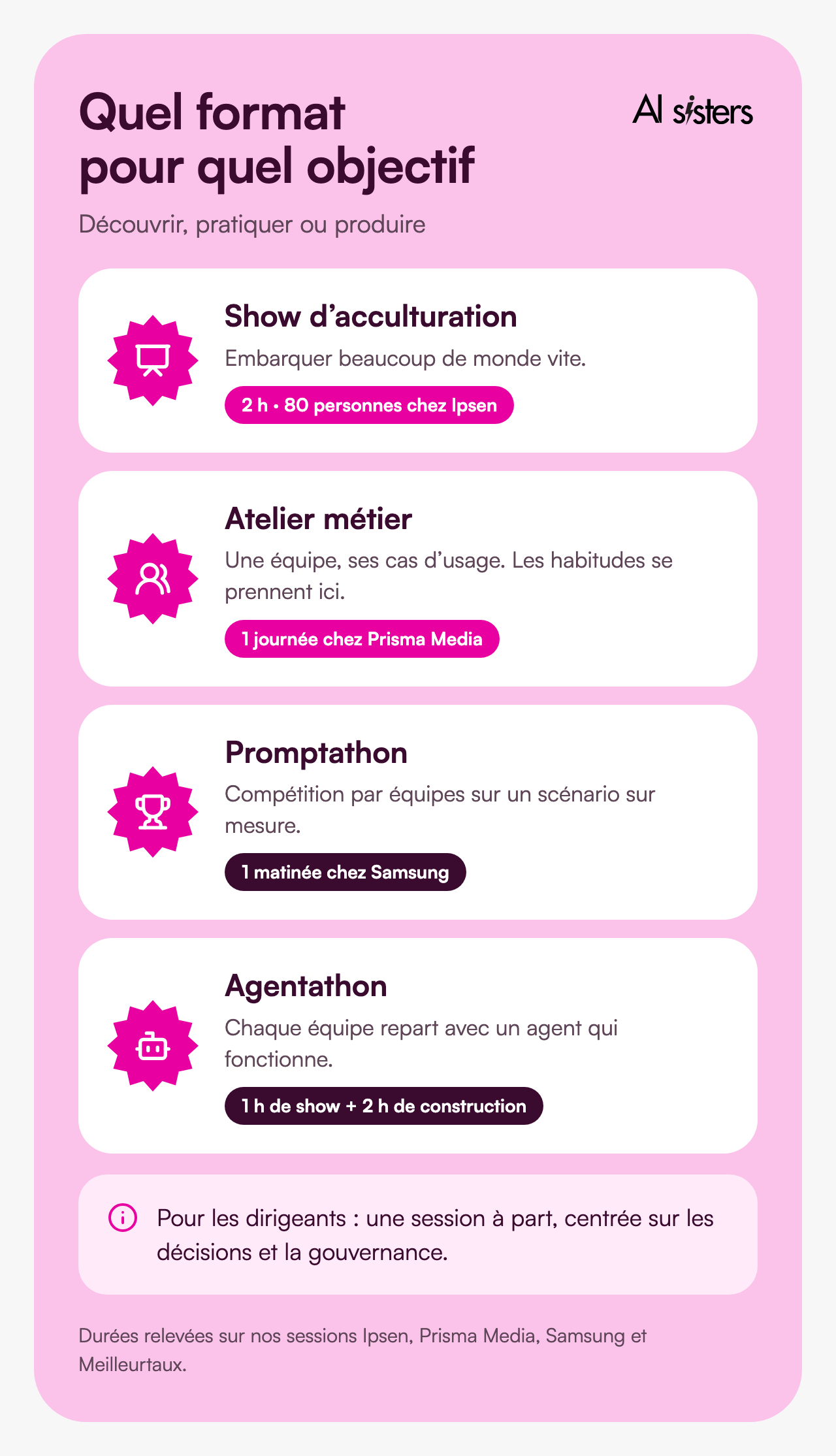
The AI awareness show:
bring a lot of people on board quickly. Two hours are enough for 80 people, as at Ipsen. It is the right starting point when AI is still abstract for part of the teams.
The role-based workshop:
one team, its use cases, half a day or a full day. This is the format where habits form. See our AI workshops.
The Promptathon:
a team competition on a scenario built for you. The Promptathon works very well for moving from occasional use to a method.
The Agentathon:
each team leaves with a working agent. The Agentathon is aimed at teams that already use AI every day.
And for executives:
a separate session, focused on decisions and governance rather than tools.
Where to start
There is no need to train the whole company at once. Rollouts that last start with one team and measure what changes.
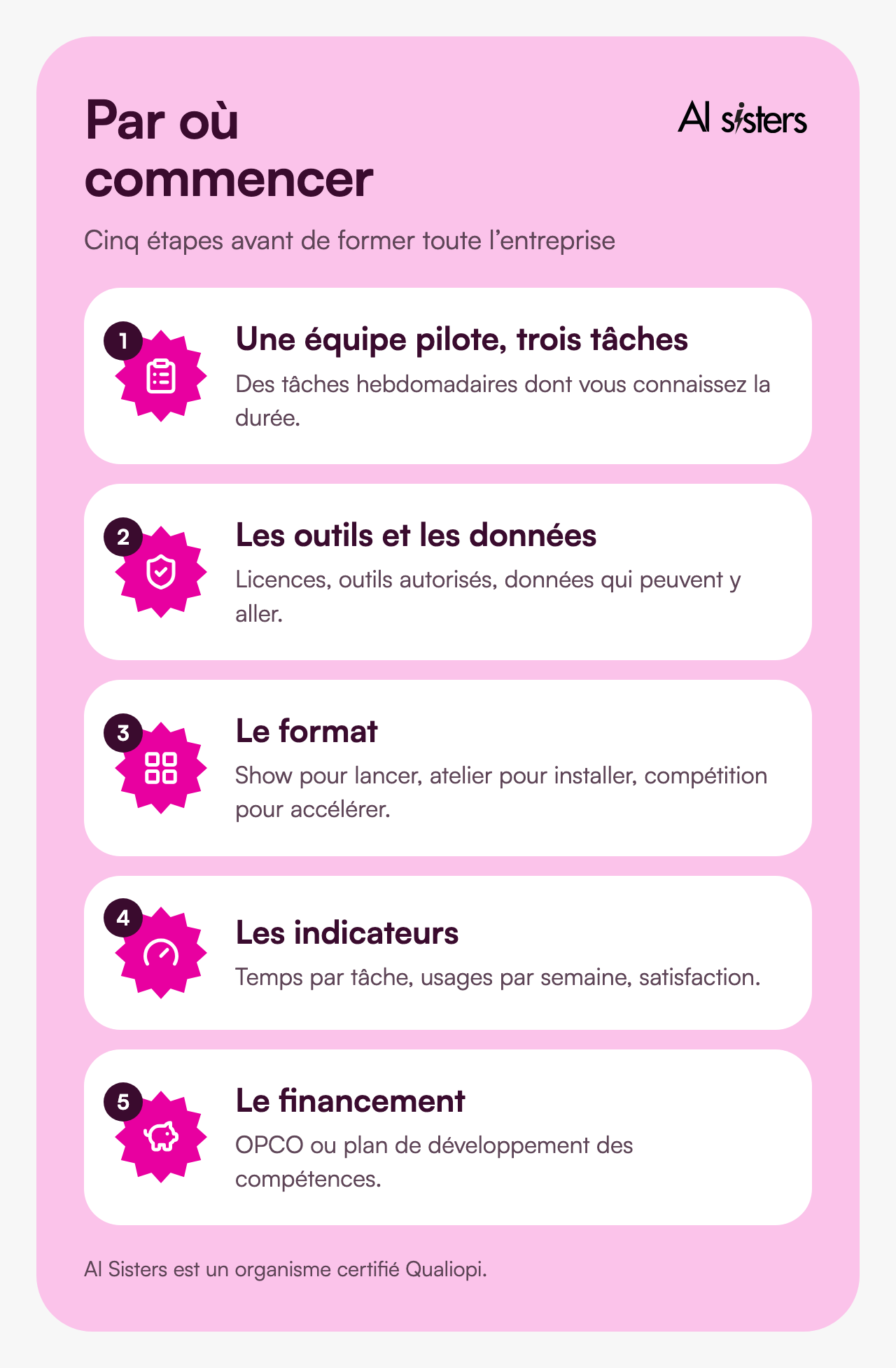
1. Choose a pilot team and three tasks.
Tasks that come back every week and whose current duration you know.
2. Review the tools and the data.
Which tools are authorised, with which licence, and which data can go into them. If you are still unsure about the tool, compare Claude, ChatGPT and Gemini first.
3. Choose the format.
A show to launch, a workshop to embed, a Promptathon or Agentathon to accelerate.
4. Set your metrics before the session.
Time spent per task, number of uses per week, satisfaction. Our article on the ROI of AI training explains the method.
5. Check the funding.
AI Sisters is Qualiopi certified, which makes the training eligible for funding by your OPCO or your skills development plan, subject to their conditions. Details are in our funding guide.
For more free guides and tools, our resources page brings together everything we have published.
Book your 30-minute call now
A no-obligation conversation to build your AI training around your tools.
👉 Tell us about your AI project 👈
Key takeaways
- Start from the tasks of a role, then choose the tool.
- Marketing, sales, HR, finance and AI agents are the five most requested training programmes in 2026.
- Settle the data question first, especially in HR and finance.
- Choose the format according to the objective: discover, practise or produce.
- Measure before and after, on three specific tasks.
- Think about funding: OPCO and skills development plan.
Sources
- AI Sisters case study, Webedia, role-based AI workshops.
- AI Sisters case study, Molotov.TV, marketing and editorial workshops.
- AI Sisters case study, Les Échos - Le Parisien, workshops on MaIA.
- AI Sisters case study, Prisma Media, training 60 salespeople.
- AI Sisters case study, Accor, Sales seminar in Cancún.
- AI Sisters case study, Samsung Electronics France, HR Promptathon, 27 August 2026.
- AI Sisters case study, Ipsen, Finance kick-off in Brussels.
- AI Sisters case study, Ipsen, Agentathon Copilot.
- AI Sisters case study, SFL, AI Show on commercial real estate.
- AI Sisters case study, Institut Français, talk at the Théâtre des Abbesses.
- AI Sisters case study, Meilleurtaux, AI Show and Agentathon.