.svg)

Behind Jev is the start-up TypeSafe AI, which came out of stealth in mid-September 2026 with 40 million dollars raised. Its founder, Diogo Almeida, spent four years at OpenAI and co-authored the research paper that led to ChatGPT.
For the past two weeks, a new AI has been getting a lot of attention. It is called Jev, and it does not write anything. 😅
No paragraphs, no summaries, no emails. It answers “yes”, “no”, “urgent”, “follow up”, and it adds its confidence level.
Its developer announces dizzying prices. And several major web platforms plugged it in within three days.
We read the tests, including the uncomfortable ones. Here is what it is worth for your teams 👇
“LLMs produce words for humans. Jev produces typed decisions, closer to code: reliable, fast, consistent,” writes TypeSafe AI on its website.
In brief
- Jev does not generate text, it decides. It returns a label and a confidence score, never a paragraph.
- It is built for sorting work: emails, comments, tickets, documents, in high volumes.
- On these tasks, it is very fast and very cheap, according to its developer’s measurements.
- No independent body has evaluated it, and TypeSafe refuses public leaderboards on principle.
- The same public test goes from 63% to 95% correct answers depending on how the questions are split up.
- The service is hosted in the United States, with no European region. Worth checking before sending it personal data.
Also worth reading
Explore our other articles to go further with AI in the workplace:
Jev, the AI that decides instead of writing
Imagine two colleagues facing the same pile of files.
The first reads each file and writes you a note. That is what ChatGPT, Claude or Gemini do.
The second writes nothing. They put a label on each file: urgent, to invoice, to ignore. And they tell you how sure they are.
The second one is Jev.
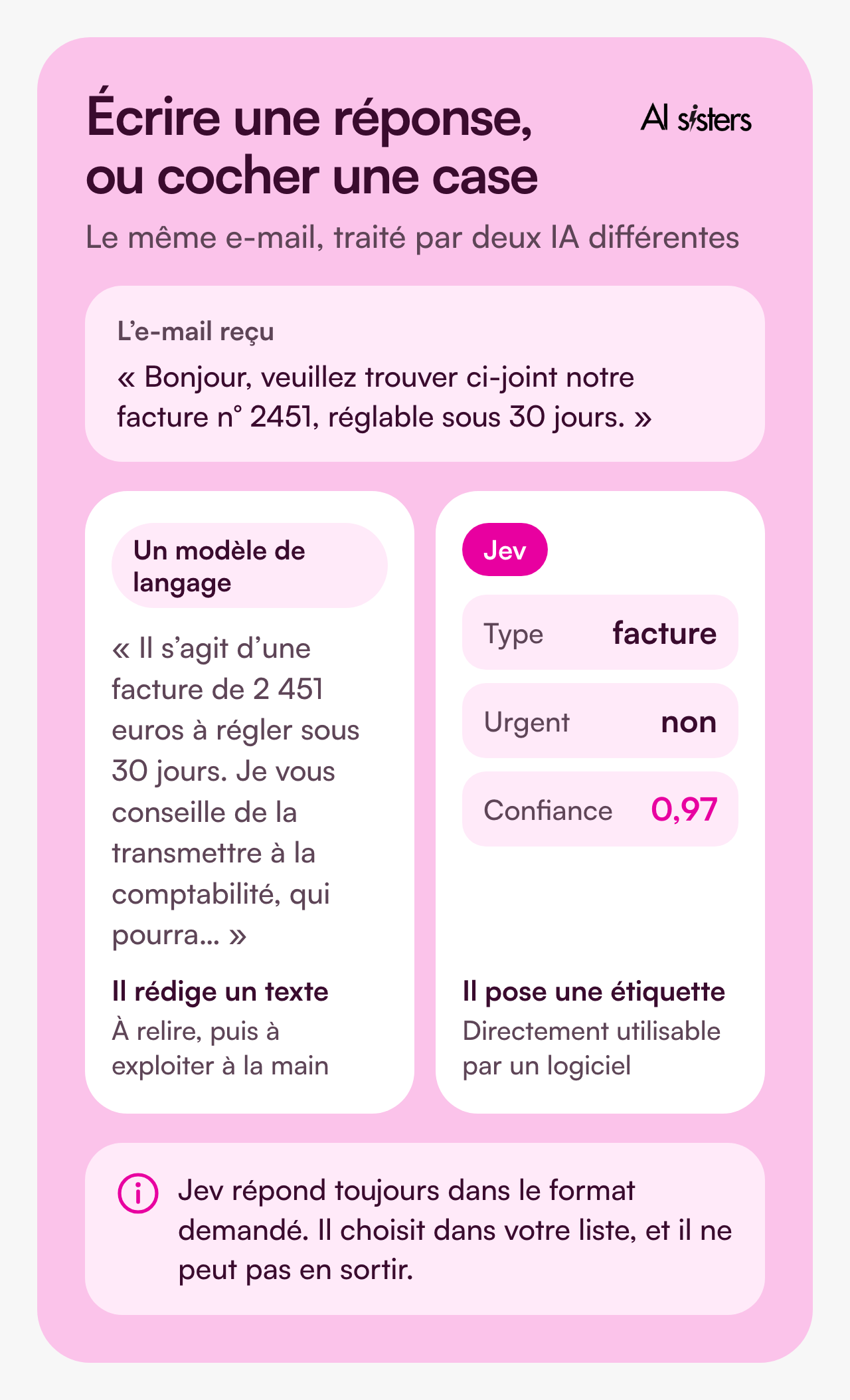
You give it a text and a closed question. It answers with a choice, a score or a probability, always in the requested format. You can ask twenty questions at once and it barely changes the response time.
💡 In simple terms: a language model writes an answer, Jev ticks a box.
A small nod along the way: the model is named after the economist William Stanley Jevons, who showed that a more efficient machine ends up making consumption soar.
Adoption on the tools side was very fast. Vercel, Cloudflare, LangChain and Langfuse integrated it within three days.
Jev in companies: the recurring use cases
The first published trials always point to the same family of tasks. Sorting, in high volumes, with simple rules.
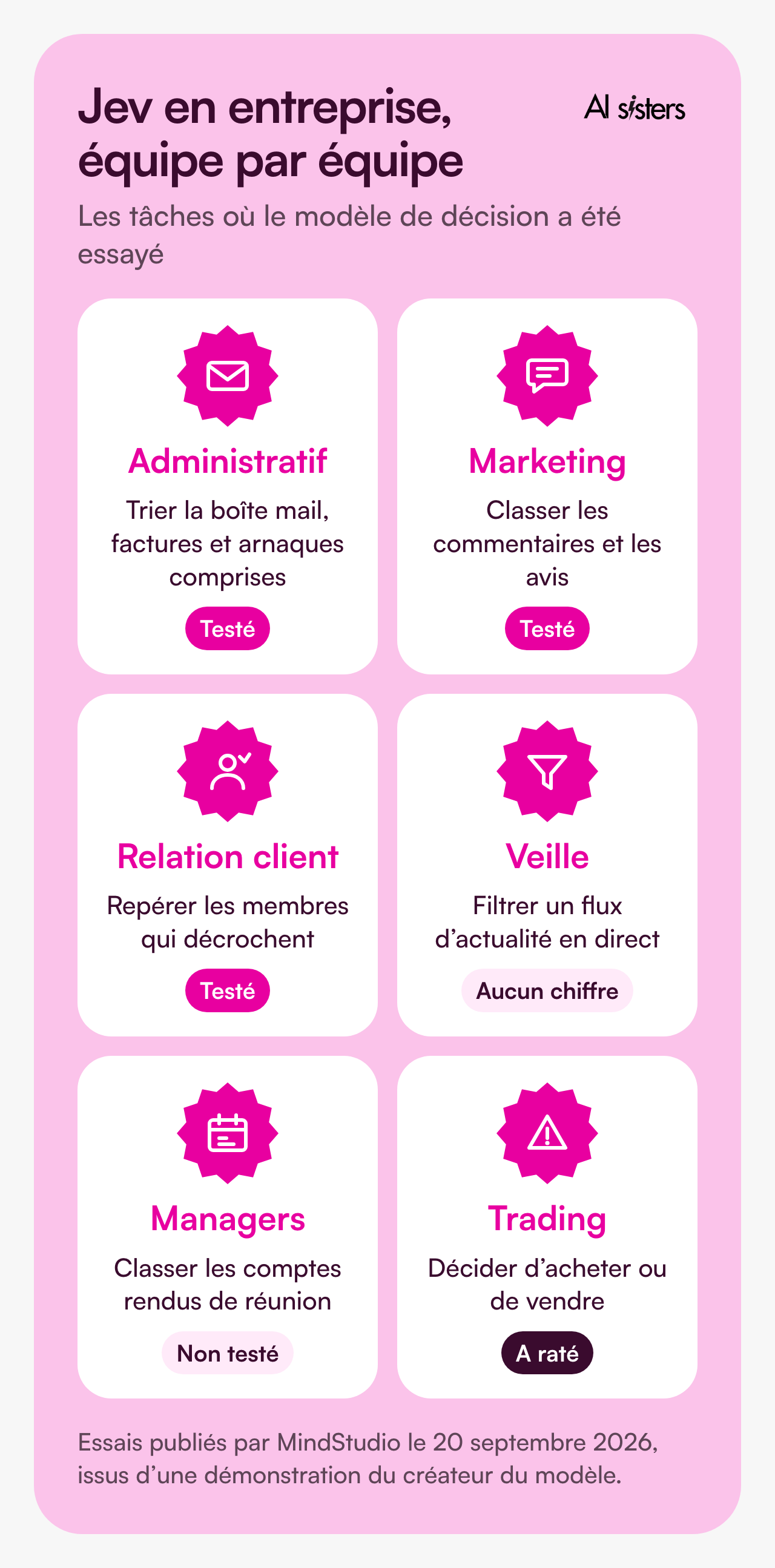
For an admin team: sorting the inbox.
In the most discussed demonstration, 1,000 emails are screened against seven rules at once, including invoice detection and scam detection. All in a few seconds, for a few cents.
For a marketing team: sorting comments and reviews.
Same principle on 1,000 comments, classified by type, by sentiment, and by whether they deserve a reply.
For a customer relations team: spotting customers who are drifting away.
On a community’s messages, the labels cover churn risk, member level and the strength of the testimonial. Enough to surface the right verbatims without rereading everything.
For a monitoring team: filtering a live news feed, between useful information and noise.
No figures are given for this case.
For managers: classifying meeting minutes.
Type of meeting, decision taken or not, action assigned to someone or not. Note that this case has not been tested, only described.
And a case that fails, just as instructive: a trading bot that replayed one decision per second. Its author admits it behaved badly from the very first hour. Going fast does not mean getting it right.
These figures come from a demonstration by the model’s creator, picked up by a platform that sells access to AI models. No one outside has re-run them.
This is exactly what we see in training: teams make progress when they choose the task before the tool 💡 That is the whole principle of our role-based approach to training.
Explore our AI training & book a call
Explore our different training modules and choose, with us, the one that best meets your AI needs.
📚 See our AI training 📞 Book a discovery call
Jev’s figures: what is measured and what is not
TypeSafe claims up to 193 times faster and 444 times cheaper than the large models.
The figure is spectacular. The method behind it, less so.
To check whether Jev answers correctly, the developer compares its answers with the average of those from two large competing models. So it measures whether Jev agrees with them, not whether it is right.
And it says so itself, in black and white: these gains are at the top of the range, and the tests were designed by its own team. This level of candour is rare, and it deserves credit for it.
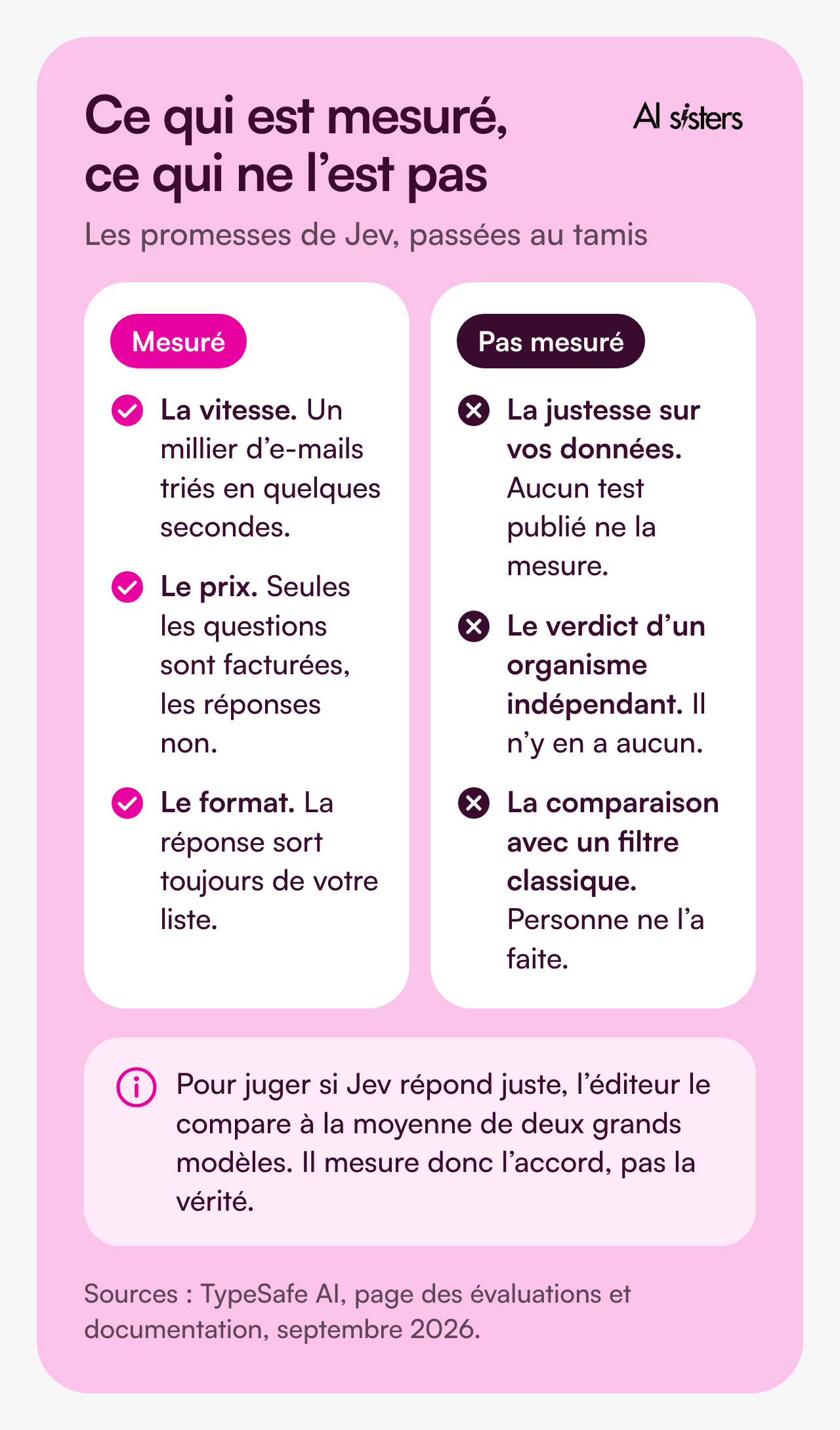
The same goes for the famous zero hallucination claim. Jev cannot invent a category that is not on your list. But it can choose the wrong one, and the developer says so on its website.
The price, on the other hand, can be checked from outside. The platforms that resell access display the same rate: only the questions are billed, not the answers.
The order of magnitude can be calculated from public prices: analysing the same text costs more than two hundred times less with Jev than with a large model. In return, you get no written answer, just a label.
On accuracy, two independent evaluations exist, published by individuals with their raw data. Neither Artificial Analysis, nor ARC Prize, nor any recognised body has tested Jev.
The first gives it 96% correct answers on a sorting test, far ahead of a hand-written keyword list.
The second, on 2,000 phishing emails, is much harsher. Asked as a single question, Jev does worse than a simple pattern filter. Split into five simple questions, it moves back ahead of everyone.
What it mainly shows: the way you ask the question accounts for half of the result.
💡 In short: the speed and price are credible. Accuracy needs to be checked on your side, with your data.
Jev or your current AI: how to choose
No one is asking you to cancel your subscription. The question is which task deserves which tool.
If the expected output is a text, a summary, a message or an analysis: keep your usual assistant.
If the expected output is a label or a score, across thousands of cases: a decision model becomes interesting.
And if your rule fits in three lines, a classic filter will do the job for free. It is the comparison no one has made, and it is worth ten minutes of your time.

There are still five limits to know about.
🚨 Jev does not take time to think. One analyst sums it up well: it has no process for working a problem through.
🚨 On the same document, it will not necessarily give the exact same answer word for word. The developer claims consistency, not reproducibility.
🚨 A security safeguard cannot rely on it alone. A test shows that malicious text slipped into a document can flip its decision.
🚨 It does not count reliably, as its developer says itself. For adding up amounts, it is not the right tool. And it processes one document at a time, not your entire document base.
🚨 The service is served from the United States, with no documented European region. Compliance relies on contractual clauses, not on local hosting. For personal data, this question must be dealt with before all the others.
Book your 30-minute call now
A no-obligation conversation to build your AI training around your tools.
👉 Tell us about your AI project 👈
Testing Jev without losing a week
You want to know whether it works for you. The shortest protocol that gives an honest answer fits into five steps.
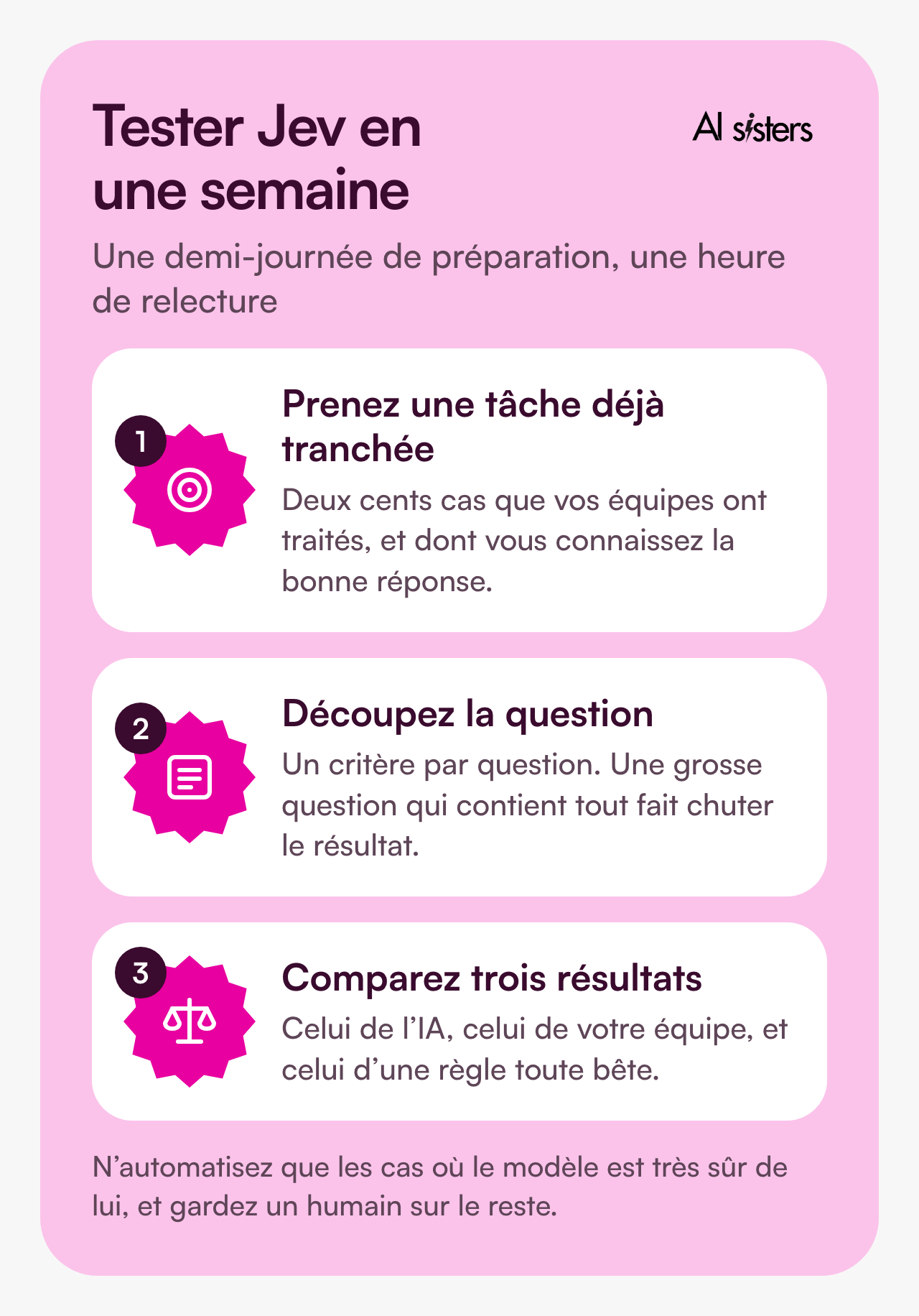
1. Choose a sorting task that comes up every week and for which you already know the right answer. Incoming emails, tickets, job applications.
2. Pull a sample already processed by your teams. Two hundred cases are enough, as long as they reflect your day-to-day work.
3. Split your question into simple questions. One per criterion, never one big question that contains everything.
4. Compare three results: the AI’s, your team’s, and that of a very basic rule. You will see straight away whether the model adds anything.
5. Look at the confidence scores. Only automate the cases where the model is very sure, and keep a human on the rest.
Allow half a day of preparation and an hour of review. And if you want to plug this kind of sorting into a tool that runs on its own, we have written a complete guide to building an AI agent.
A word on access: Jev is still in early access. You get in through the developer’s waiting list, or through platforms that resell access to models, such as Vercel and OpenRouter.
Book your 30-minute call now
A no-obligation conversation to build your AI training around your tools.
👉 Tell us about your AI project 👈
Key takeaways
- Jev decides, it does not write. It is a new category of tool, not a competitor to your assistant.
- Its use cases are high-volume sorting: emails, comments, tickets, documents.
- The speed and price gains are credible, but measured by the developer, on its own tests.
- No independent body has evaluated it. Accuracy needs to be checked on your side.
- The result depends mainly on how you split up your questions.
- Before you start: check where the data is hosted and keep a human on uncertain cases.
Sources
- TypeSafe AI, announcement of Jev and the System One Models, 15 September 2026.
- TypeSafe AI, model documentation and known weaknesses page.
- TypeSafe AI, privacy policy and data processing agreement.
- TypeSafe AI, in-house evaluation method.
- The Register, TypeSafe AI debuts model for machines, 16 September 2026.
- TechCrunch, a new kind of AI model is thrilling developers, 18 September 2026.
- VentureBeat, a cheaper way to decide, 28 September 2026, and prompt injection, 21 September 2026.
- LeMagIT, Jev, the decision model designed to speed up agentic AI, 24 September 2026.
- Blog du Modérateur, Jev, a new AI model designed to make decisions, 23 September 2026.
- MindStudio, Jev use cases, 20 September 2026.
- PriorBench, pre-registered independent evaluation, 20 September 2026.
- Public price recorded on OpenRouter, 29 September 2026.







.avif)
