You bought Microsoft 365 Copilot licences for part of your teams. A few months later, the same picture often emerges: Copilot summarises Teams meetings, rewords two or three emails, and most of the licences sit idle. In most cases, the problem lies in the rollout, rarely in the tool itself.
At AI Sisters, an AI consultancy, we support companies in exactly this situation. Here are the five levers we pull with them to revive Copilot adoption across the business, in the order in which they take effect, with what you can measure this week.
In brief
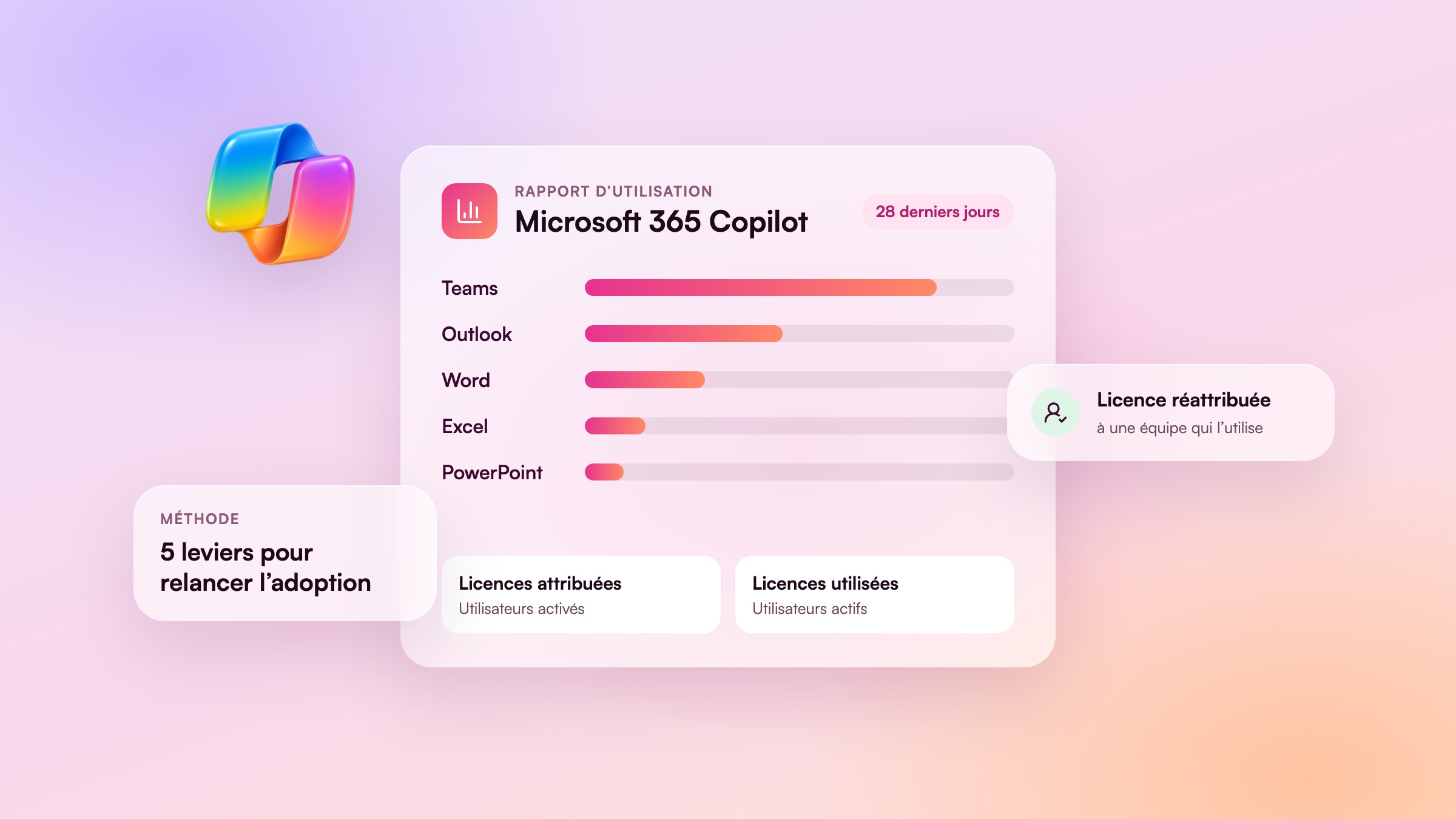
- An underused Copilot licence shows up in the usage report in the Microsoft 365 admin centre: enabled users, active users, adoption by app.
- The first lever is measurement. Without it, you do not know which teams to re-engage or which licences to reassign.
- Copilot takes off when each role leaves with two specific tasks to hand over to it, taken from their day-to-day work.
- Training works when it uses the teams’ real files: an Excel budget, a Word contract, an Outlook inbox.
- One ambassador per team keeps usage going after the training, far better than a reminder email.
- Copilot agents turn a good prompt into a reusable tool. At Ipsen, nearly 200 employees built some in a single afternoon.
Read also: why so few Microsoft 365 users pay for Copilot and our guide to training your teams on Microsoft Copilot.
Why Copilot licences sit idle
The scenario is almost always the same. IT assigns the licences, sends an announcement email and offers a general demo. Employees try Copilot on a vague question, get an average answer, and go back to their old habits. Only the Teams meeting summary survives, because it takes no effort.
Three causes come up again and again in the companies we meet. Nobody told the teams what to ask Copilot in their role. The demo used fictitious examples, far removed from their files. And once the session was over, nobody followed up, shared good prompts or answered questions.
To put it simply. A Copilot licence is like a gym membership paid for by the company. The card alone gets nobody through the door. People turn up when they are offered a programme at their level and a colleague is waiting for them on Tuesday evening.
Lever 1: measure real usage before deciding
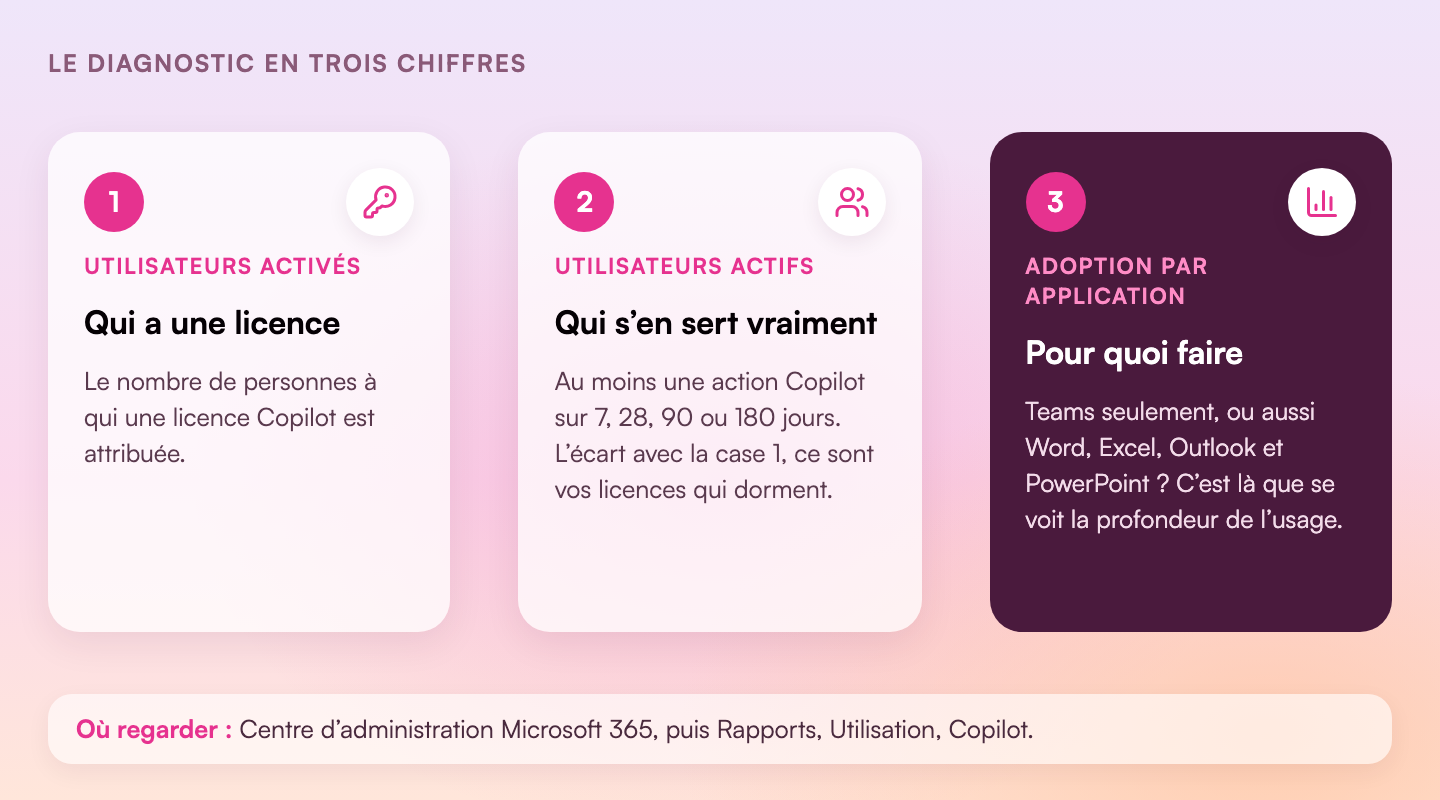
Before training anyone, look at the numbers. Microsoft provides a Copilot usage report in the Microsoft 365 admin centre: Reports, Usage, then Microsoft Copilot. Your administrator can get to it in a few clicks.
| Indicator | What it measures | What you do with it |
|---|---|---|
| Enabled users | People with a Copilot licence over the period | Your starting point: the number of licences paid for |
| Active users and active user rate | Those who used at least one Copilot feature, over 7, 28, 90 or 180 days | The gap with enabled users gives the number of idle licences |
| Adoption by app | Active users in Teams, Outlook, Word, Excel, PowerPoint | If everything goes through Teams, usage stays superficial |
| Last activity date per user | The last day each licence was used | Spot licences inactive for more than a month, to reassign |
| Copilot Dashboard (Viva Insights) | Readiness, adoption and impact, team by team | Choose which teams to support first |
Read these numbers by team rather than by person: they tell you where usage is taking off and where it is stuck. The data arrives with a delay of around 48 hours, which is more than enough for monthly tracking.
This diagnosis also gives you a quick decision: licences with no activity for several weeks can go to people who are asking for them. In many companies, a waiting list already exists, even though nobody has written it down.
To put it simply. The active user rate works like the occupancy rate of a train. Knowing which carriages are empty tells you where to send a conductor, and which carriages to take off the train.
Lever 2: one use case per role, taken from daily work
“Use Copilot to save time” triggers nothing. “In Excel, ask Copilot to compare budget against actuals and isolate the five largest variances” triggers a try the same day. The second lever is to give each role two specific tasks, the ones they do every week.
| Role | Where in Microsoft 365 | The first prompt to try |
|---|---|---|
| Management | Word, Outlook | “Summarise the last three committee minutes and list the decisions still pending.” |
| Finance | Excel | “Compare budget and actuals by line item, isolate the five largest variances and suggest a comment for each.” |
| Legal | Word | “List the differences between these two versions of the contract and flag the amended clauses.” |
| Human resources | Word, Outlook | “Using this job description, write the job advert and five interview questions.” |
| Sales | Outlook, Teams | “Summarise my exchanges with this client over the last three months before our meeting tomorrow.” |
| Project management | Teams, Excel | “List the missed deadlines and blocking issues in this project tracker.” |
This is the approach we took with VIAVEÏS, the telecoms subsidiary of VINCI Autoroutes. On 20 October 2026, we demonstrated Copilot live to its executive committee, in its own Microsoft 365 environment, on its own topics: comparing contract amendments, structuring a monitoring watch, analysing budget tracking, preparing a committee summary in Excel. Each demo started from a real responsibility of an executive present in the room.
To find these two tasks per role, the most effective approach is still a short workshop with each team. Our role-based AI workshops start from the list of what the team does each week, then test Copilot on it.
Are your Copilot licences sitting idle?
We train your teams on Word, Excel, Outlook, Teams and Copilot Studio, using their own files.
Corporate Copilot trainingBook a callLever 3: train on the teams’ real files
A demo on a fictitious document convinces the room for an hour. The next day, faced with their own file, the employee no longer knows what to type. The training that revives adoption uses what teams open every day: the quarterly budget, the contract under negotiation, the Monday-morning inbox.

At VINCI Facilities, the session on Copilot and Copilot Studio was built on cases tailored to the group’s activities: meeting minutes written from handwritten notes, complex emails, legal monitoring and document translation. The innovation department summed it up like this: “We understood that AI could fit naturally into our tools, without making our methods more complicated.”
Three habits to pass on during training: name the file in the prompt, specify who the result is for, and say what form you want it in (table, email, three sentences). Add verification: Copilot cites its sources in Microsoft 365, and every figure intended for a committee is checked against the original file.
Lever 4: ambassadors in every team
Training creates a spike in usage. What makes it last is a colleague you can ask “how do you do that?”. Appoint one Copilot ambassador per team: someone curious, who already uses the tool, and whom you give a little time each month.
Their role is simple. They collect the prompts that work and share them in a Teams channel. They answer first-level questions. They escalate blockers: a badly filed document in SharePoint, a missing feature, a need that would warrant an agent.
To bring everyone on board before moving on to teams, a collective format helps. VIAVEÏS started with its executive committee, and is following up with an AI Show for all employees and role-based workshops. At Ipsen, the finance Agentathon worked the same way: everyone built on Agent Builder, while the “champions” went further on Copilot Studio. These champions are your future ambassadors.
To put it simply. The ambassador plays the role of the neighbour who knows how to set up the broadband router. You do not call the helpdesk for a two-minute question, you knock on their door. Without them, the question goes unanswered and the tool stays in the drawer.
Lever 5: move on to Copilot agents
A good prompt for Copilot can sometimes take ten or twenty minutes to write. Then the conversation closes, and everything has to be redone the following month. A Copilot agent keeps those instructions, the reference documents and the output format. You write it once, test it and share it with the team.
The best candidates are recurring tasks, with stable input data and a deliverable in a known format: the monthly management commentary, the summary note for the committee, the standard reply to a supplier request. Agent Builder, built into Copilot, is enough for the first agents. Copilot Studio takes over when you need to connect other sources or automate further.
Business teams can do it. On 17 September, nearly 200 employees from Ipsen’s finance, procurement and IT teams built their agents on Copilot in one afternoon, in six 20-minute rounds: create the agent, give it business documents, check that it cites its sources, improve it, connect it to Outlook, Teams or SharePoint, then put a figure on the time saved. At Meilleurtaux, 93 employees who had never coded produced 14 agents in three hours on Copilot Agent Builder.
When an agent needs to go further, plug into a CRM or ERP, or run without intervention, the AI Sisters Lab designs it with you. See our AI agents page and our custom AI agent development offer.
The 90-day plan
The five levers follow on from one another over a quarter. Here is the order we follow with our clients.
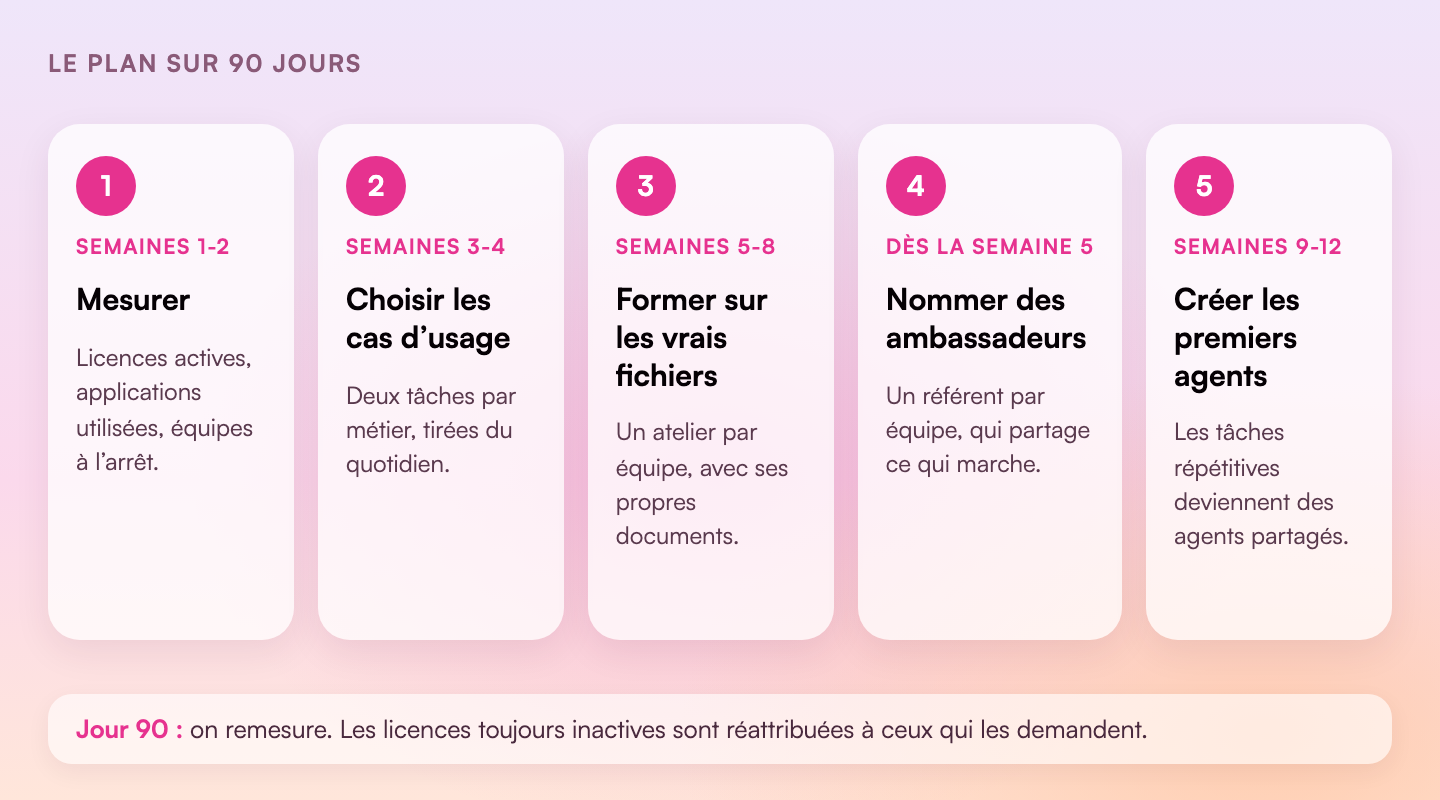
- Weeks 1 and 2, measure. Record enabled and active users, adoption by app and inactive licences. Sort the teams into three groups: those who use it, those who have tried it, those who have never opened Copilot.
- Weeks 3 and 4, choose the use cases. With each team, list what it does every week and pick two tasks to hand over to Copilot. Start with tasks that involve no sensitive data.
- Weeks 5 to 8, train. One workshop per team, on its own files, with a sheet of ready-to-copy prompts. Our training courses are eligible for OPCO funding (French training funds).
- From week 5, appoint the ambassadors. One per team, a Teams channel to share the prompts that work, a thirty-minute monthly check-in.
- Weeks 9 to 12, create the first agents. Start from the recurring tasks identified in the workshops. A one-afternoon Agentathon lets you produce several at once.
On day 90, repeat the lever 1 measurement and compare. Licences that are still inactive change hands, and the teams that have taken off become the example to show the others. To put a figure on the gain, use our method for calculating the ROI of AI training.
Let’s review your Copilot licences
A 30-minute conversation to read your usage figures and choose which teams to start with.
Book a callCorporate Copilot trainingKey takeaways
- An underused Copilot licence can be measured: enabled users, active users, adoption by app, last activity date.
- Read these numbers by team, to know where to act.
- Give each role two specific tasks to hand over to Copilot, taken from their week.
- Train on real files: a precise prompt makes all the difference.
- One ambassador per team keeps usage going after the training.
- Recurring tasks become Copilot agents, which business teams can build themselves.
- After 90 days, measure again and reassign the licences that are still idle.
Sources
- Microsoft Learn, Microsoft Copilot usage report, Microsoft 365 admin centre, accessed 6 November 2026.
- Microsoft Learn, Microsoft Copilot Dashboard for Microsoft 365 customers, accessed 6 November 2026.
- Microsoft Learn, Overview of Microsoft Copilot Studio, accessed 6 November 2026.
- AI Sisters, VIAVEÏS (VINCI Autoroutes) introduces its executive committee to Copilot, 28 October 2026.
- AI Sisters, Ipsen’s finance Agentathon, 24 September 2026.