An AI talk in the auditorium, a full room, questions until the very last minute. Three weeks later, usage is back where it started. The soufflé has collapsed, and many AI upskilling programmes stop at this point.
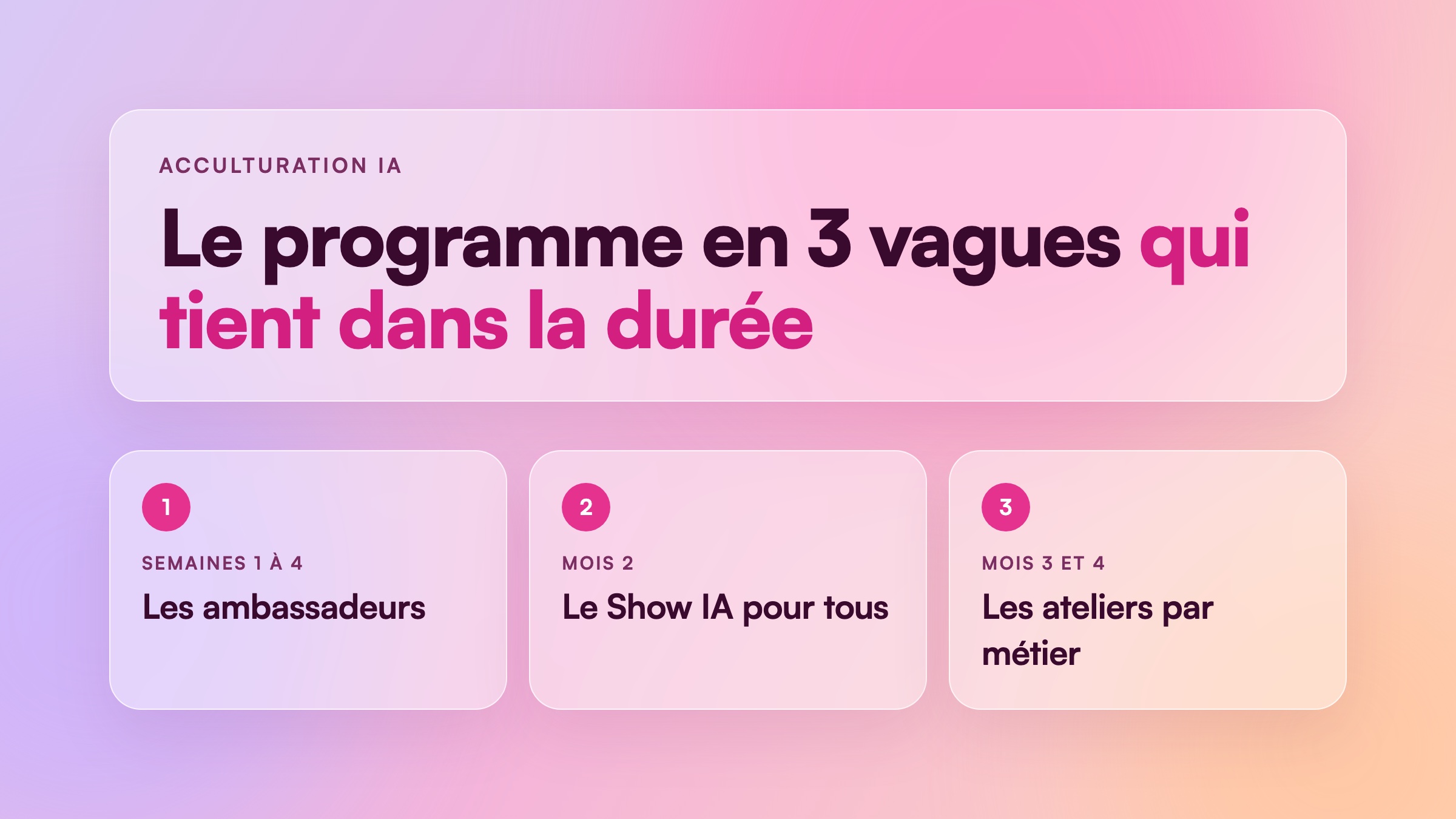
At AI Sisters, an AI consultancy, we have supported more than 900 companies and trained 60,000 employees. The programmes that last almost always follow the same pattern: three waves, each one preparing the next. Here is how it runs, with examples from our engagements, and how to measure what remains six months later.
In brief
- AI upskilling gives every employee the bearings they need to use AI in their work, safely.
- A one-off event makes people want to try, but it rarely builds habits.
- Wave 1: volunteer ambassadors, trained in depth, one per team.
- Wave 2: an AI Show for the whole company, built on your tools and your documents.
- Wave 3: role-based workshops, with 90% hands-on practice.
- Usage is measured before the programme, then at 30 and 90 days, with four simple indicators.
See also: role-based AI training, department by department, the AI Act obligation to train your teams and shadow AI in the workplace.
What is AI upskilling?
AI upskilling is the first step in an artificial intelligence training plan. It is for everyone, not just technical teams. By the end, every employee knows what generative AI does well and where it gets things wrong, which data they can share with it, and how to use it for an everyday task.
It aims to give the whole company a common foundation: nobody is left behind, whether through fear of the tool or through too much confidence in its answers. Expertise comes later, for the teams that need it.
It is also a regulatory matter. Since 2 February 2025, Article 4 of the AI Act has required companies that use AI systems to take measures to ensure a sufficient level of AI literacy among their staff, according to the European Commission.
To put it simply. AI upskilling plays the role of the highway code. It does not make you a racing driver, but without it nobody gets behind the wheel with confidence. Role-based workshops come next: they are the driving lessons, on your usual route.
Why the soufflé collapses
After a single event, the usage curve often looks like a spike followed by a long decline. A programme run in several stages builds usage step by step.

The causes are almost always the same:
- A single session. People discover AI on a Tuesday, then nothing more. Without practice in the following week, no reflexes form.
- Generic examples. A poem about cybersecurity amuses the room, but nobody writes one at the office. People remember what looks like their own work.
- Unclear rules. If nobody knows which data can be pasted into the tool, caution wins and the tool stays closed. Or everyone uses a personal account, and the company discovers shadow AI.
- Nobody to keep it going. Without relays in the teams, the question “how did you do that?” has nobody to go to.
The questionnaire sent to TotalEnergies’ People & Services teams before their July 2026 session confirmed it: 81% of respondents wanted to know more about using AI responsibly. As long as security remains a grey area, usage plateaus on low-stakes tasks.
The 3-wave AI upskilling programme
The timeline below is indicative. An SME can complete everything in six weeks, a large group in six months. The order of the waves matters more than their length.

Wave 1: training the ambassadors
Start small, with volunteers: one per team, or one per site. They are not necessarily the most tech-savvy. You are looking for people their colleagues listen to, and who are keen to try.
They take in-depth training on the company’s tool, whether it is Copilot, ChatGPT, Claude or Gemini. Then each of them identifies two or three tasks in their department where AI would save time. These examples will feed wave 2.
The Promptathon suits this wave well: a team prompt competition, on challenges drawn from your business. At TotalEnergies, the Copilot Promptathon brought together 8 groups, each led by a designated Tech Leader. That role foreshadows the ambassador role.
Wave 2: the AI Show for everyone
Once the ambassadors are ready, the whole company goes through an AI Show, from 15 to more than 500 participants per session. Live demonstrations, then hands on the keyboard, on your tools and your real documents. The ambassadors present their examples, and a colleague from the department next door is often more convincing than an outside speaker.
A few recent Shows show how the format adapts. At VINCI Facilities, it focused on Microsoft Copilot and Copilot Studio, the tools already deployed in the company. TV5Monde combined it with an audit of its processes. The Sustainability Department at Accor ran an AI Show and a Promptathon on the same day, on Accor GPT, the group’s in-house AI.
To put it simply. The AI Show works like a film trailer. It makes you want to see the film, without replacing it. Without wave 3, the enthusiasm fades within a few weeks.
Wave 3: role-based workshops
This wave turns enthusiasm into habit. Each department takes a role-based AI workshop, with 90% hands-on practice on its own files. HR drafts a job description and compares CVs, finance analyses a report, communications adapts a message for several channels. Everyone leaves with prompts tested on their own documents.
To design the workshops department by department, our role-based AI training page details the pathways by function.
Samsung Electronics France has followed this rhythm for two years, one department after another: 400 employees on board the generative AI programme, then, on 27 August 2026, a tailored morning for the HR teams, with a Promptathon on real HR cases.
| Wave | Who for | Format | Outcome |
|---|---|---|---|
| 1. Ambassadors | Volunteers, one per team or per site | In-depth training, Promptathon | Two or three use cases identified in each department |
| 2. AI Show | The whole company, from 15 to more than 500 people per session | Live demonstrations and hands-on keyboard practice | Prompting basics and shared security rules |
| 3. Role-based workshops | Department by department | 90% hands-on practice on the team’s files | Tested prompts and a shared library |
Build your AI upskilling programme
We start from your tools, your documents and the tasks of each role.
Discover the AI ShowBook a callMeasuring adoption at 30 and 90 days
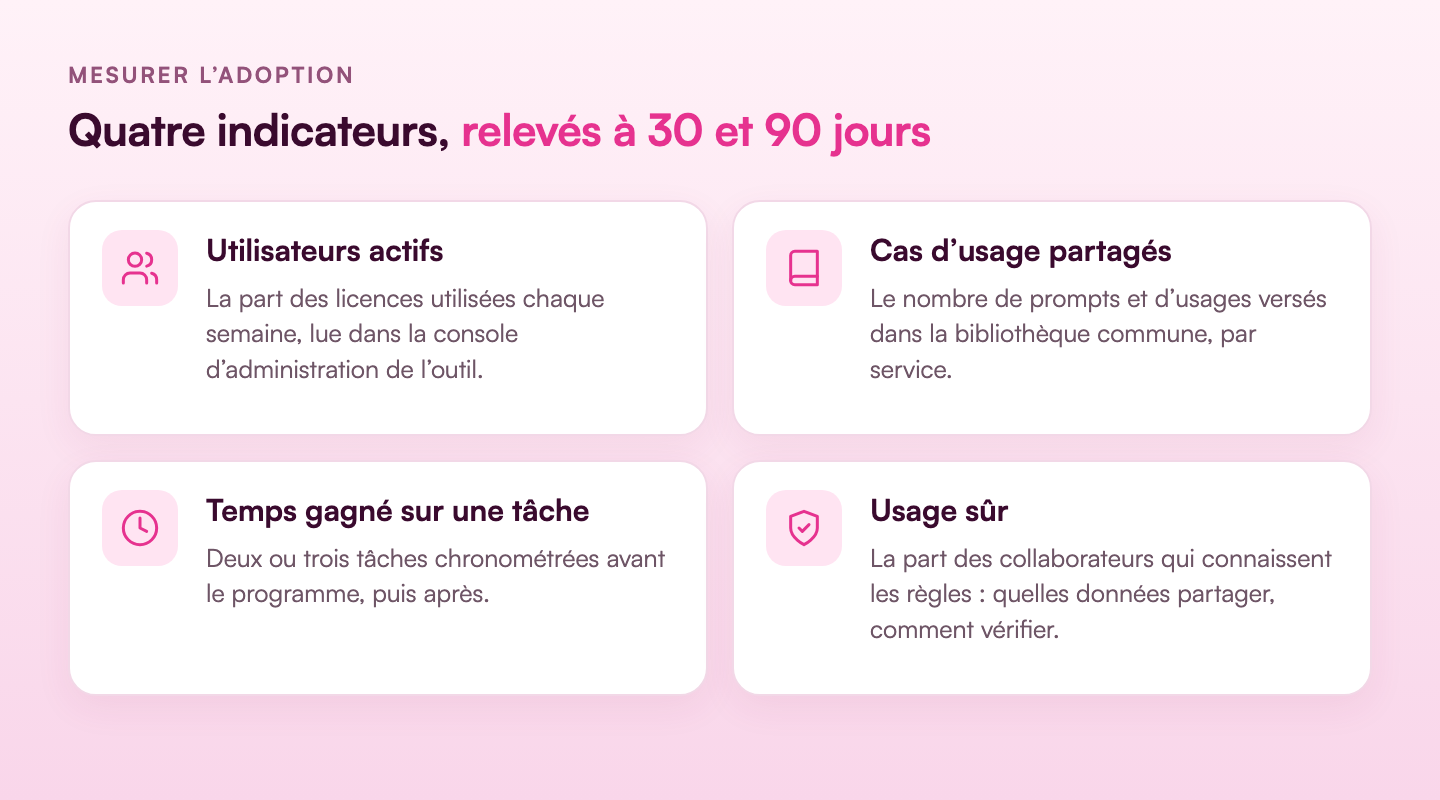
The number of people trained tells you what you have spent. To know what has changed in the work itself, four indicators are enough.
| Indicator | Where to find it | When to measure it |
|---|---|---|
| Weekly active users | The tool’s admin console: Microsoft 365, ChatGPT Enterprise, Claude or Gemini | Before, at 30 days, at 90 days |
| Shared use cases | The shared prompt library, maintained by the ambassadors | Every month |
| Time saved on two or three tasks | Before-and-after timing, carried out with the teams | Before, at 90 days |
| Safe use | A short questionnaire: which data to share, how to check an answer | Before, at 30 days |
The baseline questionnaire is often the most revealing. At TotalEnergies, it showed that 89% of respondents already used Copilot every day. The session therefore focused on advanced uses and security rules, and skipped the introduction to the tool.
When an indicator drops in a department, the answer is often a refresher workshop or a new use case championed by the ambassador. To put a figure on the return on investment, our article on the ROI of AI training explains the calculation.
Planning and funding the programme
Many companies launch their AI upskilling at the start of the year, once the skills development plan has been approved. To start in February or March, prepare the ground in the autumn: choosing the ambassadors, taking stock of the tools deployed, pre-auditing each role.
AI Sisters is a Qualiopi-certified training provider, and our training is rated 9.5/10. All three waves can therefore be eligible for OPCO funding (French training funds). The details are explained on our Qualiopi AI training page.
Key takeaways
- AI upskilling concerns every employee, and the AI Act requires a sufficient level of AI literacy.
- A one-off event creates a spike in usage, then usage falls back.
- Start with ambassadors, continue with an AI Show for everyone, finish with role-based workshops.
- Take your examples from the company’s roles and documents.
- Set the data rules from wave 2.
- Track four indicators before the programme, then at 30 and 90 days.
Launch your AI upskilling
30 minutes with an expert to design your three waves, based on your tools and your teams.
Book a callSources
- European Commission, AI Literacy, Questions & Answers, accessed 6 November 2026.
- AI Sisters, 45 HR employees trained in one afternoon: the TotalEnergies Copilot Promptathon, case study, published 12 June 2026.
- AI Sisters, The Samsung Electronics France AI Promptathon, case study, published 2 September 2026.
- AI Sisters, Accor’s Sustainability Department moves to Accor GPT, case study, published 6 October 2026.
- AI Sisters, AI upskilling: the AI Show, accessed 6 November 2026.