Your teams have ChatGPT, Claude or Copilot. They ask a question, get an average piece of text, rewrite it by hand and conclude that AI does not save them much time. In most cases, the tool is not to blame: the request was too vague.
Prompt engineering is the art of phrasing that request. At AI Sisters, an AI consultancy, we teach it to business teams: more than 900 companies supported and 60,000 employees trained. Here is what people really learn, with before-and-after examples by role, a typical one-day programme, how long it takes and how to fund it.
In brief
- Prompt engineering applied to work comes down to one method: tell the AI who it should be, what you know, what you want and in what form.
- Five techniques make most of the difference: context, role, examples, output format and iteration.
- One day is enough to change habits, as long as you work on the team’s real files.
- To embed new practices, a 6 to 12-week programme with a 90-day follow-up goes further.
- Training delivered by a Qualiopi-certified provider can be eligible for OPCO funding (French training funds).
- Progress can be measured: the same task before and after, time spent, number of back-and-forths, quality of the deliverable.
Also read: how to fund AI training with your OPCO or your skills development plan.
Prompt engineering, applied to work
In research labs, prompt engineering refers to studying how models respond to instructions. In a company, the question is simpler: how do you get a usable deliverable first time, whether a memo, an email, a table or a summary, instead of a draft you have to rework?
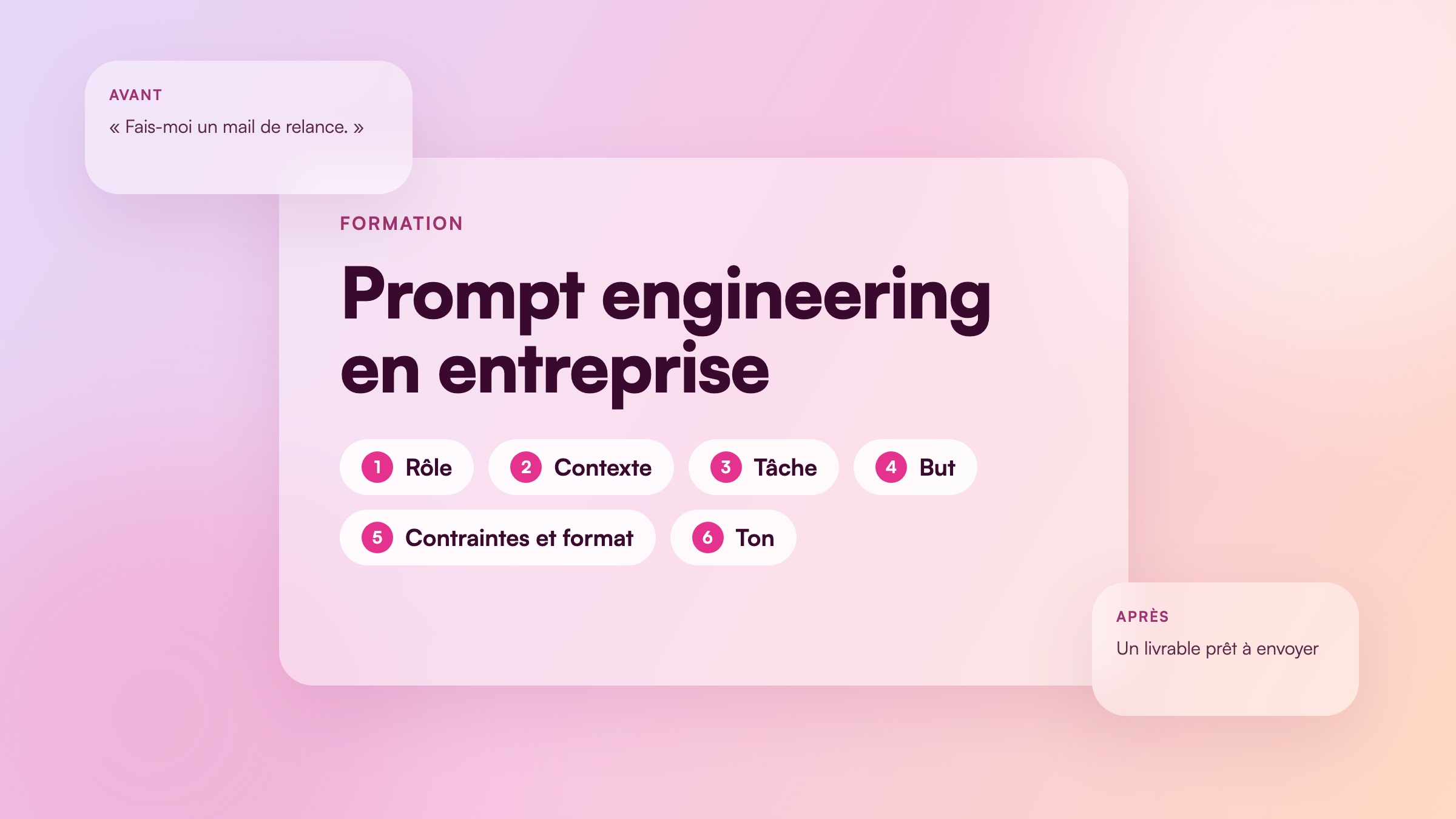
The answer lies in a structure. Our method has six blocks, always in the same order: Role, Context, Task, Goal, Constraints and format, Tone. Each block is a few sentences long. The prompt stays readable at a glance and can be passed from one colleague to another.
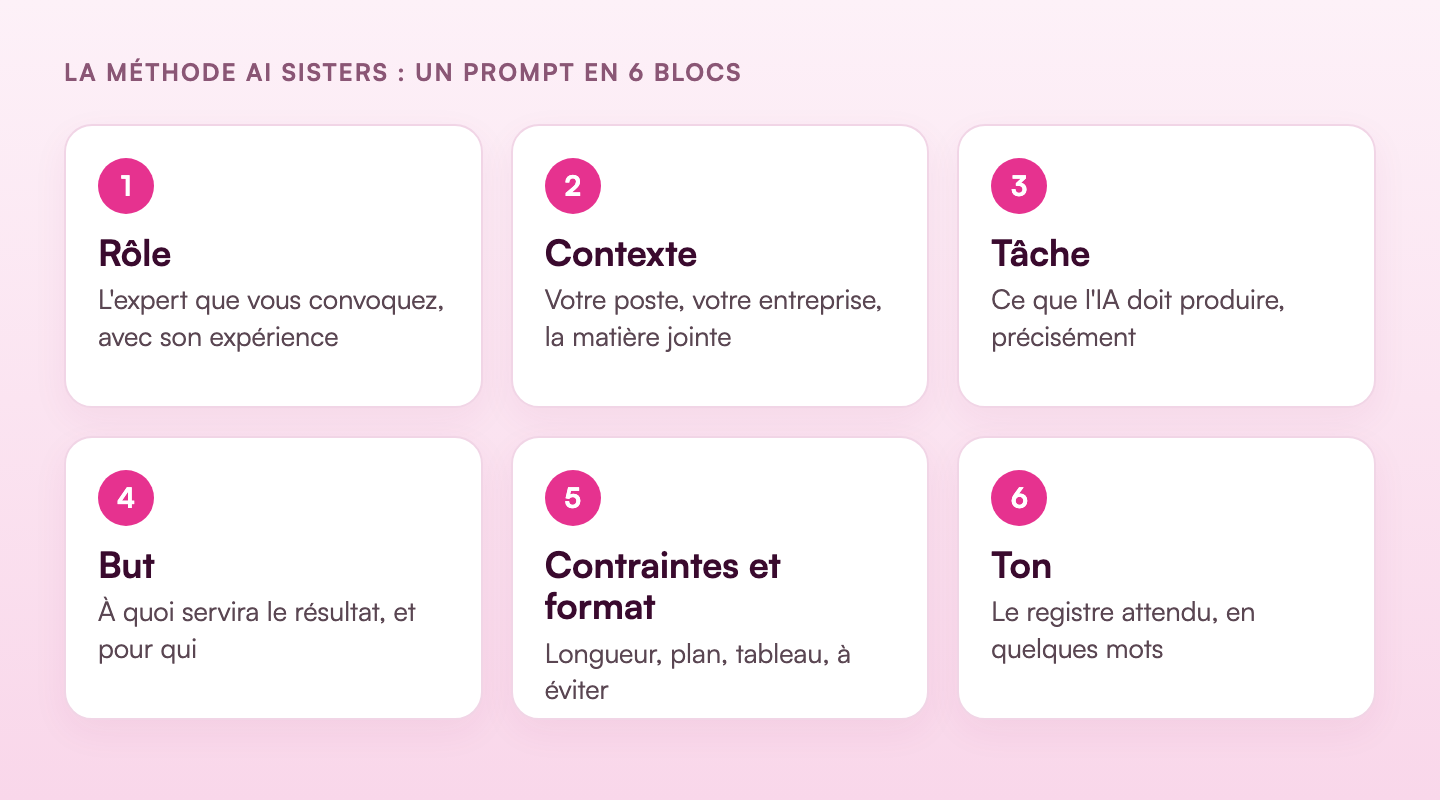
The most misunderstood block is the first. The Role is the expert you call on, not you. “You are HR manager at Martin Industrie” gives the AI no particular expertise. “You are an employment law expert with more than 15 years’ experience, specialising in sensitive HR letters” changes the level of the answer. Your job, your company and your situation go into the Context.
To understand. A prompt works like a brief to a contractor you are meeting for the first time. If they do not know who they are working for, what the document is for or what it should look like, they will hand back something correct and generic. The model has the same problem.
The five techniques that work
The guides published by Anthropic and OpenAI recommend the same habits we work on in our sessions. They come down to five techniques.
1. Give the context
Who you are, which company you work for, what material you have. “I am a management controller in a retail group, and I am sending you the export of the third-quarter budget and actuals.” Without those two lines, the AI invents an average situation.
2. Call on an expert role
Name the speciality, the experience and the expected level. The model then draws on the vocabulary and standards of that profession.
3. Show an example
Attaching an approved meeting report, a template email or a model table works better than three paragraphs of description. Ask it to keep the structure; only the content changes.
4. Set the output format
Length, structure, a table and its columns, number of bullet points, what not to do. This is the block that makes the result usable without editing. Add a caution rule: “if a piece of information is missing, write to be confirmed”.
5. Iterate instead of starting again
You correct the first result in the same conversation: “shorten part 2”, “add a deadline column”, “rephrase for a non-financial reader”. When a version works, you save the final prompt in the team’s library.
| Technique | Common mistake | What to write instead |
|---|---|---|
| Context | A question with no situation | Job, company, attached material, what is at stake |
| Role | “You are an assistant” or your own job | A specific expert, with their experience |
| Examples | Describing the deliverable in detail | Attaching a model to reproduce |
| Output format | Letting the AI choose the form | Structure, length, table, columns |
| Iteration | Asking the question again from scratch | Correcting within the conversation, then saving |
To understand. Iterating with AI is like reviewing a colleague’s work with a red pen. You do not ask them to redo everything; you show them the three places to fix.
Train your teams in prompt engineering
One day on your real files, with ChatGPT, Claude or Copilot. Qualiopi-certified provider, training rated 9.5/10.
See our tailored AI trainingBook a callBefore and after: three roles, three prompts
Here are three requests that come up in almost all our sessions, first as participants write them in the morning, then rewritten with the method.
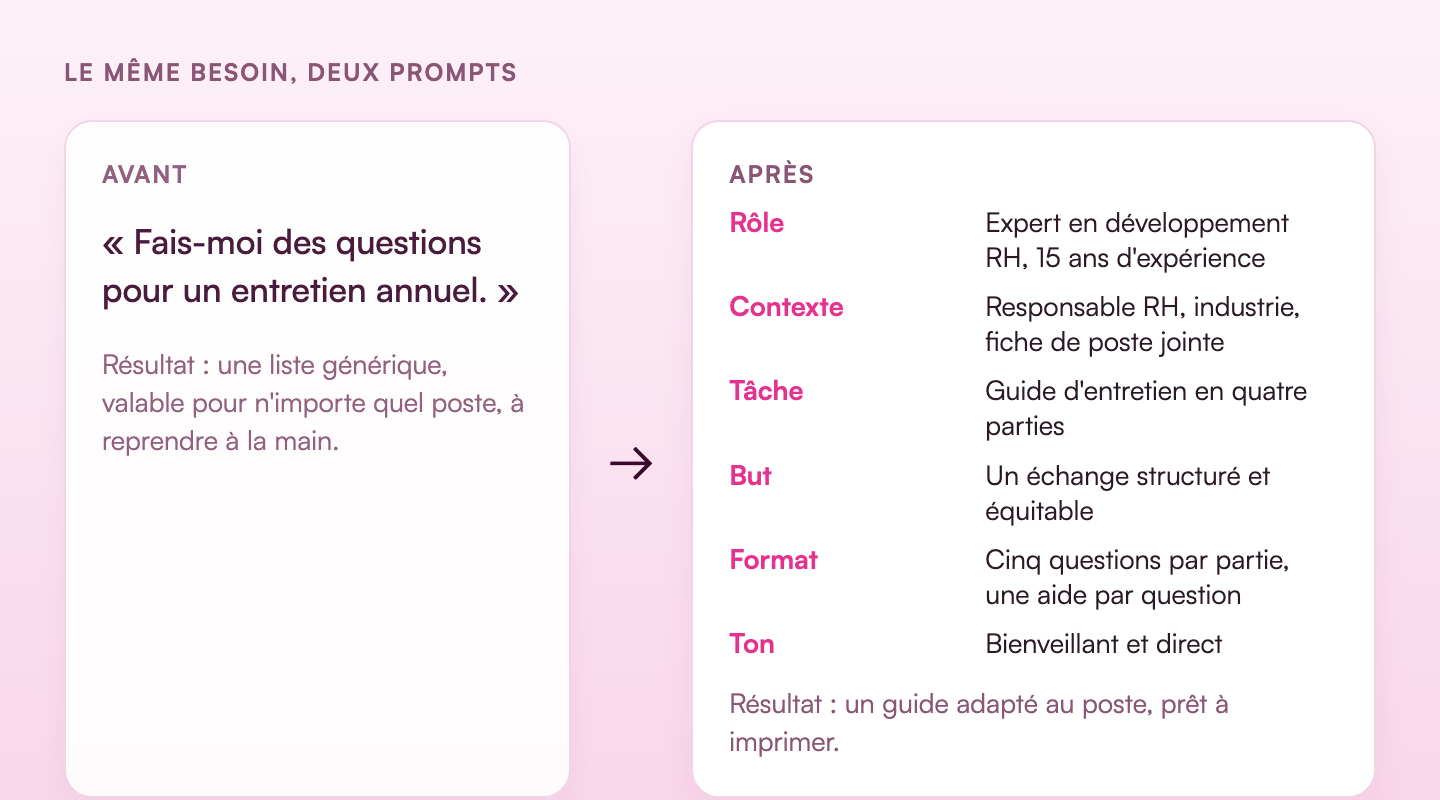
HR: preparing an annual review
Before
“Give me some questions for an annual review.”
After, with the method
Role. You are an HR development expert with more than 15 years’ experience, recognised as one of the leading specialists in annual reviews.
Context. I am HR manager in a 300-person industrial company. I am preparing the annual review of a maintenance technician. I am sending you their job description and our team objectives, with no personal data.
Task. Write a four-part interview guide: review of the year, skills, objectives, career development wishes.
Goal. Help the manager lead a structured and fair conversation, then write up the report.
Constraints and format. No more than five open questions per part, with one line of guidance for the manager under each question. No HR jargon.
Tone. Supportive and direct.
The result goes from a list of generic questions to an interview guide tailored to the job, ready to print. A rule to set beforehand: no personal data about an employee in a tool the company has not approved. At Samsung Electronics France, the HR teams worked on their prompts using real files, with this habit set from the start.
Finance: explaining a budget variance
Before
“Explain the budget variances.”
After, with the method
Role. You are a management controller with more than 15 years’ experience, recognised as one of the leading specialists in reporting to executive committees.
Context. I am a management controller in a retail group. I am sending you the third-quarter budget and actuals export, line by line. I am presenting to the executive committee on Thursday.
Task. Identify the five largest variances, in value and as a percentage, and for each one suggest the questions to ask the operational teams.
Goal. Prepare a memo the committee can read in two minutes.
Constraints and format. A table (line item, budget, actual, variance, questions), then a five-line summary. Do not invent any cause: if you do not know, write to be checked.
Tone. Factual and plain.
The controller gets a structured memo, which they complete with what they know from the ground. The AI does not know the real causes of the variances: every explanation needs checking. At Albioma, 30 employees from the finance department practised on real finance and accounting cases, with ChatGPT Enterprise.
Sales: following up after a meeting
Before
“Write a follow-up email for a client.”
After, with the method
Role. You are a B2B sales expert with more than 15 years’ experience, recognised as one of the leading specialists in long sales cycles.
Context. I am a sales engineer at a software publisher for industry. Here are my notes from yesterday’s meeting with a prospect’s operations director: her three priorities, her objections and the timeline discussed.
Task. Write the follow-up email.
Goal. Get a second meeting with her technical team.
Constraints and format. 120 words maximum. Use her own words about her priorities and suggest a single next step, with two time slots. No stock sales phrases.
Tone. Professional and warm.
The follow-up email uses the client’s own words and suggests a concrete next step. Once the prompt is approved, it goes into the sales team’s library, or into a shared GPT, Claude project or Copilot agent.
A typical one-day prompt engineering training programme
A day of prompt engineering training is built around the team’s tasks, gathered before the session through a questionnaire. The outline below is an example: it adapts to the company’s tool, whether ChatGPT, Claude, Copilot or Gemini, and to the participants’ roles.
| Time | Content | What participants produce |
|---|---|---|
| Early morning | What generative AI does, its limits, and which data can go into which tool | The team’s usage rules |
| Morning | The six-block method, demonstrated on a case from the team | A first structured prompt |
| Late morning | Workshop: rewriting three everyday prompts | Three tested prompts, before and after |
| Early afternoon | Examples, output format, iteration, attached documents | A complete deliverable on a real file |
| Afternoon | Role-based workshop, then a Promptathon-style team challenge | The best prompts, presented to the group |
| End of the day | Prompt library, shared GPT or project, individual usage plan | A team library and the assessment of learning |
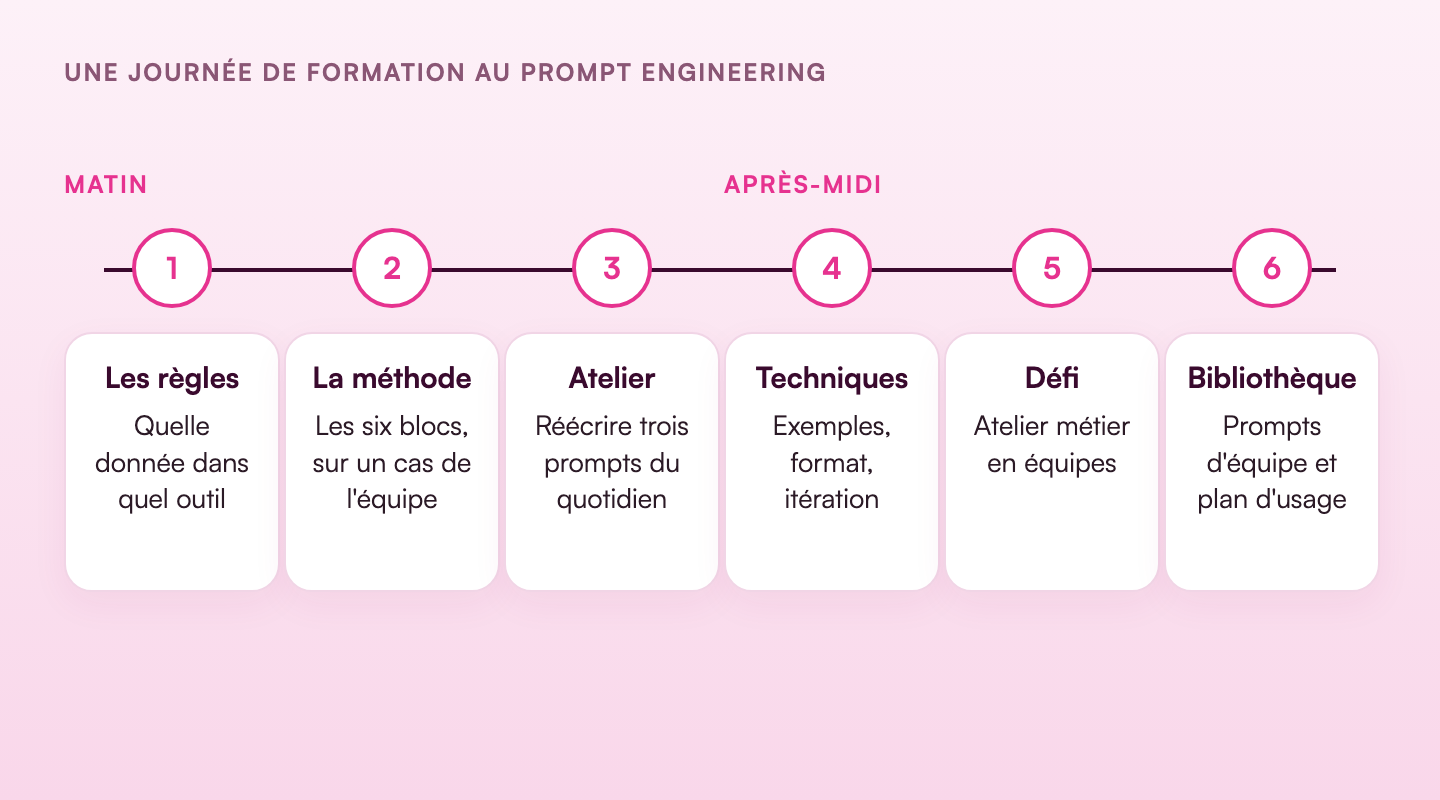
The workshops use the participants’ own documents and processes, so they can reuse the prompts the very next day. The format is described on our corporate ChatGPT training and corporate Claude training pages, depending on the tool you use.
How long should prompt engineering training last?
The right length depends on the goal: getting a group on board, changing habits or establishing lasting practices.
| Format | Length | What it is for |
|---|---|---|
| Promptathon | Half a day | A team prompt competition on role-based challenges, to get a group on board quickly |
| Intensive training | One day | Learn the method and leave with prompts tested on your own files |
| Programme | 6 to 12 weeks | Several sessions to embed practices and go as far as agents, with a 90-day follow-up |
The Promptathon works well for an away day or a tool launch: a one-hour introduction, then several rounds of challenges. At Albioma, the sequence took three hours: a one-hour AI Show, then a two-hour Promptathon with six teams. For a group that has to produce work with AI every day, one day remains the minimum. To go further, our tailored AI training combines these formats by role.
Funding: Qualiopi, OPCO and the skills development plan
Prompt engineering training is a training activity like any other. It can be included in the company’s skills development plan and funded by its OPCO, the skills operator for its sector. The condition: the provider delivering it must be Qualiopi-certified, the national quality certification awarded after an audit.
AI Sisters is a Qualiopi-certified provider. For your application, we supply the quote, the training programme, the attendance sheets and the certificates. The process happens before the session: check your sector’s funding criteria with your OPCO, submit the application with the programme, then wait for approval before setting the date.
The schemes, the list of OPCOs and the questions HR directors ask are covered in detail in our article on funding AI training, and on our Qualiopi-certified AI training page.
How to measure progress
Prompt engineering training is judged by what teams do afterwards. Four measures are enough, and none of them requires a special tool.
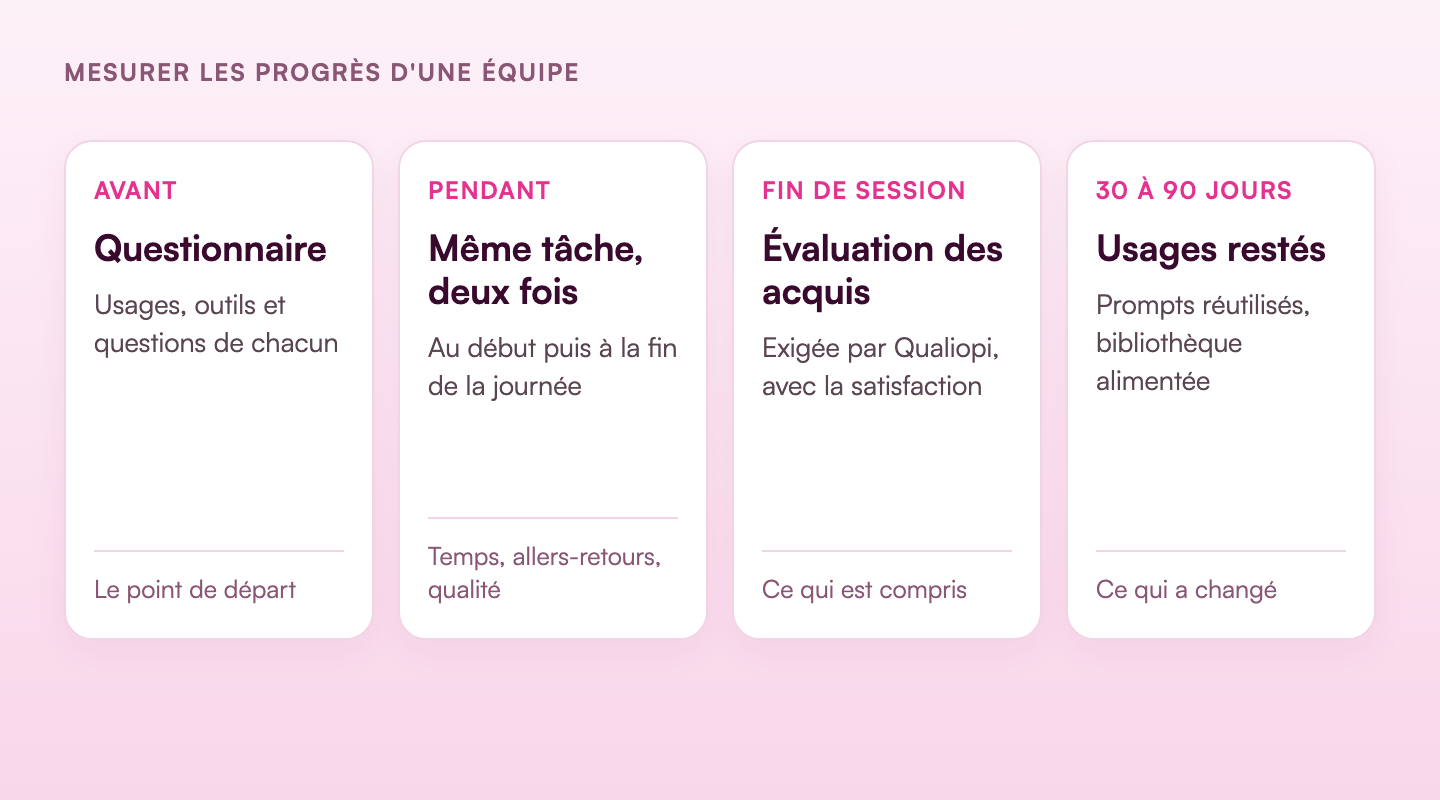
- Before the session, a questionnaire gathers each person’s practices, tools and questions. At Albioma, it showed that every participant still had questions about what they could share with an AI.
- During the day, everyone does the same task at the start and at the end: time spent, number of back-and-forths with the AI, quality of the deliverable scored on a simple grid.
- At the end, the assessment of learning required by Qualiopi and the satisfaction questionnaire. Participants rate our training 9.5/10.
- Thirty to ninety days later, we look at what has stuck: prompts reused, team library kept up to date, tasks the team now hands over to AI.
The last point matters most: a participant who has saved five prompts and uses them every week has truly changed the way they work.
Key takeaways
- Prompt engineering in a company means briefing the AI like a contractor: role, context, task, goal, format, tone.
- The Role calls on an expert; your job and your situation go into the Context.
- An attached example and a precise output format avoid most rework.
- One day on the team’s real files changes habits; a 6 to 12-week programme makes them stick.
- With a Qualiopi-certified provider, the training is OPCO-fundable.
- Measure on the same task, before and after, then at 90 days.
Let’s build your team’s training
30 minutes to talk about your roles, your tools and funding. More than 900 companies supported.
Book a callDiscover the PromptathonSources
- Anthropic, Prompt engineering overview, Claude documentation, accessed 6 November 2026.
- OpenAI, Prompt engineering, developer documentation, accessed 6 November 2026.
- French Ministry of Labour, Qualiopi, the quality certification mark for training providers.
- French Ministry of Labour, Skills operators (OPCO).
- AI Sisters, case studies Albioma (24 June 2026) and Samsung Electronics France (2 September 2026).