Training a team on generative AI usually starts with a question of format: in-house AI training, run only for your employees, or open (inter-company) training, where they join people from other organisations. Most comparisons online stop at the definitions. This article also answers the questions we hear before every project: real documents, licences, mixed levels and senior leaders.
In short
- In-house training is for a single company, on its own tools and use cases. Open training mixes several companies on a fixed programme.
- For one or two people, open training is enough. Once a team shares the same tools, in-house becomes more useful.
- Working on internal documents is only possible in-house, and only in the tool your company has approved.
- No ChatGPT, Claude or Copilot licence yet? In-house training can help you choose the tool.
- In France, both formats can be funded by your OPCO if the provider is Qualiopi certified.
- Article 4 of the EU AI Act requires companies to train AI users. In-house training leaves a record for the whole team.
In-house vs open: the comparison
In-house training is organised for a single company. The group is made up only of your employees, the date and venue are set with you (your offices, a seminar venue or online) and the content starts from your roles. Open training brings together people from several organisations on a session with a fixed programme, often at the provider's premises.
| Criterion | In-house | Open |
|---|---|---|
| Content | Built on your use cases and tools | Shared programme, generic examples |
| Internal documents | Possible, under your security rules | Best avoided in front of other companies |
| Tool used | The one deployed in your company | The one chosen by the provider |
| Dates | Set around your calendar | Provider's calendar |
| Group size | From a small team to several hundred people | One to a few people per company |
| Discussion | Between colleagues with the same constraints | With other sectors |
How many people before choosing in-house?
Providers often quote a threshold of 5 or 6 participants. In practice, headcount matters less than this question: do these people work on the same tools and the same tasks? A six-person executive committee is better trained on its own, because it talks about strategy and risk. Two assistants from two different departments can easily join an open session.
Beyond one team, in-house training scales: you can train a department, then a site, then the whole company.
Can you work on real documents during the training?
Comparisons rarely mention it, yet it often decides the format. In an open session, nobody shares a contract, a sales spreadsheet or a client email in front of other companies. Exercises stay generic and participants have to adapt them alone.
In-house, you can start from real files on two conditions: use the tool approved by your IT department (ChatGPT Enterprise, Claude, Microsoft Copilot or an internal LLM) and follow your data rules. When a document is sensitive, it is anonymised or turned into an exercise version with your teams before the session.
Good to know: the free version of an AI assistant does not offer the same data guarantees as an enterprise version. Check what your company allows before uploading an internal document.
Your teams don't have licences yet: what now?
This is common and does not hold you back. There are two cases.
- The company has not chosen its tool yet. The training then doubles as a test: teams compare ChatGPT, Claude and Copilot on their own tasks, which helps management decide.
- The tool is chosen but licences are not rolled out. Training runs on demo accounts and non-sensitive documents, and teams redo the same exercises once access opens.
Open training allows neither scenario, since the tool and programme are fixed for the whole group.
ChatGPT and Copilot users in the same session?
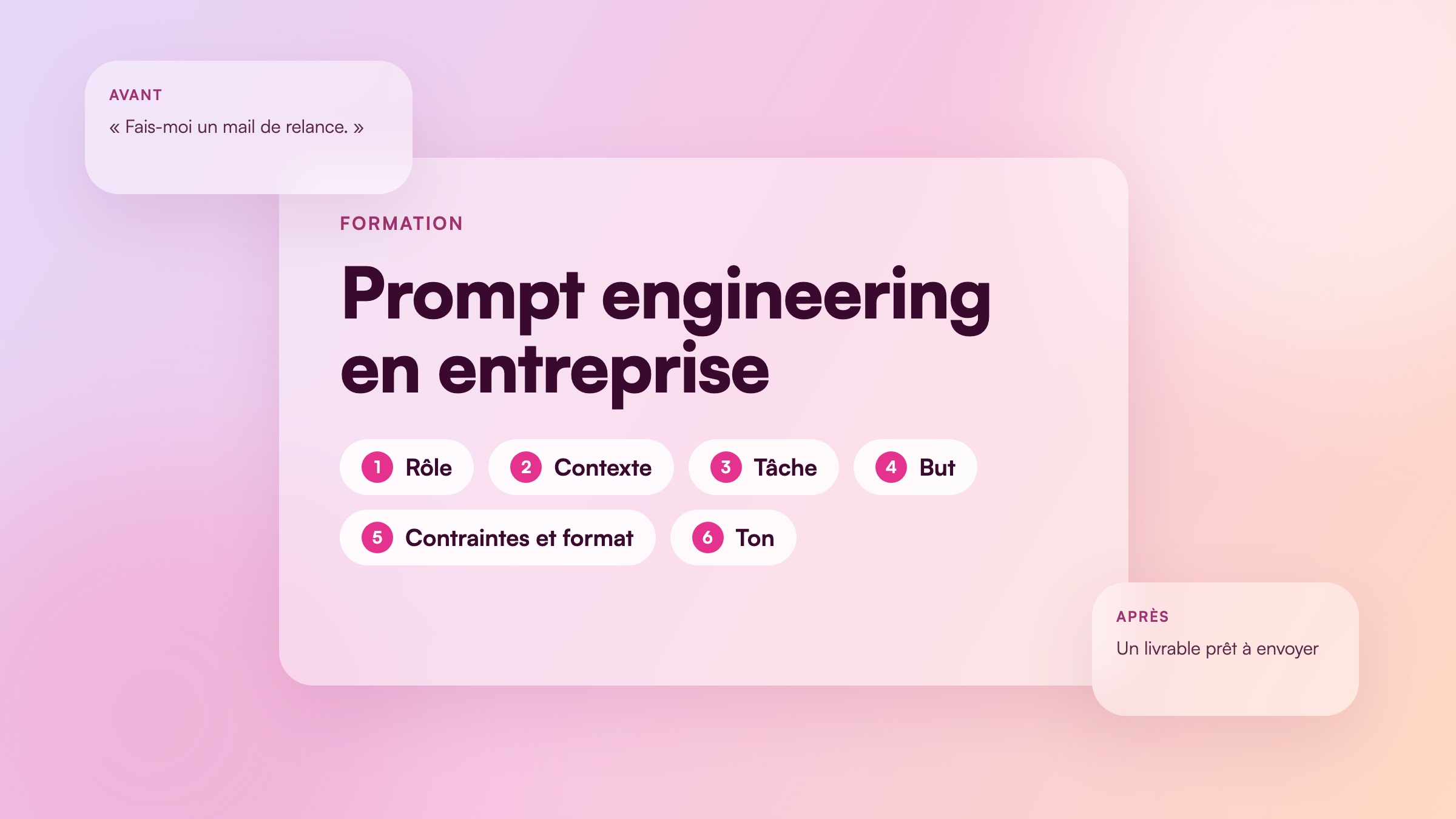
Yes, if the goal is learning to write a good request. The prompt method (role, context, task, goal, constraints, tone) works the same way in both tools. The hands-on steps differ a lot, though: Copilot works inside Outlook, Excel and Teams, while ChatGPT and Claude have their own interface.
When a company uses several tools, we keep a shared foundation and then split exercises by tool. To go further: ChatGPT training for companies, Copilot training for companies and Claude training for companies.
Beginners and advanced users in one group?
In any team, some people use AI every day and others have never opened it. In an open session, the provider does not know participants beforehand. In-house, we send a questionnaire before the training to gauge each person's level and collect their daily tasks. We can then group people by level or role, or plan two-speed exercises in the same workshop.
Should leaders train with their teams?
Usually not. Leaders need to discuss strategy, risk, budget and priorities, which is hard to do in front of their teams. Employees talk more freely about their difficulties without their manager in the room.
The order that works best: a session dedicated to the executive committee, then the teams. Leaders then know what their teams will learn and can champion the project. See our AI training for executives.
Training 300 people across several sites
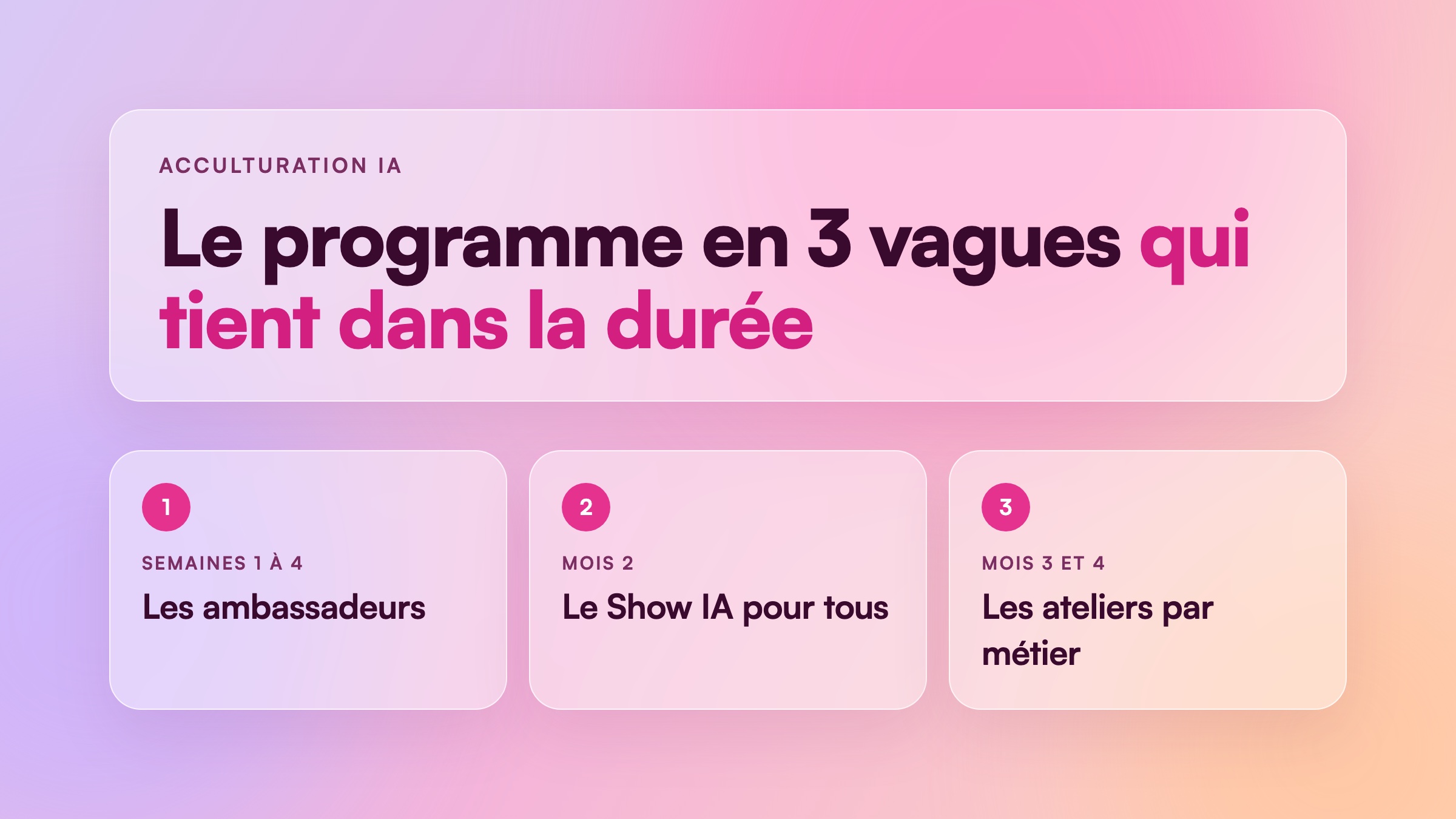
No open session can handle that volume. In-house, we work in two stages:
- An AI literacy session for a large group, on site or online, so everyone shares the same vocabulary and rules. This is the role of the AI Show, our AI literacy programme.
- Job-specific AI workshops, department by department, to practise on each person's real tasks.
Remote sites follow the same path online, so the company does not end up with two levels of training.
The limits of open training nobody mentions
- A session can be postponed or cancelled if the minimum number of participants is not reached, sometimes a few days before the date.
- The participant comes back alone, with no colleague to apply what they learned with them.
- The tool used during the training is not always your company's tool.
Open training still has its place: it suits one or two people, a first introduction before a roll-out, or someone who wants to swap ideas with other sectors.
In-house, open and the AI Act
Since February 2025, Article 4 of the EU AI Act requires companies that use AI to give their staff a sufficient level of AI literacy, suited to their role. The text sets no format. In-house training has a practical advantage: a whole department is trained at once, on the approved tool, with a shared programme and attendance sheets. More in our article AI Act: the obligation to train your teams.
Funding: OPCO and Qualiopi
In France, both formats can be part of the skills development plan, with possible support from your OPCO if the provider is Qualiopi certified. The amount depends on your OPCO and company size. AI Sisters is Qualiopi certified, and our guide to funding AI training explains the steps.
Checklist to decide
- One or two people with no specific need: open.
- A team sharing the same tools and tasks: in-house.
- Internal documents to use during the training: in-house.
- A tool to roll out or choose for the whole company: in-house.
- A seminar or kick-off to run: in-house (see our AI seminar activity).
Key takeaways
- Open training suits individual needs. In-house suits any team that has to adopt a tool together.
- Only in-house training lets you work on your documents, in your tool, under your rules.
- Train leaders separately, then teams by role.
- In France, both formats can be funded by the OPCO with a Qualiopi-certified provider.
AI Sisters is an AI consultancy that delivers in-house training in your offices in Paris, anywhere in France or online. More than 900 companies supported, 60,000 employees trained, and training rated 9.5/10. See our AI training in Paris, Lyon or Marseille.
An AI training project for your teams?
Let's look at your tools, your teams and the right format together.
Talk to an expertRead also: corporate AI training by AI Sisters, the AI Act training obligation and funding AI training.