Claude Fable 5.2 is Anthropic’s most powerful model, released on November 9, 2026. It runs work lasting hours or even days on its own, in coding, financial analysis and research. It is included in the Claude Pro, Max, Ultra, Team and Enterprise plans, costs $8 per million input tokens and $40 per million output tokens through the API, and Anthropic recommends keeping it for tasks where Opus 5.5 falls short.

Uber let it audit its security for twelve hours unattended. Oracle trusts it with SQL queries that two other models got wrong by a factor of 5 to 8. At AI Sisters, an AI consulting firm, we sorted through the feedback from the first companies to test it, kept what carries over to your teams, and flagged when Opus 5.5 is enough.
In short
- Released on November 9, 2026, Fable 5.2 is Anthropic’s most capable model, above Opus 5.5, Sonnet 5.5 and Haiku 5.5.
- It is built for long, loosely defined work: code audits, large files to cross-check, financial models, research.
- API pricing: $8 input and $40 output per million tokens, 20% less than Fable 5.1. Responses are up to 30% faster.
- It is available in Claude Pro, Max, Ultra, Team and Enterprise, in Claude Code, and on AWS, Google Cloud and Microsoft Azure.
- Claude Mythos 5.2 is the same model with fewer cybersecurity and biology safeguards. It is reserved for vetted organizations.
- For most office tasks, Anthropic recommends starting with Opus 5.5 and moving to Fable when the result falls short.
- On data, Fable conversations are kept for 30 days by default for safety monitoring.
7 real business use cases for Claude Fable 5.2
These cases come from company testimonials published by Anthropic on November 9. They are not independent measurements.
1. Finance: correct SQL on complex data
Oracle asked Fable 5.2 to combine country debt summaries, repayment history and regional benchmarks. Its SQL query returned the expected results. The queries from two other models summed amounts that were already aggregated, producing totals 5 to 8 times too high.
For you: a financial controller querying the data warehouse without waiting for the data team. Still check a known total before sharing the figure.
2. Financial analysis: a forecasting model filled from an annual report
Fundamental Research Labs had it move a company’s figures from its 10-K into a forecasting model. Fable 5.2 inferred the author’s intent from ambiguous cells, noticed that the regional numbers did not add up to the reported total, and got every cell right: 91% on their evaluation, against 86% for the next best model.
For you: the finance team or the M&A team bringing a target’s accounts into its own Excel model.
3. Banking and insurance: a loan file checked line by line
Box tested it on the files attached to a loan application. Fable 5.2 flagged that the salary deposits did not match the bank statement balance, so the underwriter knew what to check first.
For you: underwriting, KYC checks, a 300-page tender. The model flags inconsistencies; the analyst keeps the decision.
4. HR and legal: a compliance review that says who must act
Harvey, the legal AI tool used by large law firms, tested it on an I-9 compliance review, the US check of the right to work. Fable 5.2 listed the employees needing immediate attention, explained how to fix each file and said who should act.
For you: work permit checks or an audit of the staff register. Our legal uses of Claude are covered in our article on Claude for Legal.
5. IT: a 12-hour unattended security audit
An Uber engineer had Fable 5.2 run a 10 to 12 hour security audit. The model sent out about 170 reviewer agents and came back with a write-up, fix pull requests and a policy proposal.
For you: a security review of an internal application before it goes live. Penetration testing stays blocked by Fable’s safeguards and belongs to Mythos 5.2, reserved for vetted organizations.
6. Software: weeks-long projects finished in days
At Vercel, projects that had dragged on for weeks with other models were finished and approved in a few days. At Shopify, an engineer describes a model you give a loose idea to and that, after a few turns, carries the work on its own, “like another staff-level engineer”.
For you: migrating an old application or reviving a project nobody dares touch. Our Claude Code training starts from your own repositories.
7. Research and investment: an analyst that says what it does not know
Balyasny Asset Management asked it to investigate how a company had tested a new integration in its core systems. Fable 5.2 found the right sources without overstating what they proved, and flagged that the question itself could mislead. At Cognition, it corrected its own estimate and refused to give a number before measuring it.
For you: a competitive intelligence note or due diligence, where an invented figure is expensive.
Your teams already use Claude?
Our training starts from your real files to learn how to pick the right model and hand it long tasks.
Claude business trainingBook a callOperating system, Fermat, robots: the demos everyone is talking about
They do not concern your accounting team directly, but they show how far the model’s autonomy goes.

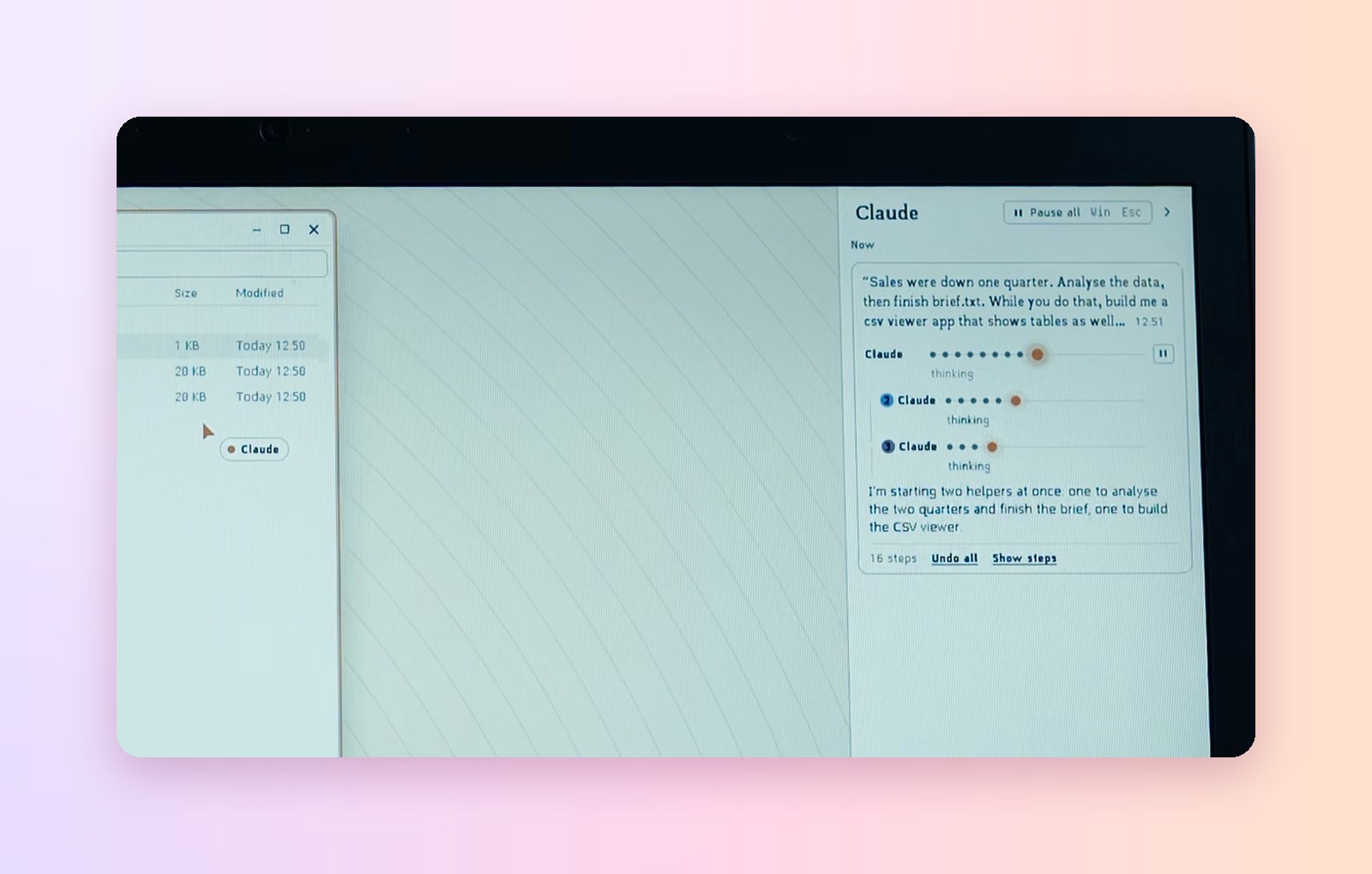
- Fable 5.2 wrote an operating system in eight days. Starting from an empty folder, it coordinated more than 1,000 subagents around the clock. The result boots on a laptop, with windows, a login screen and an installer.
- 1,000 Fable 5.2 agents formalized Fermat’s Last Theorem in 30 hours, where a first version had taken 11 days. In the same setup, Opus 5.5 had completed only 26% after 18 hours.
- From a one-paragraph prompt, it designed three electronic devices: a voice-assistant hub, a USB speakerphone and a handheld virtual pet. All three worked without electrical changes, according to Anthropic and the board maker Diode.
- It controlled robots to solve a puzzle cube, unscrew a bottle cap or draw. On the RoboDojo test, Fable 5.2 reaches 64.9%, more than double GPT-6 Astra (29.8%), according to Anthropic’s internal runs.
In plain terms. A subagent is a colleague the model hands part of the work to. Fable 5.2 acts as project lead: it splits the job, assigns it, reviews it and puts the pieces back together.
Fable 5.2 or Opus 5.5: which one for your teams?
Anthropic says so itself: for most coding and knowledge tasks, start with Opus 5.5, its everyday model. Move up to Fable 5.2 when the task is long, ambiguous, or when Opus fails. Move down to Sonnet 5.5 or Haiku 5.5 for simple, repetitive tasks.
| Your need | Recommended model | Why |
|---|---|---|
| Write an email, summarize a meeting, rephrase a note | Sonnet 5.5 or Opus 5.5 | Fast, cheaper, more than enough |
| Analyze an Excel file, prepare a presentation, write everyday code | Opus 5.5 | The default recommended model |
| Cross-check a large file (data room, tender, contracts) for inconsistencies | Fable 5.2 | Better judgment on ambiguous documents |
| Code audit, migration, multi-day development | Fable 5.2 | Holds the course and coordinates hundreds of agents |
| Financial model, SQL on complex data | Fable 5.2 | Fewer calculation errors, according to Oracle and Fundamental Research Labs |
| Penetration testing, biology research | Mythos 5.2, on application | Blocked by Fable’s safeguards |
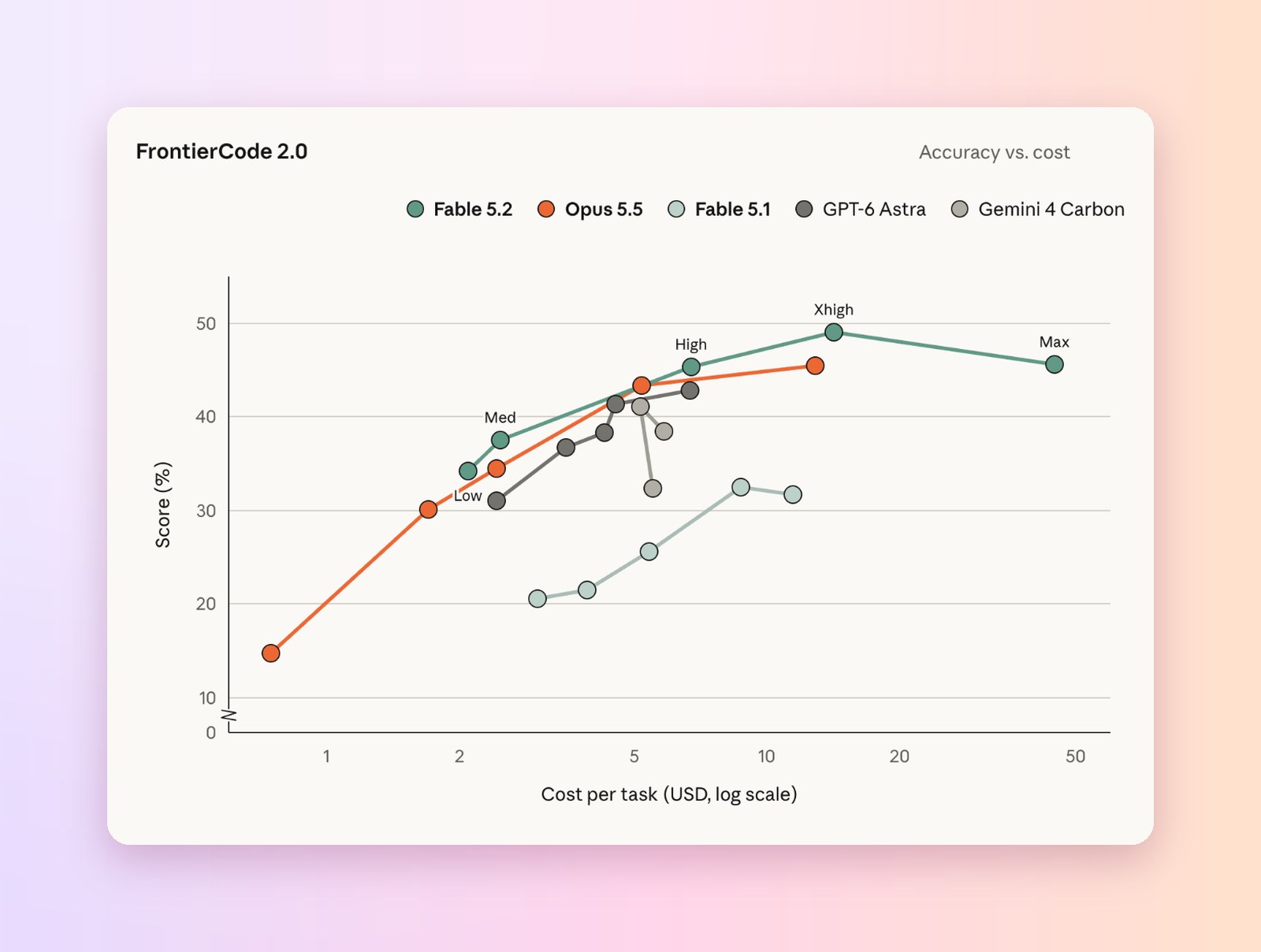
Fable costs more per token than Opus, yet the bill per task can go down. On the FrontierCode 2.0 coding test, Fable 5.2 at High effort scores 45.3%, as much as Opus 5.5 at its maximum (45.5%), for roughly half the cost per task, according to Anthropic.
In plain terms. Effort is the thinking time you give the model. “Medium”, the default in Claude, answers quickly; “High” or “Xhigh” lets it check more. More effort uses more, with no guarantee of better: at maximum effort, Fable 5.2 does worse than at Xhigh on this test.
Official Anthropic video (3 min 28): when to start on Opus 5.5 and when to move up to Fable 5.2.
The numbers, and who measured them
| Test | What it measures | Fable 5.2 | Opus 5.5 | GPT-6 Astra | Gemini 4 Carbon |
|---|---|---|---|---|---|
| AutomationBench | Automated business workflows | 51.4% | 42.5% | 41.4% | 53.9% |
| AA-Briefcase v1.1 | Office work, rubric score | 66.1% | 61.2% | 52.0% | 61.8% |
| Remote Labor Index | Real freelance assignments | 41.3% | 21.3% | 20.8% | n/a |
| FrontierSWE v2 | Software engineering | 69.9% | 62.3% | 65.5% | 61.2% |
| Chartography | Reading charts, no tools | 73.4% | 64.4% | 71.0% | 72.5% |
| OSWorld 2.1 | Using a computer | 89.3% | 87.2% | 79.5% | 81.5% |
These scores are measured by Anthropic. Fable 5.2 does not lead everywhere: Gemini 4 Carbon does better on automated business workflows, and the AA-Briefcase Elo ranking puts Opus 5.5 slightly ahead.
On the independent side, Artificial Analysis puts Fable 5.2 at the top of its Intelligence Index with 65 points, five more than Gemini 4 Carbon and six more than Opus 5.5, according to OfficeChai.
Pricing, plans and data: what to know before switching it on
- Fable 5.2 is included in Claude Pro, Max, Ultra, Team and Enterprise. On Pro and standard Team seats, it can account for up to 50% of weekly usage limits.
- Through the API, it costs $8 input and $40 output per million tokens, against $10 and $50 for Fable 5.1. Fast mode, up to 2.5 times quicker, costs $16 and $80.
- Sensitive cybersecurity or biology requests are automatically routed to a less capable model (Opus 4.8 or Opus 5).
- Using Fable means 30-day data retention by default for safety monitoring. Eligible Enterprise customers can stay on zero data retention. Check with your DPO.
In plain terms. The price per million tokens is the price per litre. The bill is what you consume. A model that costs more per litre but reaches the destination without detours can cost less in the end.
Where to start: test Fable 5.2 in 4 steps
- Pick a task that has already beaten Opus 5.5: a 200-page file to cross-check, a report whose totals do not add up, a bug nobody can find.
- In Claude, open the model selector in the message box and choose Fable 5.2. In Claude Code, type /model.
- Give the full context and the expected result, then let it work. Ask it to list what it could not verify.
- Run the same request on Opus 5.5 and compare quality, time spent and the share of your quota used. Keep Fable for tasks where the gap is clear.
Where would Fable 5.2 save your teams time?
A 30-minute call to spot the tasks where Fable, Opus or Sonnet really make a difference for you.
Book a callClaude business trainingRead also: Claude at work, the guide for your teams, Claude, ChatGPT or Gemini: which AI to choose and Claude and Pennylane for finance teams.
Key takeaways
- Claude Fable 5.2, released on November 9, 2026, is Anthropic’s most powerful model, included in the Pro, Max, Ultra, Team and Enterprise plans.
- Its best business uses: large files to cross-check, financial models, complex SQL, audits and long development projects.
- For everyday work, Opus 5.5 remains the starting point Anthropic recommends.
- Conversations are kept for 30 days by default: clear it with your DPO.
Sources
- Anthropic, Introducing Claude Fable 5.2 and Claude Mythos 5.2, November 9, 2026, updated November 11.
- Anthropic, Claude Fable 5.2 product page (pricing, availability, data retention), accessed November 12, 2026.
- Claude on YouTube, Fable 5.2 or Opus? When to use each model in Claude Code, November 11, 2026.
- CNBC, Anthropic releases Claude Fable 5.2 and Claude Mythos 5.2 ahead of IPO, November 9, 2026.
- OfficeChai, Anthropic Jumps To Top Of Artificial Analysis Intelligence Index With Fable 5.2, November 2026.