Since February 2025, the European AI Act has made AI awareness training mandatory for every employee who works with AI systems. Put simply: if your teams use ChatGPT, Copilot, Claude or any other AI tool in their daily work, which is already the case in the vast majority of companies — training is now a legal obligation, not an optional investment.
The good news: this training can be funded, often for 50 to 100% of its cost. OPCO (French training funds), CPF, Skills Development Plan: the schemes exist, they are accessible, and many HR directors do not use them yet for lack of clear information on the procedures.
This guide explains, scheme by scheme, how to get your AI training funded in 2026, with indicative amounts, real timelines and the questions you should ask your training provider before signing.
The AI Act has made AI training mandatory since February 2025: what the law says
The European regulation on artificial intelligence, the AI Act has come into force gradually since 2024. Since February 2025, Article 4 imposes an AI literacy obligation: employers must ensure that employees who interact with AI systems have a sufficient level of understanding of these tools.
In practice, this covers three very common situations in companies: using a text or image generation tool (ChatGPT, Midjourney, Copilot), using an AI-based decision-support tool (sales scoring, HR recommendations, automated financial analysis), and interacting with a chatbot or AI agent in a professional context.
Penalties for non-compliance can reach €15 million or 3% of worldwide annual turnover for the most serious breaches. For mid-sized companies, the risk is mainly contractual and reputational — public buyers and large groups are starting to include AI Act compliance clauses in their tenders.
What this changes for you as an HR director: AI training is no longer an "innovation" budget line to be decided at the end of the year. It is a compliance obligation, just like safety training or GDPR training. And like those, it can be funded through the standard schemes.
💬 Not sure whether your teams are already covered by the AI Act obligation? We will review it with you in 20 minutes, free of charge.
→ Talk to an AI Sisters expert
The 3 funding schemes to know in 2026
1. The Skills Development Plan (PDC)
The Skills Development Plan is the simplest and most flexible scheme for funding corporate AI training. It is managed directly by the employer, with no action needed from the employee.
The principle: each year, you define a training plan for your teams. The costs incurred under this plan are tax-deductible and can be partly covered by your OPCO if you are an SME with fewer than 50 employees.
For companies with more than 50 employees, the PDC is funded from your own training budget (the statutory contribution is 1% of the payroll). For micro-businesses and SMEs with fewer than 50 employees, your OPCO can cover all or part of the training cost.
The main advantage of the PDC: you decide, you manage. No need to wait for the employee’s agreement, no constraint on the schedule, and the range of fundable training is very wide — including tailored AI training that is not listed in the Qualiopi catalogue.
How to use it for AI training: include the AI training in your annual training plan, ask your provider for a quote, and submit the funding request to your OPCO if you are eligible.
2. OPCOs: your main funding lever
Skills Operators (OPCOs) are joint bodies that collect companies’ training contributions and redistribute them as funding. There are eleven in France, each covering one or more business sectors.
For corporate AI training, OPCOs can fund the teaching costs (the price of the training), and in some cases additional costs (the trainer’s travel, accommodation and meals).
Funding rates vary depending on your OPCO, the size of your company and the type of training. For SMEs with fewer than 50 employees, funding can reach 100% of the teaching cost. For companies with 50 to 300 employees, it generally ranges between 30 and 70% depending on the OPCO.
Indicative funding rates — SMEs < 50 employees, in-house AI training
| OPCO | Sectors covered | SME funding | Mid-sized company funding |
|---|---|---|---|
| ATLAS | Banking, insurance, finance, consulting, audit | Up to 100% | 30–50 % |
| AKTO | Hospitality, tourism, personal services | 60–100 % | 20–40 % |
| OPCO 2i | Industry, chemicals, pharmaceuticals, metalworking | 50–80 % | 20–35 % |
| AFDAS | Media, communication, culture, sport, audiovisual | Up to 100% | 30–50 % |
| CONSTRUCTYS | Construction, building, public works | 50–80 % | 15–30 % |
| OPCO Santé | Private healthcare, medico-social, pharmacies | 60–100 % | 25–45 % |
| Opcommerce | Retail, distribution, supermarkets | 40–70 % | 15–25 % |
Indicative rates — actual amounts depend on your sector, your headcount and the available budgets. Check with your OPCO or ask your provider for an estimate.
🧾 Want to know exactly how much your OPCO can fund? We will send you a funding estimate with your quote, within 24 hours.
→ Get my free OPCO estimate
The practical steps to get OPCO funding
Step 1 — Identify your OPCO (on the moncompteformation.gouv.fr website or by contacting your professional federation).
Step 2 — Check that your training provider is Qualiopi-certified. Without this certification, your OPCO cannot fund the training.
Ask for the Qualiopi certificate before signing any quote.
Step 3 — Submit a funding request before the training starts.
OPCOs do not accept retrospective requests: this is the absolute rule and the most common source of errors.
Step 4 — Wait for the funding approval before launching the training.
Processing takes 3 to 6 weeks depending on the OPCO and the time of year.
Step 5 — Send the supporting documents at the end of the training (signed attendance sheets, provider’s invoice, certificate of completion).
How to find your OPCO: the list of the 11 OPCOs
Your OPCO depends on your company's collective agreement, which appears on payslips: its IDCC code determines the relevant OPCO. Your chartered accountant or each OPCO's website can confirm it in a few minutes.
There are 11 OPCOs in France:
- Atlas: financial services and consulting (banking, insurance, digital, engineering, consulting)
- AKTO: labour-intensive services (cleaning, hotels and restaurants, temporary work…)
- Constructys: construction and public works
- OCAPIAT: agriculture, fishing, food industry and local areas
- OPCO 2i: cross-industry
- OPCO EP: local businesses (crafts, salaried liberal professions, local services)
- OPCO Mobilités: transport and automotive services
- OPCO Santé: private health, social and medico-social sector
- Uniformation: social cohesion (social and solidarity economy, social housing, sport…)
- AFDAS: culture, media, communication, sport and leisure
- Opcommerce: retail
3. The CPF (Personal Training Account)
The Personal Training Account is an individual scheme: it is the employee — not the employer — who decides to use their CPF to fund a course. The amount available on each account is about €500 per year, capped at €5,000 (or €8,000 for low-skilled workers).
When to offer the CPF to your employees for AI training: the CPF is relevant when the training leads to a recognised certification (listed in the National Register of Professional Certifications — RNCP — or the Specific Register — RS), and when the employee wants to train on a personal basis, outside working hours.
The main constraint of the CPF: only certifying or degree courses are eligible. Tailored in-house AI training, even of very high quality, is generally not CPF-eligible if it is not linked to a certification. Always check this point with your provider.
The CPF as a complement: some companies use the CPF alongside the Skills Development Plan — the employer funds the teaching through the PDC, and the employee uses their CPF to fund additional modules or a certification. This is legal and common.
Can you combine schemes?
Yes, and it is often the best strategy. Professional training funding schemes are not mutually exclusive — you can combine them to reduce the remaining cost.
Take a one-day AI training course for 15 employees:
For an SME with 30 employees in the services sector (OPCO AKTO), the OPCO can cover a large share of the teaching cost, up to 60%. The remaining cost per trained employee is then modest. If the day saves each participant 1 to 2 hours a week, it pays for itself quickly.
For a mid-sized company with 400 employees in industry (OPCO 2i), funding is lower (20 to 30%), but the training can be rolled out at scale using the annual training budget, over several sessions, with a decreasing cost per employee.
Self-employed workers and non-salaried executives: AGEFICE, FIF PL, FAFCEA
Non-salaried executives and self-employed workers do not depend on an OPCO but on a training insurance fund, financed by their professional training contribution. The fund depends on their activity:
- AGEFICE: non-salaried business owners in retail, industry and services.
- FIF PL: liberal professions (lawyers, chartered accountants, consultants, health professionals…).
- FAFCEA: owners of craft businesses.
Each fund sets its criteria and funding caps every year: check them on its website before submitting your request, ahead of the training.
ESF+: European co-funding
The European Social Fund Plus (ESF+) can co-fund training for employees and executives. It is not usually requested directly: it goes through programmes run by the regions or by some OPCOs. Check with your OPCO or your region to find out whether a scheme is open.
Summary: which funding for which situation?
- Skills Development Plan: for the employer, companies of all sizes, with no action needed from the employee.
- OPCO: partial or full funding, especially for companies with fewer than 50 employees; the application must be submitted before the training.
- CPF: at the employee's initiative, only for certifying courses (RNCP or Specific Register).
- AGEFICE, FIF PL, FAFCEA: for non-salaried executives and self-employed workers, depending on their activity.
- ESF+: co-funding possible through the regions or OPCOs.
Questions HR directors ask (and clear answers)
Are all our employees on permanent and fixed-term contracts eligible?
Yes. The Skills Development Plan covers all employees, whatever their type of contract, as long as the training is in the company’s interest.
For temporary workers, AKTO, the OPCO for temporary work, is responsible (it replaced the former FAF.TT).
What is the minimum duration for OPCO funding?
There is no regulatory minimum duration, but most OPCOs require a minimum of 7 hours of training to process an application.
One day of training (7 hours) is therefore the ideal format for a first funding request.
Does the provider have to be Qualiopi-certified?
Yes, for any OPCO funding.
It has been a strict requirement since 2022.
Always ask for the Qualiopi number and certificate before signing.
A serious provider will give it to you straight away.
How long between the request and the actual payment?
Allow 3 to 6 weeks for the funding approval, and 30 to 60 days after the end of the training for the actual payment.
The provider usually invoices the OPCO directly, so you do not advance the funds!
How can this training prove AI Act compliance?
Your provider must give you an individual training certificate for each employee, specifying the content, duration and skills acquired.
Keep these certificates in each employee’s training file: they are your proof in the event of an inspection or audit.
Can the training take place outside working hours?
Yes, with the employee’s agreement. In this case, the training gives rise to compensation (financial compensation or time off) under the terms set out in your company agreement or collective agreement!
📅 Ready to launch your AI training programme? We build your tailored plan and handle the OPCO procedures with you.
→ Request a free quote within 24 hours

How AI Sisters supports you with funding
At AI Sisters, we have supported more than 900 companies in their corporate AI training projects — from 10-person start-ups to major international groups such as Samsung, Accor, Daher, Vinci and La Poste.
We are Qualiopi-certified for our Qualiopi-certified AI training, which means your OPCO funding applications can be processed as soon as the quote is signed. We provide all the necessary documents: a detailed quote with the Qualiopi reference, a training programme that meets OPCO requirements, signed attendance sheets and individual training certificates.
Our team can help you identify your OPCO, estimate the funding amount you are eligible for, and prepare your application. The goal is simple: you should not have to handle any paperwork on your own.
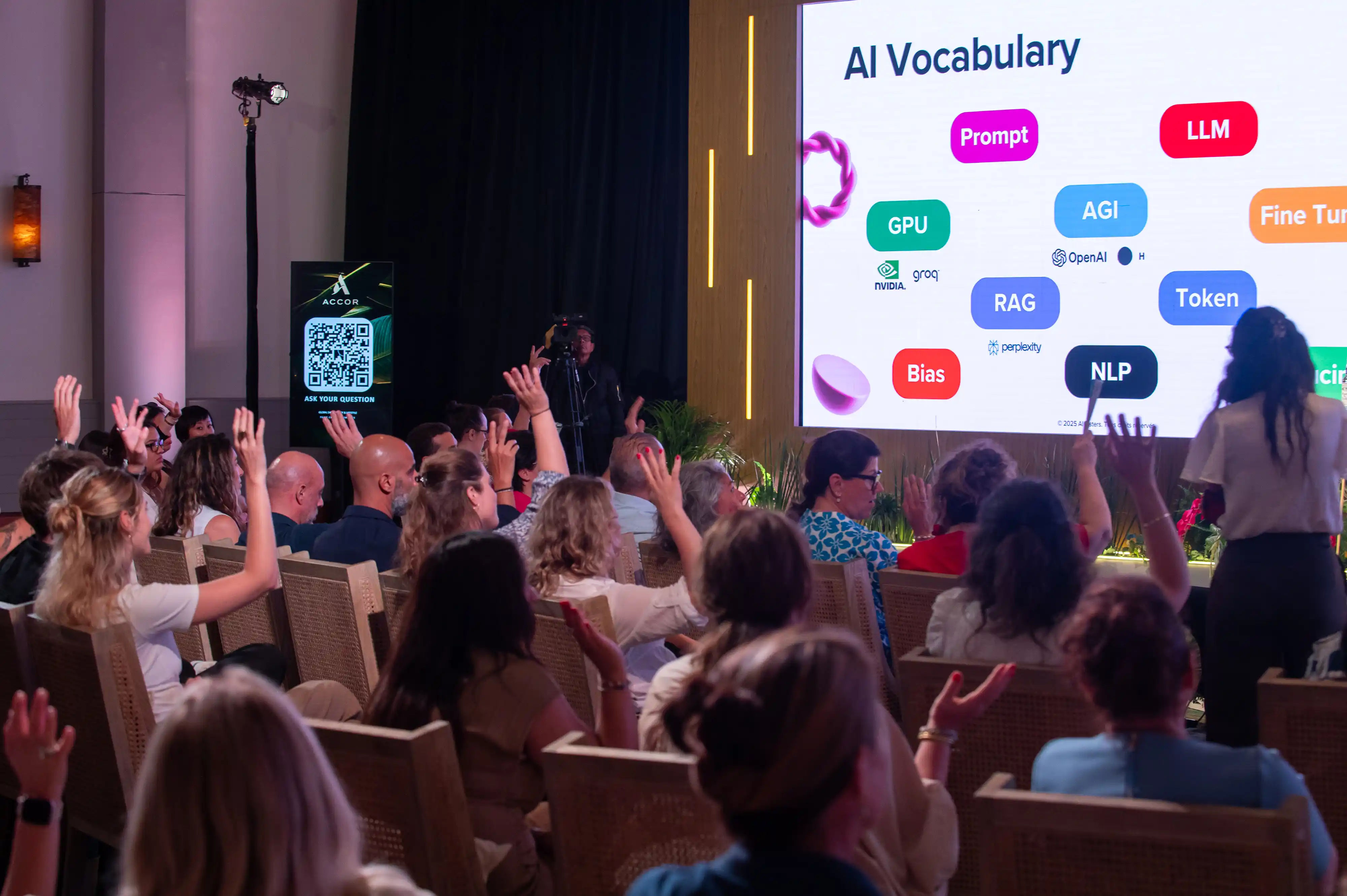
We offer three formats adapted to your constraints: the AI Show (an AI awareness conference for 50 to 400 employees in half a day), role-based workshops (7-hour sessions per department, 8 to 20 participants, 100% hands-on with your real use cases), and tailored multi-session programmes for large-scale roll-outs.
Request a free quote within 24 hours — we will send you the estimated OPCO funding amount for your company with the quote.
Where does your company stand with AI? Take the free AI diagnostic in 5 minutes and receive your action priorities.