In 2026, your employees are already using AI.
The real question is no longer "should we go for it?" but "which AI should we officially roll out across the company?".
Once the tool is chosen, corporate ChatGPT training or corporate Claude training speeds up adoption by your teams.
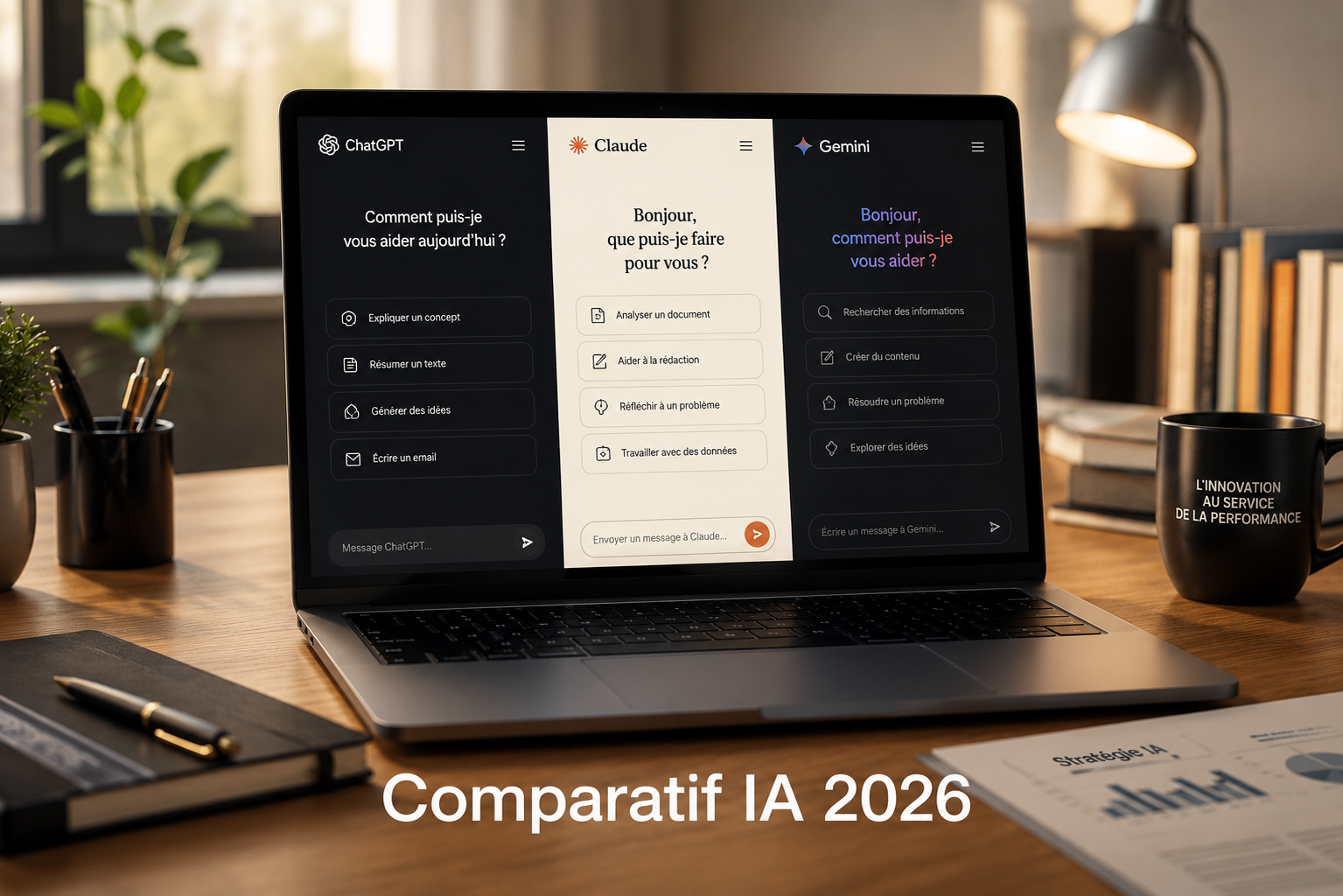
OpenAI's ChatGPT, Anthropic's Claude and Google's Gemini are fighting head-on for the B2B market and each one is fundamentally right… for different contexts.
Most comparisons drown you in benchmarks.
This guide does the opposite: it starts from your business context, your GDPR constraints and the tools you already have in place to tell you which of the three is the right choice.
And which ones to avoid in your case.
By the end of this article, you will know exactly which model to roll out, with what governance, and how to train your teams to turn this tool into a measurable productivity gain!
No time to read it all?
30 minutes with an AI Sisters expert to frame the right choice for your stack and your uses.
Book a free scoping call
Why the choice between Claude, ChatGPT and Gemini became strategic in 2026
In three years, generative AI has gone from gadget to everyday productivity tool in more than 60% of European companies.
The consequence: every day a company has not made its choice, its employees make one for it often by pasting confidential data into whichever free version is most convenient.
Three giants now share the professional market:
ChatGPT (OpenAI) remains the pioneer, with more than 300 million weekly users. Its current version, GPT-5.5, focuses on creative versatility and integration with Microsoft 365.
Claude (Anthropic) has become the benchmark for long-form reasoning, document analysis and code. The Opus 4.7 version reaches 87.6% on SWE-Bench Verified, the reference benchmark for software development.
Gemini (Google) is betting everything on the Google Workspace ecosystem. If your teams live in Gmail, Drive, Docs and Meet, Gemini becomes an ever-present assistant, with no change of tools.
The global generative AI market is expected to reach $137 billion in 2026.
The wrong choice is expensive: poorly sized licences, teams that do not adopt, data that leaks. The right choice multiplies productivity...
- 60%
- of European companies use at least one AI tool
- $137bn
- size of the generative AI market in 2026
- models dominate B2B in 2026
- 87.6%
- Claude Opus 4.7 score on SWE-Bench Verified
Claude, ChatGPT and Gemini: strengths, weaknesses and where each one shines
Three very different product approaches. Here is what really sets them apart, beyond the marketing benchmarks.
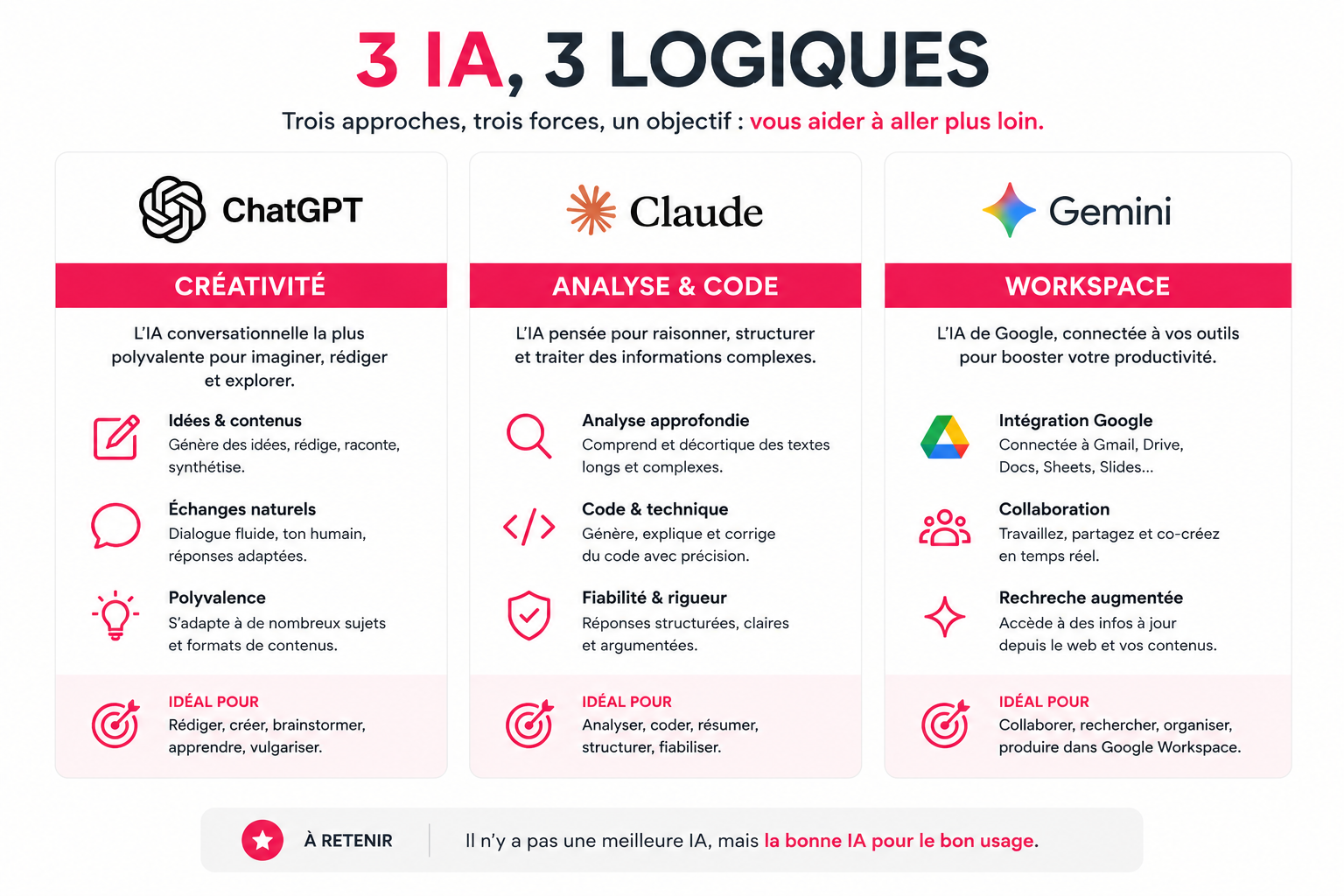
ChatGPT (OpenAI, GPT-5.5): the creative Swiss Army knife
ChatGPT remains the most versatile of the three. Native image generation, videos via Sora, smooth voice mode, real-time web search, a catalogue of specialised GPTs: no other assistant offers such functional breadth in a single interface.
Where ChatGPT excels:
- Creating varied marketing content (text, image, video)
- Brainstorming, ideation, creative exploration
- Office productivity via Microsoft 365 Copilot
- Teams that want one tool to do everything
Where ChatGPT disappoints:
- Editorial consistency on long texts: Claude outperforms it
- Stability of reasoning on complex technical analyses
- Data governance: Enterprise terms are needed to avoid exposing your data
Claude (Anthropic, Opus 4.7) — the analytical brain
Claude has become the benchmark for tasks that require depth: analysing legal documents, summarising financial reports, code review, long-form writing of editorial quality.
Its 1 million token context window lets it take in an entire tender, an annual report or a complete codebase without losing the thread.
Its integration via the Model Context Protocol (MCP) makes it the most "neutral" AI: it connects to Slack, Notion and GitHub without depending on any particular Big Tech ecosystem.
Where Claude excels:
- Large-scale document analysis (legal, finance, compliance)
- Long, consistent writing to high editorial standards
- Software development and code review (world leader on SWE-Bench)
- Autonomous agents and complex automations
- Companies that care about data security and AI Act compliance
Where Claude disappoints:
- No native image or video generation
- Less viral, less "fun" for mass adoption
- Less advanced Workspace integration than Gemini or Copilot
Gemini (Google, 3.1 Pro) — the Workspace integrator
Gemini is the natural structural choice for companies on Google Workspace. It reads your emails, analyses your Drive files, writes in Docs, creates tables in Sheets and summarises your Meet meetings, with no change of tool or habits.
It is also the only truly natively multimodal model: it handles video and audio as naturally as text or images.
Where Gemini excels:
- 100% Google Workspace companies
- Research + writing tasks (native web access)
- Video / audio analysis
- Automatic summaries of Meet meetings
- Cost included in existing Workspace licences
Where Gemini disappoints:
- Outside the Google ecosystem, its appeal collapses
- Less analytical depth than Claude
- Less creative versatility than ChatGPT
Read also: Read our complete guide to Claude AI in the workplace.
How to choose: the decision matrix for your context
There is no right model in absolute terms. It depends on four variables, listed here in order of importance.
Variable 1 — Your current ecosystem
This is by far the most decisive criterion.
- You are on Microsoft 365 ChatGPT (via Copilot Enterprise) is the natural path. SSO, governance, centralised billing.
- You are on Google Workspace Gemini Business has been included in most Workspace licences since 2025. It is structurally the cheapest option.
- You have a hybrid or independent stack (Slack, Notion, SaaS tools) Claude is the best compromise thanks to its neutral MCP protocol.
Variable 2 — Your main use
Variable 3 — Your security and compliance constraints
The AI Act came into application in 2026. Your employees must never pass confidential data through free consumer versions.
Every honest comparison will tell you the same: only the Enterprise / Business plans from the three vendors offer the necessary contractual guarantees (no use of data for training, hosting, traceability).
On this criterion, Claude stands out with its "Constitutional AI" approach and the automated cyber safeguards introduced with Opus 4.7.
It is the most widely adopted AI in regulated sectors (banking, healthcare, defence, legal advice).
Variable 4 — Your AI maturity
Less friction = faster adoption.
Unsure about the right choice?
AI Sisters audits your stack and your uses, and proposes the AI strategy best suited to your context.
Request a free auditConcrete use cases: what companies are already doing with each of the three
To make the choice tangible, here is what the 900+ companies supported by AI Sisters are actually doing with these three models.
With ChatGPT — creation, brainstorming, everyday productivity
With Claude — analysis, code, demanding automations
With Gemini — Workspace, multimodal, Google productivity

See our corporate AI case studies
Mistake no. 1 to avoid: choosing the tool before the strategy
This is the mistake we see in more than half of the companies that call us: they have already bought ChatGPT Enterprise or Copilot licences, and find after 6 months that fewer than 20% of employees really use them.
The cause is always the same: the tool was chosen before the use cases were scoped, the teams trained and the governance defined.
A successful AI rollout always follows the same order:
- Scope the 3 to 5 use cases with the highest ROI for your business.
- Choose the model that gets the most out of these use cases for your stack.
- Train the teams in prompt engineering and good AI habits.
- Put governance in place: usage policy, charter, data control.
- Measure ROI: time saved, quality, satisfaction.
This is exactly the AI Sisters method applied at Accor, Samsung, Daher, Vinci, La Poste, ENGIE, Tikehau Capital, Sopra Steria, JCDecaux, Havas, The Hoxton and 900+ other companies.
Read also: Our guide: how to choose your AI training.
Where to start in practice?
Here is the sequence we recommend to any French company that wants to make the right choice between Claude, ChatGPT and Gemini in 2026.
Step 1 — Audit your stack and your real uses. Which tools do your teams really use?
Which AI use cases have the most business impact for you? Without this starting picture, any choice is arbitrary.
Step 2 — Test on 2 or 3 priority use cases.
Once the target is identified, run a short POC (4 to 6 weeks) on a limited scope, with a quantified goal for time saved or quality.
Step 3 — Train the teams before rolling out widely.
A licence without training = adoption of around 20%. A licence with structured training = adoption above 80% and measurable ROI from the first quarter.
Step 4 — Set up governance.
AI charter, usage policy, approval of authorised data.
Align HR, IT, finance and legal teams.
Step 5 — Measure and scale up. Once the first ROI has been demonstrated, gradually extend to other teams, other uses and other models where relevant.
Read also: How to measure the ROI of corporate AI training.
FAQ — Claude, ChatGPT or Gemini in the workplace
Frequently asked questions
What is the best AI for a company in 2026: Claude, ChatGPT or Gemini?
There is no "best universal AI". The right choice depends on your ecosystem (Microsoft, Google, hybrid), your priority use cases (creation, analysis, Workspace productivity) and your security constraints. Claude leads on document analysis and code, ChatGPT on creative versatility, Gemini on Google Workspace integration.
Is Claude really better than ChatGPT for analytical work?
On demanding analytical tasks — summarising legal documents, code review, long technical writing — Claude Opus 4.7 regularly outperforms ChatGPT in practical tests in 2026. Its 1 million token context window and its 87.6% score on SWE-Bench Verified make it the market benchmark for these uses.
Should you roll out one AI or several in the company?
For most SMEs and mid-sized companies, starting with one main model aligned with your stack is the right approach. Large, mature groups often roll out a mix: ChatGPT or Copilot for office productivity, Claude for demanding analytical uses. The key rule: a single governance framework, however many tools you use.
Is my data protected with these three AIs?
Only with contracted Enterprise / Business plans. The three vendors then guarantee that your data is not used for training, with suitable hosting and traceability. Free or consumer versions must never be used with confidential data. This is one of the key obligations of the AI Act, applicable in 2026.
How do I train my teams to use Claude, ChatGPT or Gemini properly?
Training is the number 1 factor in adoption and ROI. AI Sisters, a Qualiopi-certified training provider, designs tailored programmes adapted to the model you have chosen, your business and your teams' level. More than 60,000 employees already trained at Samsung, Accor, Vinci, La Poste, ENGIE and 900+ companies. The training is eligible for OPCO funding (French training funds) / skills development plan.
The right choice takes preparation. AI Sisters supports you.
Choosing between Claude, ChatGPT and Gemini is no longer a technical question — it is a strategic decision that affects your teams' productivity and the security of your data for the next 18 months.
AI Sisters supports 900+ companies with this choice and with the operational rollout: audit, model choice, Qualiopi training, governance, ROI measurement.
Whether you are an HR director, CIO, CFO or business leader, we design the programme that turns your teams into productive, compliant AI users.
Make the right AI choice for your company
30 minutes with an AI Sisters expert to frame your AI strategy, choose the right model and plan your teams' training.
Book my free strategy callThe right choice between Claude, ChatGPT and Gemini in 2026 is not made on a benchmark — it is made on your stack, your use cases and your teams' training. Share it with others if the question comes up with your leadership team (COMEX).
Where does your company stand with AI?
Take the free AI assessment in 5 minutes and get your priority actions.
Take the assessment