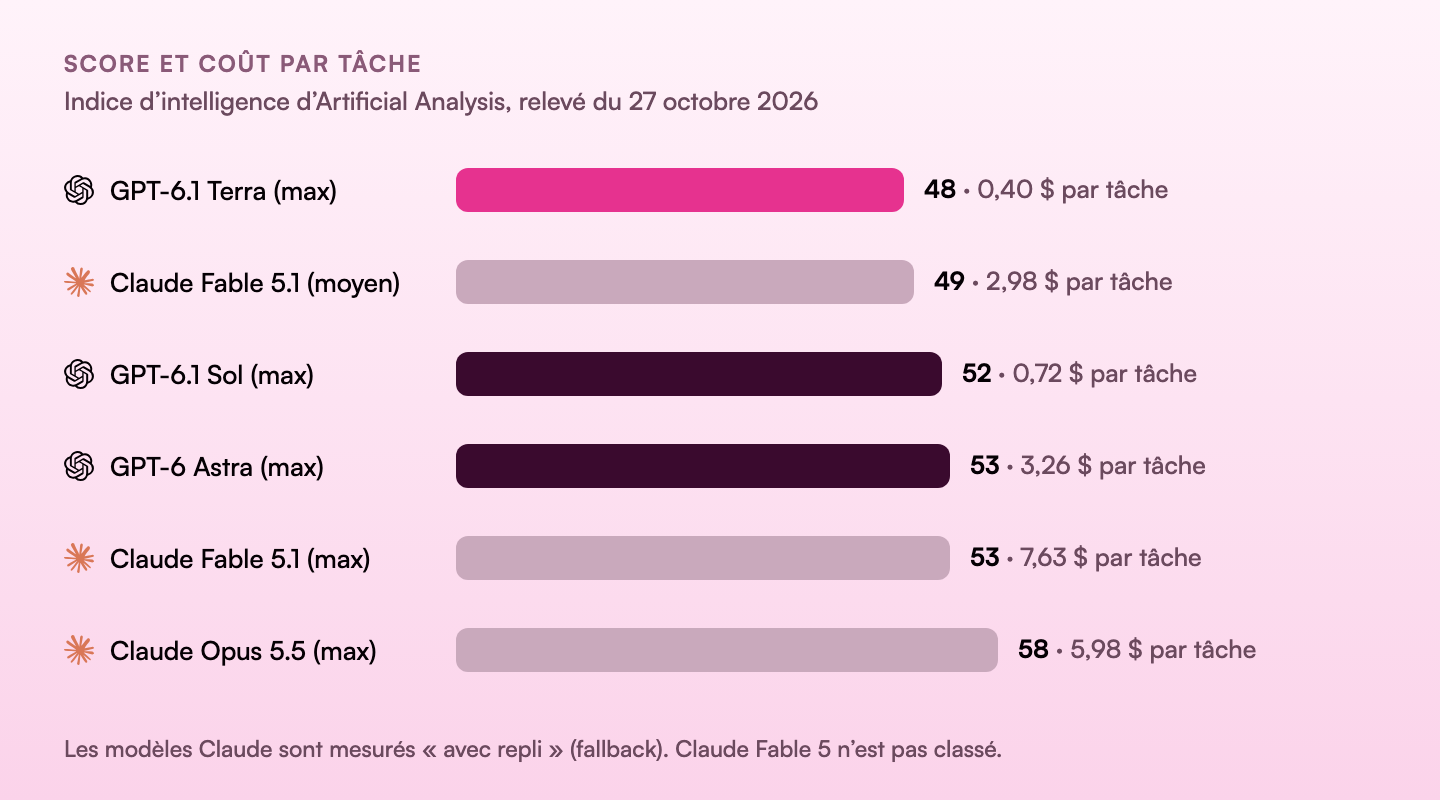
On 26 October 2026, OpenAI launched GPT-6.1 Terra, the mid-tier model in its GPT-6 range. Its API price is half that of GPT-6.1 Sol. On the Artificial Analysis index, it sits level with Claude Fable 5.1 at medium effort, for a cost per task around seven times lower.
At AI Sisters, an AI consultancy, we help teams choose and use these models. Here is what GPT-6.1 Terra is really worth: what OpenAI announces, what independent evaluators measure, what it costs, and which tasks to choose it for.
In brief
- GPT-6.1 Terra was released on 26 October 2026. It replaces GPT-5.6 Terra, between Luna, the lightest, and Sol, the top of the range.
- Its API price is $1 per million input tokens and $5 per million output tokens: half the price of GPT-6.1 Sol and of the previous Terra.
- On the Artificial Analysis index, it scores 48 points at maximum effort, against 49 for Claude Fable 5.1 at medium effort and 52 for GPT-6.1 Sol.
- OpenAI presents it as a model for office work: reading a screen, clicking, filling in forms, entering invoices.
- It is available in ChatGPT Work and Codex for Plus, Pro, Enterprise and Edu subscribers, and in the API under the name gpt-6.1-terra.
- OpenAI rates it at the “critical” level for cybersecurity and applies the same safeguards as GPT-6 Astra.
Also worth reading: Claude, ChatGPT or Gemini: which AI to choose for your company, OpenAI Dots, the arrival of AI colleagues and Claude Duet, Anthropic’s AI agent.
What is GPT-6.1 Terra?
GPT-6.1 Terra is OpenAI’s mid-range model. OpenAI describes it as “a fast and efficient model”, designed for vision, precise computer use and more natural writing.
Since September, OpenAI’s range has had four tiers, from the cheapest to the most powerful: Luna, Terra, Sol and Astra. Sol and Luna moved to generation 6 in September; Terra stayed on version 5.6. GPT-6.1 Terra fills that gap.

Its knowledge cutoff is 1 June 2026, more recent than that of Sol and Astra (30 April 2026), according to The Register. Ted Sanders, a researcher at OpenAI, summed up its strengths on Hacker News: Terra is “probably better” than Astra and Sol for technical communication, comparable in vision and computer use but much faster, and “a bit worse at most other things”.
In plain terms. OpenAI’s four models work like the tiers of a company vehicle fleet. Luna is the city car, Astra the lorry. Terra is the van: it does not carry everything, but it handles most everyday journeys at a much lower cost than the lorry.
Half the price of GPT-6.1 Sol
Price is the main selling point of this release. OpenAI charges $1 per million input tokens and $5 per million output tokens for GPT-6.1 Terra, half the rate of GPT-6.1 Sol and GPT-5.6 Terra.
| Model | Input | Output | Positioning |
|---|---|---|---|
| GPT-6 Luna | $0.10 | $0.50 | Fast, simple tasks |
| GPT-6.1 Terra | $1 | $5 | Office work, vision |
| GPT-6.1 Sol | $2 | $10 | Complex code |
| GPT-6 Astra | $10 | $50 | Most powerful |
The price per token does not tell the whole story. Artificial Analysis also measures the real cost of a task, which depends on how many tokens the model produces to reason. At maximum effort, a task from its index costs $0.40 with Terra, against $1.40 with GPT-5.6 Terra: less than a third.
In plain terms. The price per million tokens is the price per litre. The cost per task is the fuel for the whole journey. A model that is cheaper per litre can use more if it reasons for a long time; that is why cost per task is the figure to compare.
Close to Claude Fable 5.1? What the figures say
OpenAI claims that Terra matches GPT-6 Astra, its most powerful model, on the Agents’ Last Exam test, at a tenth of the price per token. This result comes from OpenAI and covers a single test. The ranking from Artificial Analysis, an independent evaluator, gives a more nuanced picture.
| Result | Figure | Measured by |
|---|---|---|
| Intelligence Index, maximum effort | 48 (Sol: 52, Astra: 53, Fable 5.1: 47 to 53 depending on effort) | Artificial Analysis |
| Cost per index task | $0.40 (Sol: $0.72, Fable 5.1 max: $7.63) | Artificial Analysis |
| Agents’ Last Exam, maximum effort | 60.0% (Sol: 58.6%, Opus 5.5: 63.2%) | OpenAI |
| Terminal-Bench 4.0, maximum effort | 50.3% (GPT-5.6 Terra: 21.5%) | OpenAI |
| Error rate on trick questions, low effort | 16.7% (GPT-5.6 Terra: 53.6%) | OpenAI |
| Rate of guessed answers | 38% (GPT-5.6 Terra: 88%) | Artificial Analysis |
Three takeaways. Terra is not the strongest model: Claude Opus 5.5 keeps a 10-point lead on the index. However, it matches Claude Fable 5.1 set to low or medium effort (47 to 49 points), for a cost per task six to seven times lower. And Claude Fable 5, the previous version, does not appear in the ranking: no direct comparison has been published.
OpenAI says so itself: for the most complex code, it is better to stick with GPT-6.1 Sol or GPT-6 Astra.
Choose the right model for each task
Our training starts from your real use cases: which model, which setting, what cost.
ChatGPT training for companiesBook a callWhat GPT-6.1 Terra can do at the office
OpenAI presents Terra as the model for “everyday office work”. Its headline strength is computer use: it reads what is on the screen, clicks, types and switches from one application to another.
The examples cited by OpenAI, reported by The Next Web: entering incoming invoices into accounting software, filling in forms, drafting proposals, reading technical drawings and editing video. In a demonstration, Terra turned architectural plans into a 3D model and produced a timestamped log of an animated film, shot by shot.
OpenAI also reports tasks completed more than three times faster than with GPT-6 Astra and GPT-6.1 Sol. This speed matters most for agents, which chain dozens of actions.
In plain terms. Computer use is what an intern does when shown the screen: they look for where to click, fill in the fields, move on to the next piece of software. The model does not go through a technical connection between applications; it uses the screens as a human would.
Three business use cases to start with
1. Accounting: entering supplier invoices
This is the example highlighted by OpenAI. Terra reads the invoice, opens the accounting software and fills in the fields. First task to hand over: a batch of invoices already entered, so you can compare. Watch out: check every entry before approval, as you would for a new starter. Our AI training for finance covers this kind of check.
2. Sales: commercial proposals
OpenAI highlights “clearer and more natural” writing. Terra can draft a first version of a proposal from a brief and past offers. First task: a template proposal for a fictitious client. Watch out: prices and commitments must still be written by the team.
3. Engineering office: reading drawings
Terra’s vision lets it interpret technical drawings. First task: extract the list of components from a drawing you already know and compare it with the existing bill of materials. Watch out: a misread drawing is expensive, so always keep a human review.
Security and reliability: what to know
OpenAI rates Terra at the “critical” level for cybersecurity in its risk assessment framework, the Preparedness Framework. In other words, the model is judged capable enough to assist with serious cyberattacks. OpenAI therefore applies the same safeguards as for GPT-6 Astra, according to The Next Web.
On reliability, the progress is clear. According to Artificial Analysis, Terra guesses in 38% of cases where it does not know, against 88% for the previous version. OpenAI also says it stays better within the scope of the task requested and flags its limits more often.
For company data, the rule does not change with the model: keep sensitive documents for ChatGPT’s business plans, and write down what can and cannot go into them.
How to get started this week
Plus, Pro, Enterprise and Edu subscribers can select Terra in ChatGPT Work and Codex. Developers call it in the API under the name gpt-6.1-terra. The launch articles do not specify access for free accounts or for the Business plan.
- Choose a repetitive task you know how to check: data entry, a form, a document summary.
- Test Terra at two effort levels, medium then maximum, and note the time taken and the quality obtained.
- Compare the cost per task, not the price per token, with the model you use today.
- Keep Sol or Astra for complex code, as OpenAI recommends.
- Train your teams to choose the model according to the task. That is the purpose of our ChatGPT training for companies.
Where to start in your company?
A 30-minute conversation to identify the tasks where a model like Terra saves your teams time.
Book a callAI diagnosticPrefer a full programme? Our corporate AI training courses start from your own tools and real files.
Key takeaways
- GPT-6.1 Terra, released on 26 October 2026, is OpenAI’s mid-tier model, between Luna and Sol.
- It costs half as much as GPT-6.1 Sol: $1 and $5 per million tokens.
- On the Artificial Analysis index, it matches Claude Fable 5.1 at medium effort for around seven times less per task, but remains behind Sol, Astra and Opus 5.5.
- It is designed for office work: computer use, vision, writing.
- The favourable comparisons with Astra come from OpenAI and cover a single test.
- Test it on a task you know how to check, and compare the cost per task.
Sources
- OpenAI, Introducing GPT-6.1 Terra, 26 October 2026.
- Artificial Analysis, GPT-6.1 Terra pushes the cost efficiency frontier, 26 October 2026.
- Artificial Analysis, model leaderboard, accessed on 27 October 2026.
- The Register, OpenAI rolls out budget-priced mid-tier GPT-6.1 Terra, 26 October 2026.
- BleepingComputer, OpenAI launches GPT-6.1 Terra with 3x faster AI agents, 50% lower pricing, 26 October 2026.
- The Next Web, OpenAI launches GPT-6.1 Terra, a cheaper model for everyday computer work, 26 October 2026.
- Interesting Engineering, OpenAI’s GPT-6.1 Terra matches GPT-6 Astra at 10% of the token cost, 26 October 2026.
- 9to5Mac, OpenAI upgrades ChatGPT and Codex with new GPT-6.1 Terra model, 26 October 2026.