ChatGPT Health: OpenAI, medicine, medical records, GDPR and the launch of a dedicated ChatGPT space for 230 million people
With more than 230 million people using its services, ChatGPT is reaching a key milestone in the health sector. With the latest ChatGPT launch, OpenAI has introduced ChatGPT Health, a dedicated space — separate from the rest of ChatGPT — designed to answer health questions while meeting the requirements of the GDPR, confidentiality and data protection.
This development illustrates the rise of artificial intelligence in the medical field, where the management of personal data, sensitive data and medical records is becoming central to the health and well-being of users.
ChatGPT and OpenAI: AI in the service of health
OpenAI has designed ChatGPT as a natural language tool able to provide useful information on health matters. AI now helps people understand complex content related to health and well-being, without replacing healthcare professionals.
The rise of AI in healthcare is opening the way to new everyday uses, such as tracking care habits, observing trends over time or preparing for medical appointments.
Discover our AI training & book a call
Explore our different training modules and choose, with us, the one that best meets your AI needs.
📚 See our AI training 📞 Book a discovery call
ChatGPT Health: a dedicated, secure medical space
ChatGPT Health is a separate space within ChatGPT, designed in collaboration with experts from the medical field. This dedicated space can handle health-related content while applying additional protections.
Conversations in ChatGPT Health benefit from encryption mechanisms and a specific privacy policy in order to guarantee the confidentiality of medical data and personal data.
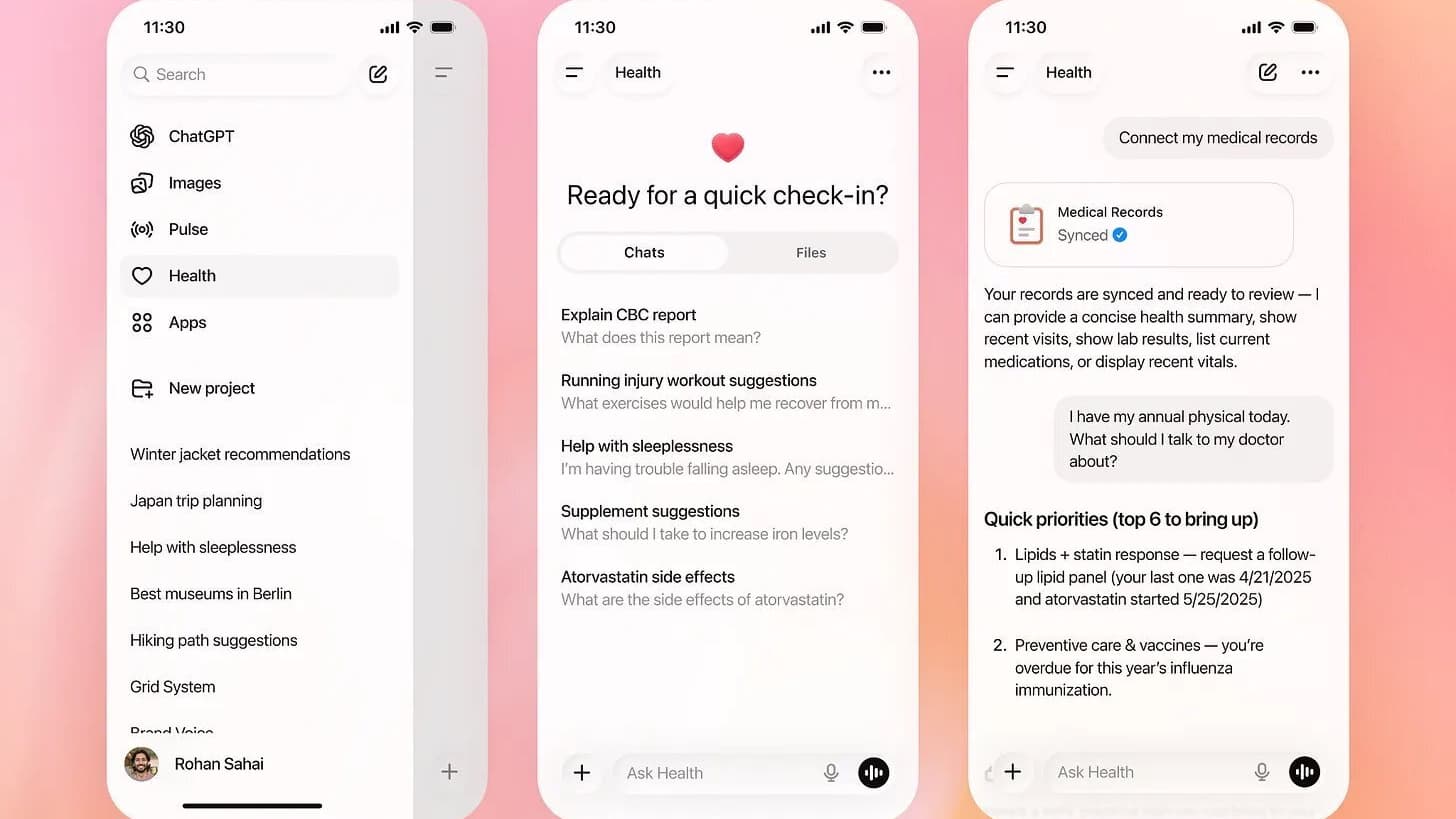
Use cases you can test right now with ChatGPT Health:
🔍 Understanding a medical report without panicking
Receiving blood test results or a medical report is often a source of anxiety: values in bold, acronyms, no context.
With ChatGPT Health, it becomes possible to:
- translate the indicators into plain language,
- put the results in context (isolated, to monitor, to discuss),
- prepare a list of relevant questions to ask the doctor.
What this changes:
less needless anxiety, and more effective medical conversations.
🩺 Preparing for a medical appointment effectively
Many appointments are too short, and patients often forget some of the important information.
ChatGPT Health makes it possible to:
- structure raw notes (symptoms, dates, treatments),
- create a clear timeline,
- prioritise the questions that really matter.
What this changes:
the patient arrives prepared and clear, and medical time is better used.
📁 Summarising scattered medical records
Between reports, tests, prescriptions and histories, information is rarely centralised.
ChatGPT Health can help to:
- produce a clear, readable summary,
- extract key information (medical history, treatments, important dates),
- identify what is missing or needs clarification.
What this changes:
records that are understandable and easy to share, with far less needless repetition.
📈 Tracking changes over time
Fatigue, pain, migraines, digestive problems… symptoms are often described vaguely.
Used as a structured journal, ChatGPT Health can:
- organise regular observations,
- identify trends or recurrences,
- help describe precisely what you are experiencing.
What this changes:
you move from a vague feeling to a description that is medically useful.
💊 Better understanding a prescription or treatment
Without interpreting or changing a prescription, the assistant can:
- clearly rephrase a prescription,
- list the points to check with a professional (duration, doses, interactions to raise),
- help organise several treatments to avoid confusion.
What this changes:
fewer mistakes in use and better adherence.
🥗 Nutrition and physical activity, finally in context
Health advice is often generic and unrealistic.
Based on the information provided by the user, ChatGPT Health can suggest:
- gradual, realistic adjustments,
- routines adapted to real constraints (time, fatigue, fitness level),
- consistent, guilt-free recommendations.
What this changes:
advice you can apply in real life.
Confidentiality, GDPR and health data management
Data management is a major issue. ChatGPT Health helps users better understand how each piece of health data is used, while complying with the GDPR and the standards of security and confidentiality.
OpenAI has put appropriate protections in place to prevent any unauthorised use of electronic medical records, medical files, and information related to health.
Diagnosis, clinical practice and medical decisions
In a clinical setting, ChatGPT Health can help structure information, without ever claiming to diagnose or replace a clinical decision. The diagnosis remains solely the responsibility of the healthcare professional.
The tool can, however, help prepare for an appointment by organising medical history, symptoms or questions, thereby improving medical practice and patient–clinician collaboration.
Collaboration with doctors and healthcare professionals
This project relies on collaboration with doctors, researchers and healthcare professionals. Designed collaboratively, ChatGPT Health aims to support professionals without interfering with their expertise.
This approach encourages better adoption of AI in healthcare, while respecting the constraints of the medical field.
Also worth reading
Discover our other articles to go further on ChatGPT and its new features:
Tools, connected apps and integrations
ChatGPT Health is gradually integrating with connected apps, tracking apps and well-being apps, such as Apple, Apple Health, or MyFitnessPal.
These integrations make it possible to use data from electronic medical records and apps, in particular for nutrition, insurance options, or understanding care habits.
b.well, chatbots and artificial general intelligence
Among the partners, b.well plays a key role. This chatbot, based on artificial general intelligence, shows how a tool can evolve towards better personalisation of health content.
Some features remain available only in the United States, and are being tested with a small group of users before a wider roll-out.
Conclusion
With more than 230 million people worldwide, ChatGPT Health represents a major step forward in the use of AI applied to people's health and well-being. Under the leadership of Sam Altman, OpenAI is showing that it is possible to provide useful information while respecting data protection, confidentiality, and the requirements of the medical sector.
Book your 30-minute call now
A no-obligation conversation to build your AI training around ChatGPT.
👉 Tell us about your AI project 👈
FAQ
ChatGPT Health and OpenAI: how it works, limitations and data
Clear answers to frequently asked questions about ChatGPT Health: medical use, diagnosis, personal data, GDPR and differences from standard ChatGPT.
What exactly is ChatGPT Health?
ChatGPT Health is a dedicated space within ChatGPT, developed by OpenAI, designed to help users better understand information related to health and well-being. It provides general information for educational purposes, without ever replacing a healthcare professional.
Can ChatGPT Health make a medical diagnosis?
No. ChatGPT Health cannot make a diagnosis or take clinical decisions. Medical diagnosis is solely the responsibility of a healthcare professional. The tool can, however, help structure information or prepare questions before an appointment.
How does ChatGPT Health protect health data?
OpenAI has put in place enhanced protections for health-related use, including encryption, a specific privacy policy and strict management of personal data, in order to guarantee the confidentiality of sensitive information.
Can ChatGPT Health be used to manage medical records?
ChatGPT Health can help organise and understand medical records, but it does not replace an official electronic medical record system. It is a tool to aid understanding, not certified medical storage.
Is ChatGPT Health GDPR-compliant?
Yes. OpenAI states that ChatGPT Health was designed to meet GDPR requirements, in particular regarding data protection, confidentiality and transparency about how health information is used.
Who is ChatGPT Health for?
ChatGPT Health is aimed at users who want to better understand their health questions, their care or medical information. It can also serve as an educational tool for healthcare professionals, without direct clinical use.
Is ChatGPT Health available worldwide?
Some ChatGPT Health features are currently available only in the United States, often as part of limited tests before a gradual roll-out to other countries.
What is the difference between standard ChatGPT and ChatGPT Health?
ChatGPT Health is a specifically regulated version within ChatGPT, with stricter rules and enhanced protections adapted to the medical field, unlike general-purpose ChatGPT.
Does ChatGPT Health replace a medical appointment?
No. ChatGPT Health never replaces a consultation, medical advice or clinical follow-up. It is a complementary information tool, intended to help people understand, not to treat.