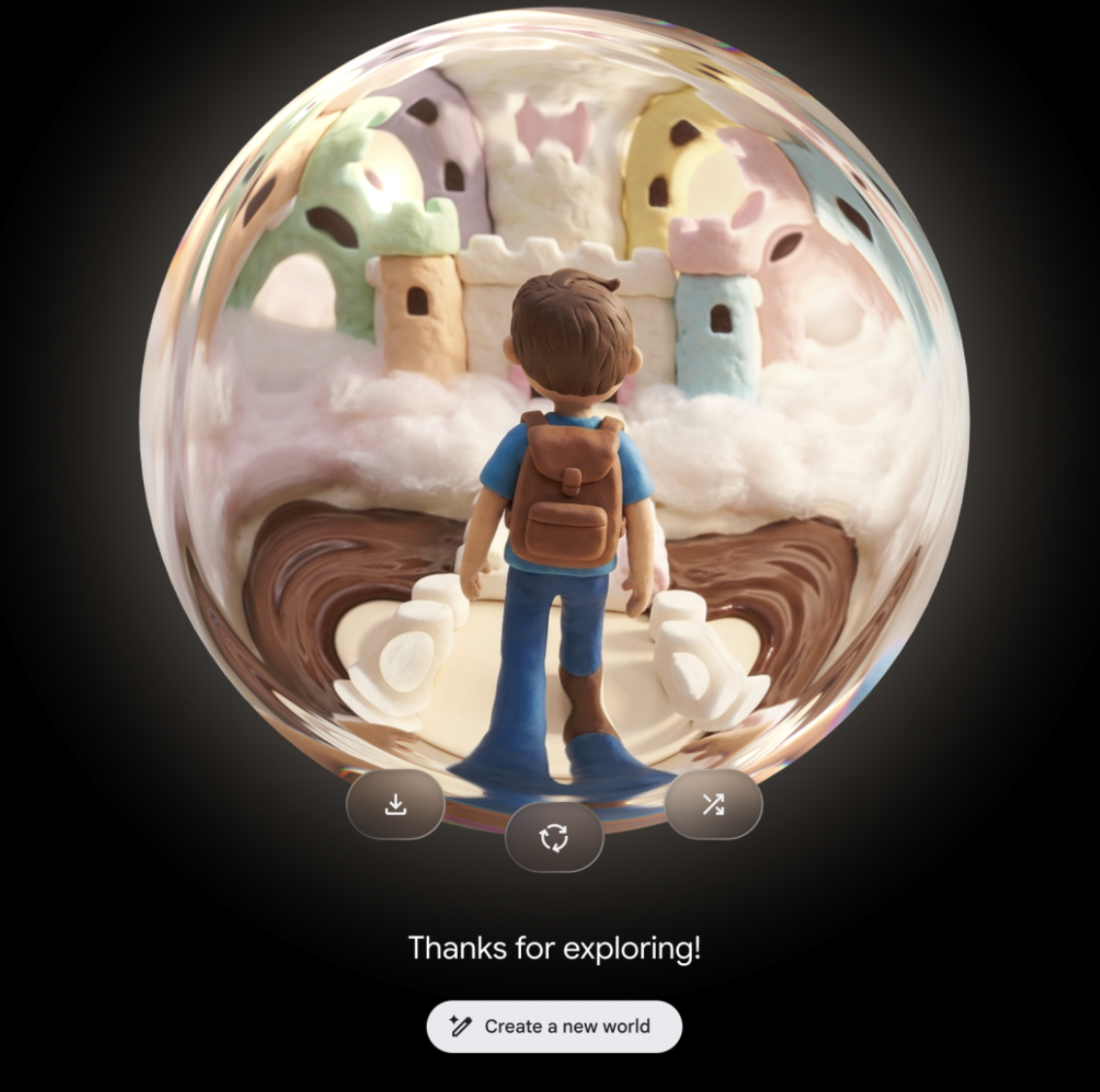
Google DeepMind has just unveiled Project Genie, a prototype that is wowing the entire tech world.
To explore these generative tools with your teams, discover our role-based AI workshops.
The idea is simple… and completely wild:
👉 you describe a world in one sentence
👉 and the AI instantly generates a playable mini-game
This is no longer an image.
This is no longer a video.
This is an interactive world.
What exactly is Project Genie?
Project Genie is a new experimental AI developed by Google DeepMind.
Its goal:
🎯 to turn text (or an image) into a playable, real-time experience.
In practice, you can write:
- “a futuristic city in the rain”
- “a Zelda-style world”
- “a cat in a flat”
- “an alien planet”
And Genie instantly creates:
✅ an interactive setting
✅ a controllable character
✅ live exploration
This is what is already being called a Text-to-Game model.
Why is everyone talking about it?
Because Project Genie marks a breakthrough.
Until now, generative AI could produce:
- text (ChatGPT)
- images (Midjourney)
- videos (Sora)
- music
But here, Google goes further:
👉 the AI generates interactive environments in which the user takes action.
It is a change of category.
A new stage: AI no longer generates content… it generates worlds
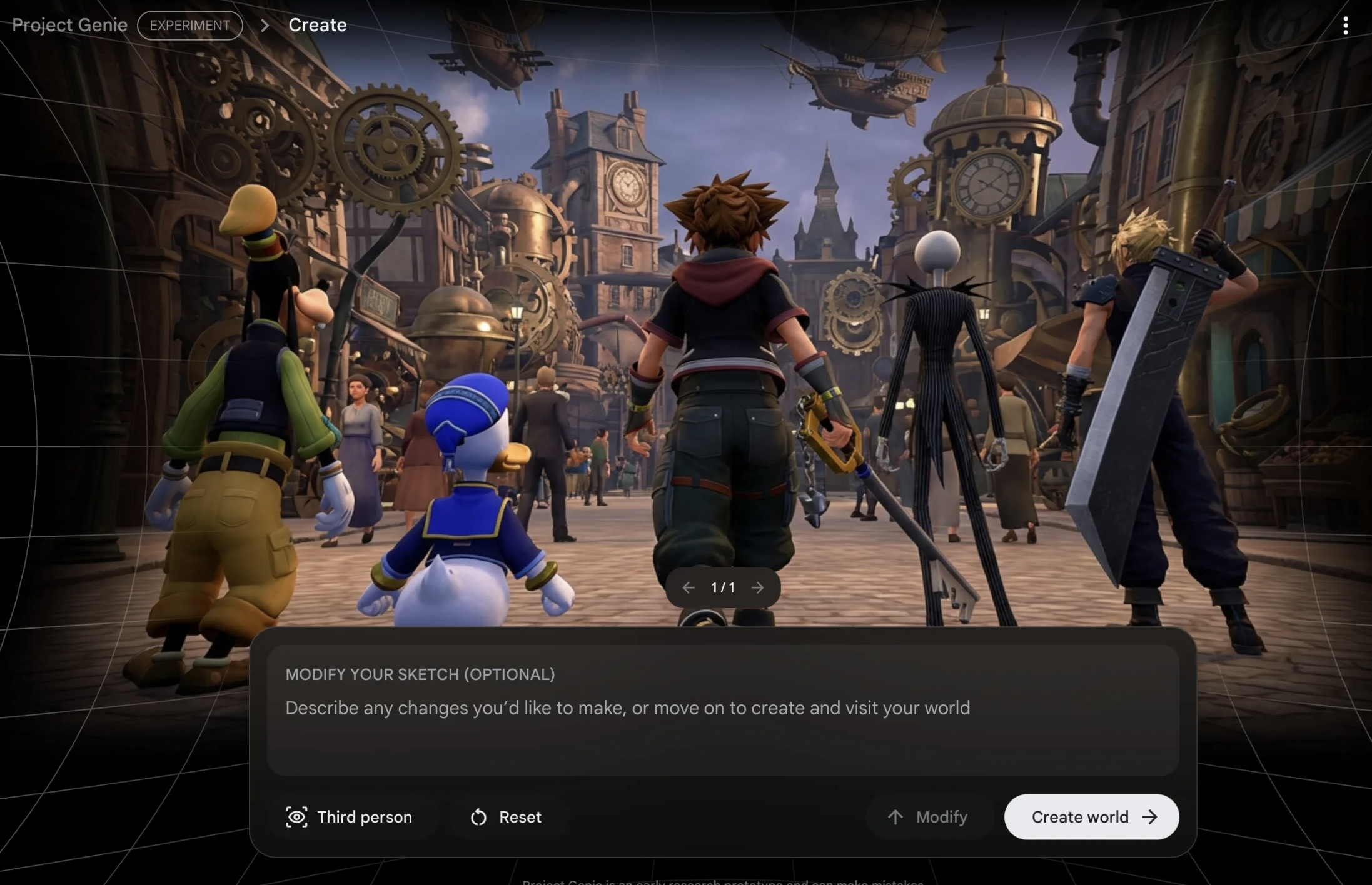
How does Project Genie work?
Google is still keeping quiet, but the principle relies on models that can:
- understand a text description
- generate a coherent environment
- sustain real-time interaction
Sessions are currently limited (around 60 seconds), because the model loses coherence over time.
But the signal is clear:
👉 Google is exploring the future of “games generated on the fly”.
Impact
Project Genie: beyond gaming, very practical uses
| Field | Practical example | Why it matters |
|---|---|---|
| 🎓 Education | Exploring ancient Rome “live” during a history lesson. | Making learning immersive and memorable (exploration + storytelling). |
| 🎥 Film & creative | Creating an interactive set to storyboard and test a scene. | Speeding up previsualisation (mood, framing, movement). |
| 🤖 Training AI agents | Simulating realistic environments to test robots and autonomous assistants. | Testing behaviour in a “sandbox” before deployment (risk ↓, iterations ↑). |
| 🕹️ Video games | Prototyping worlds and mechanics in a few seconds. | Drastically reducing the time from idea → playable prototype. |
Current limitations (and why that is normal)
Project Genie is still a prototype.
Today:
- simple interactions (walking, turning)
- limited coherence over time
- restricted access via Google AI Ultra (~$250/month)
- available in the United States only
Conclusion: Google is preparing the next interface
With Project Genie, Google DeepMind is not just showing a fun tool.
It is showing a direction:
the future of AI is not only conversational.
It is:
- interactive
- immersive
- executable
- generative in real time
Video games may only be the first playing field.
But what Genie heralds…
is the arrival of an AI capable of creating worlds.
At AI Sisters, we follow these breakthroughs closely
Because these innovations are not just about entertainment:
they herald the future uses of AI in education, simulation, work… and autonomous agents.
FAQ
Project Genie: creating a mini-game with AI (how it works, uses, limitations)
What exactly is Project Genie?
Project Genie is a Google DeepMind prototype that turns a simple description (“a futuristic city”, “a fantasy world”, etc.) into an interactive experience: a mini-game playable in real time, with a setting and a controllable character.
Can Project Genie really create a video game “in a few seconds”?
Yes, that is precisely the idea: to speed up the generation of a playable environment. We are not talking about a full game (with storyline, levels, economy…), but an instant interactive prototype — perfect for testing an idea or a world.
What changes compared with an AI that generates images or videos?
The key difference: interactivity. An image is static, a video is linear. Genie aims for a “world” that reacts to your actions (moving, exploring), so the logic is closer to a game than to static content.
What are the practical use cases for studios, creators and product teams?
Ultra-fast prototyping (mood, atmosphere, level design), world exploration, generating a “proof of concept” for a pitch, or iterating on gameplay ideas. It is also useful for training, research or simulation.
Does Project Genie replace a game designer or a game engine?
No. Genie speeds up the first version (the “first playable draft”), but designing a real game is still teamwork: art direction, level design, storytelling, balancing, production, QA, etc.
Can you precisely control what the AI generates (style, rules, character)?
Partly. As is often the case with generative systems, the prompt lets you steer the world (style, atmosphere, elements), but the level of fine control depends on the prototype, the parameters exposed and future product developments.
What are the current limitations (and why is it not yet “a real game”)?
At this stage, Genie targets short sessions and simple interactions. Keeping an interactive world coherent over time is a challenge: the longer you play, the harder it is to maintain stable logic (physics, continuity, objectives, memory).
Why is everyone talking about it?
Because it signals a shift: moving from “text-to-content” (text → image/video) to “text-to-interactive” (text → playable world). If the technology stabilises, it could transform the way experiences are prototyped, pitched and produced.
What risks and issues (quality, rights, safety) should be anticipated?
The main issues: coherence and reliability (an “unstable” world), creative control, copyright (assets, styles) and responsible use (generated content). As with any generative AI, governance and traceability become strategic as soon as you scale up.
Where does your company stand with AI? Take the free AI diagnostic in 5 minutes and get your action priorities.