E-commerce is changing in nature.
Until now, AI has mostly helped people search: compare products, read reviews, filter options, summarise features.
But a new stage is arriving: AI no longer just helps you decide. It can act.
Google has just unveiled the Universal Commerce Protocol (UCP), an initiative to standardise commerce “driven by AI agents”. Put simply: tomorrow, a user will be able to ask “find me the right product and buy it” and the agent will be able to complete the purchase directly in a conversational interface.
➡️ AI is becoming a new sales channel.

What is Google UCP (Universal Commerce Protocol)?
The Universal Commerce Protocol is a protocol designed to let different systems “speak the same language” in an automated purchase journey.
The goal: make smooth interaction possible between:
- an AI agent (conversational assistant),
- an e-commerce catalogue (products, variants, prices, stock),
- a payment system,
- rules for delivery,
- and policies for returns / after-sales service.
👉 UCP aims to make purchasing interoperable, so that AI agents can recommend and complete purchases without having to rebuild a specific integration for each merchant.

Why this is a turning point for e-commerce brands
1) The purchase journey becomes “AI-native”
Until now, the classic journey was:
search → website → filters → basket → payment
With AI agents that can act, we are gradually moving to:
intention → decision → execution
The user states a need, and the AI can do the rest: compare, select, suggest an option… and buy.
2) The website is no longer the only place where decisions are made
Your website remains essential (it is where your product information lives).
But the place where the decision is made may become: the conversational interface.
If your catalogue cannot be read and used by an AI, you can lose visibility, even with an excellent product.
3) Competition becomes more direct
In an agentic journey, comparison becomes instant.
AI can analyse several options in a few seconds.
The result: the clearest, most reliable and most “easy to choose” brand takes the lead.
What changes in practice: the purchase happens in the conversation
Until now, AI has mostly helped people compare and decide. With UCP, Google is pushing a model where buying becomes a “native” action in the conversation.
In practice, this means:
- product pages that can be viewed directly in the conversational interface,
- fewer redirects,
- a smoother journey from discovery → basket → payment → delivery.
The key point: the user no longer “browses”. They state a purchase intention, and the AI executes it.
The 4 most important uses (in the short term)
Here are the most realistic use cases for the coming months.
Discover our AI training & book a call
Explore our training modules and choose, with us, the one that best fits your AI needs.
📚 See our AI training 📞 Book a discovery call
The 4 most concrete UCP use cases
| # | Use case | Example | Business impact |
|---|---|---|---|
| 1 |
Buying without browsing a website The website is no longer the main interface: the agent must be able to buy “for you”. |
“I want the right product for my needs, order it.” |
Impact: your catalogue must be purchasable by an agent, not just readable by a human. |
| 2 |
Finding the right product from a need (not a keyword) The AI starts from an intention (use, constraints) rather than a classic “SEO” query. |
“I'm looking for a warm but light jacket to walk to the office.” |
Impact: vague product pages lose visibility, structured pages win. |
| 3 |
Automated multi-site shopping The agent compares several merchants in a few seconds (price, proof, availability). |
“Compare 3 reliable options, choose the best one, order it.” |
Impact: if your offer is less clear or less reassuring, the AI will decide quickly. |
| 4 |
Handling stock-outs without hurting conversion The agent automatically switches to the equivalent product (same features). |
“If this model is unavailable, take the equivalent.” |
Impact: fewer abandoned baskets and smoother conversion. |
How to make your brand “purchasable” by AI (SEO + GEO)
If you are a brand or an online retailer, the challenge is no longer just ranking well on Google.
You need to be understandable and selectable by an AI.
Here are the priorities:
1) Structure your product pages (clarity)
An AI needs explicit information, not vague marketing.
To include:
- technical specifications (clear format)
- variants (size, colour, compatibility)
- price, stock, lead times
- delivery, returns, warranty
- important conditions (“not suitable if…”, “ideal for…”)
2) Make your offer comparable (consistency)
For an AI to compare correctly, data must be consistent:
- standardised product names
- consistent units and formats
- complete information on options
3) Add proof (credibility)
AI favours brands that reassure.
To strengthen:
- customer reviews
- certifications / labels
- best-sellers
- proof of real-world use
- photos in context
4) Create an “AI-friendly” FAQ (GEO)
Examples of questions to add to your website:
- “What is the best product for [use]?”
- “What is the difference between [A] and [B]?”
- “Is it compatible with [X]?”
- “What is the alternative if this product is out of stock?”
- “What budget should I plan for [goal]?”
Discover our AI training & book a call
Explore our training modules and choose, with us, the one that best fits your AI needs.
📚 See our AI training 📞 Book a discovery callConclusion: UCP speeds up “agentic” commerce

E-commerce is not disappearing. But the classic journey is being partly replaced by a new interface: the conversation.
With UCP, Google is preparing a world where the user delegates:
- the search,
- the comparison,
- the choice,
- and sometimes even the purchase.
For brands, the message is clear:
👉 Performance will no longer depend only on “bringing in visitors”.
It will depend on the ability to be recommended and selected in AI answers.
What now? Move from “observation” to action with our GEO platform
At AI Sisters, we see one thing very clearly: with the arrival of standards such as Google UCP, visibility no longer depends only on classic SEO.
Brands now need to be:
- understandable by AI
- cited in answers
- selected at the moment of decision
- and tomorrow, directly purchasable by agents
This is exactly why we created our GEO platform.
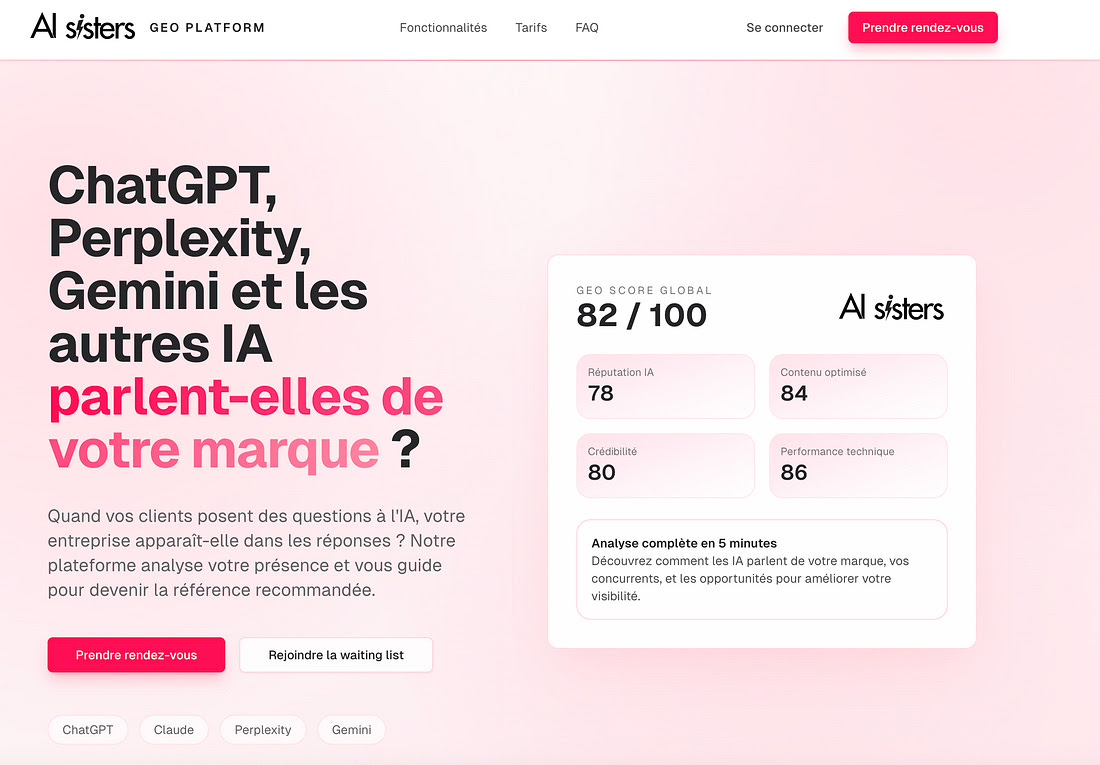
It lets you:
- audit your AI visibility (are you cited? for which queries?)
- measure your progress with a clear GEO score
- track your strategic queries over time
- analyse your competitors (who is taking your place and why)
- get actionable recommendations (what to fix, what to strengthen, and in what order)
Discover our AI training & our GEO platform
If you want to know how your brand appears today in ChatGPT, Gemini, Perplexity or Claude and how to improve your presence in these answers in practice
📚 See our AI training 🤖 Discover our GEO platform
FAQ - Google UCP and “agentic” commerce
The essential answers to understand the Universal Commerce Protocol and prepare your e-commerce business for buying in the conversation.
What is Google UCP (Universal Commerce Protocol)?
UCP is a protocol designed to standardise the way AI agents interact with an e-commerce catalogue, payment, delivery and after-sales service. The goal: allow an AI to move from recommending to completing a purchase, more smoothly.
How does UCP change the purchase journey?
The “search → pages → filters → basket → checkout” journey is partly replaced by an “intention → decision → execution” logic in a conversational interface. The conversation becomes a major entry point in the decision.
Does my e-commerce website become useless?
No. The website remains the “source of truth” (products, stock, prices, conditions). But it is no longer necessarily the place where decisions are made: if the AI compares and selects in the conversation, your content must be readable and actionable by an agent.
What is the link between UCP and GEO (ranking in AI answers)?
GEO aims to optimise your visibility in AI answers (ChatGPT, Gemini, Claude, Perplexity). UCP speeds up this shift: the AI answer can become a direct entry point to purchase. Being cited is no longer enough: you need to be chosen.
What product information does an AI need to find to recommend my brand?
Structured, verifiable information: features, variants, compatibility, lead times, availability, return conditions, warranty, proof (reviews, labels, use cases). The clearer it is, the more comparable it is, and the faster the AI can decide.
How do you prepare your catalogue for “agentic” commerce?
Standardise your data (titles, attributes, units), enrich product pages (proof, uses), make the rules explicit (delivery, returns, alternatives when out of stock) and publish an FAQ built around real questions (comparisons, compatibility, budgets).