.svg)
Google unveiled Gemini 4 Argon, its new artificial intelligence model, on 30 September 2026. It is initially reserved for organisations in the Fairwind programme, cyber defenders selected by Google. For everyone else, there is no date.
You may have read that Google has just retaken the lead. That is true on some tests, false on others, and it makes no immediate difference to you: outside the Fairwind programme, nobody can use it yet. Argon also comes after a false start: version 3.5 Pro, announced in May, was never released. The research firm SemiAnalysis says it was abandoned; Google denies it. 😅
What deserves your attention is not the ranking. It is what Google says it is aiming at, which is unusually specific: software engineering, legal, finance and cyber defence.
At AI Sisters, we train teams in all four of these roles, and we look at what independent evaluators measure before believing a press release. Let’s get started 👇
Argon “delivers state-of-the-art performance on complex processes: real-world software engineering, enterprise knowledge work such as legal and finance, and cyber defence,” Google wrote on the day of the announcement (our rendering).
In brief
- Announced on 30 September, reserved for cyber defenders in the Fairwind programme. No date for anyone else.
- It comes after a false start: version 3.5 Pro, announced in May, was never released. SemiAnalysis says it was abandoned; Google denies it.
- Google names four areas: software engineering, legal, finance, cyber defence.
- Independent evaluators do not agree: first at Vals AI and on Arena.ai, level with GPT-6 Astra at Artificial Analysis, behind Claude Opus 5.5 and Claude Sonnet 5.5.
- It makes up less, but it knows less: when it does not know the answer, it says so instead of making something up in 85% of cases, against 49% for GPT-6 Astra. But it finds the right answer less often: 50% against 63%.
- It uses 2.3 times more tokens than GPT-6 Astra for the same task. Cheaper at the launch price, it will become more expensive once that price doubles.
Further reading
Explore our other articles to go further in choosing your AI tools:
What Google announces, and what it does not say
Argon is presented by Koray Kavukcuoglu, vice-president of Google DeepMind and Google’s chief AI architect, as a model built for long-running work. Not for answering quickly, but for seeing a piece of work through to the end.
🔥 One million output tokens. The limit on what the model can produce in a single response rises from 64,000 to 1 million tokens, or roughly 700,000 words. Nobody writes a report that long: the point lies elsewhere. The model can carry out a long task, such as rewriting a large body of code, without splitting it into pieces.
💡 Explainer: a token. This is the unit these models split text into, count and bill. A token is roughly one short word, or part of a long word: count on about 700 words of French for 1,000 tokens. Everything counts, both what you send and what the model sends back, which is why these offers are billed per token rather than per question.
🔥 An introductory price, then double. $2 per million input tokens and $10 per million output tokens during the launch, then $4 and $20. Tokens that have already been read and kept in the cache, in other words those of a document you send several times, are billed 95% cheaper.
🔥 Restricted access. The model goes first to organisations in the Fairwind programme, launched on 2 September, which now has more than 650 members. The programme targets government bodies and cybersecurity authorities, critical infrastructure operators (healthcare, energy, telecoms, finance) and the major technology platforms. These organisations get Argon with its cyber safeguards switched off, in exchange for strict rules on who uses it and on how every use is logged.
⚠️ And that is where the announcement stops. Google writes that the model will reach paying API customers (the API being the technical channel through which software calls the model) and Google AI Ultra subscribers “as soon as possible”, and then everyone. Neither of these two stages has a date.
💡 In plain terms: as long as access stays limited to Fairwind, nobody else can test Argon on their own documents. A model you cannot try cannot be compared; it can only be taken at its word.
The figures, and above all who measured them
This is where the headlines part ways with reality. Some of the results come from Google, the rest from independent evaluators, and the two do not tell the same story.
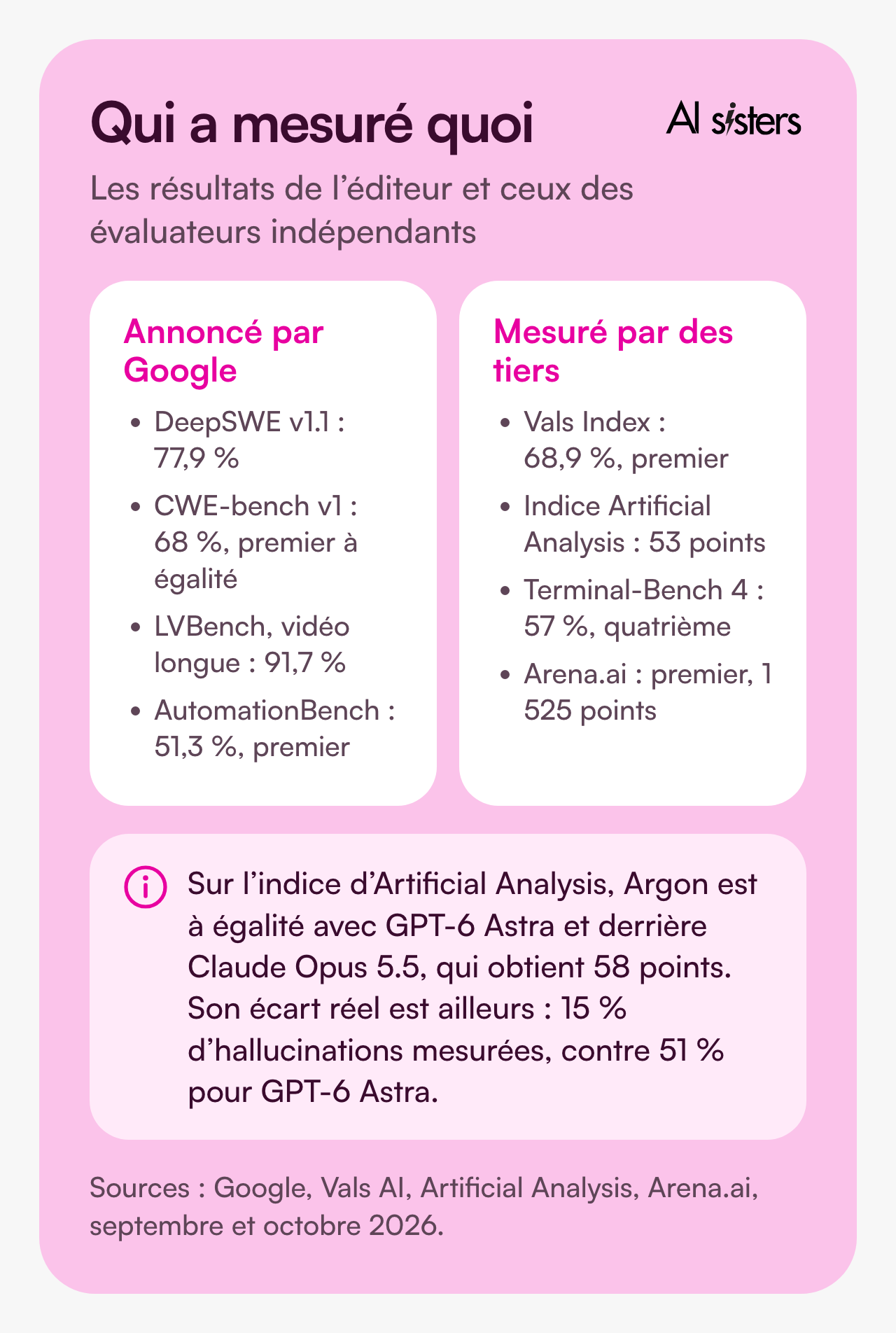
✅ Where it genuinely takes the lead. The Vals Index ranks it first, at 68.9%. This ranking matters because it comes from Vals AI, an independent evaluator that builds its tests with practising lawyers, financial analysts and engineers, and weights each area by its real share of the economy. On Arena.ai, which measures the preferences of real people, Argon also comes first for text, in a ranking that is still provisional (fewer than 5,000 votes). It is only eighth for web development.
⚠️ Where it does not take the lead. Artificial Analysis gives it 53 points on its intelligence index, level with GPT-6 Astra and Claude Fable 5.1, behind Claude Sonnet 5.5 at 56 and Claude Opus 5.5 at 58. On Terminal-Bench 4, which measures real command-line work, that is, operating a machine by typing instructions one at a time, it is fourth at 57%, behind Claude Sonnet 5.5 (64%), Claude Opus 5.5 (60%) and GPT-6 Astra (59%).
⚠️ Watch out for identical names. Google reports 51.3% on AutomationBench. Artificial Analysis measures 78% on its own variant of the same test. Two different tests behind a single name: if someone shows you a figure, ask which one.
⚠️ The hallucination figure needs reading with its instructions. Artificial Analysis asks each model factual knowledge questions (the AA-Omniscience test). When the model cannot find the right answer, it can say it does not know, or hallucinate: state something false with the same confidence as something true. The hallucination rate is the share of made-up answers in that situation: 15% for Argon, 51% for GPT-6 Astra, 54% for GPT-6.1 Sol. Argon is better at holding back. But it also finds the right answer less often: 50% of questions, against 63% for GPT-6 Astra. Safer to review, not more knowledgeable.
💡 Explainer. A model test is an exam. The same pupil does not get the same mark depending on who sets the paper, who marks it, and what is allowed during the exam. When the vendor writes and marks the test itself, the mark is still information, but it is no longer an evaluation.
Discover our AI training & book a call
Explore our training modules and choose, with us, the one that best meets your AI needs.
📚 See our AI training 📞 Book a discovery call
The detail that will decide your bill
The advertised price per million tokens tells you almost nothing about what you will pay. What matters is how many tokens the model uses to get the job done.
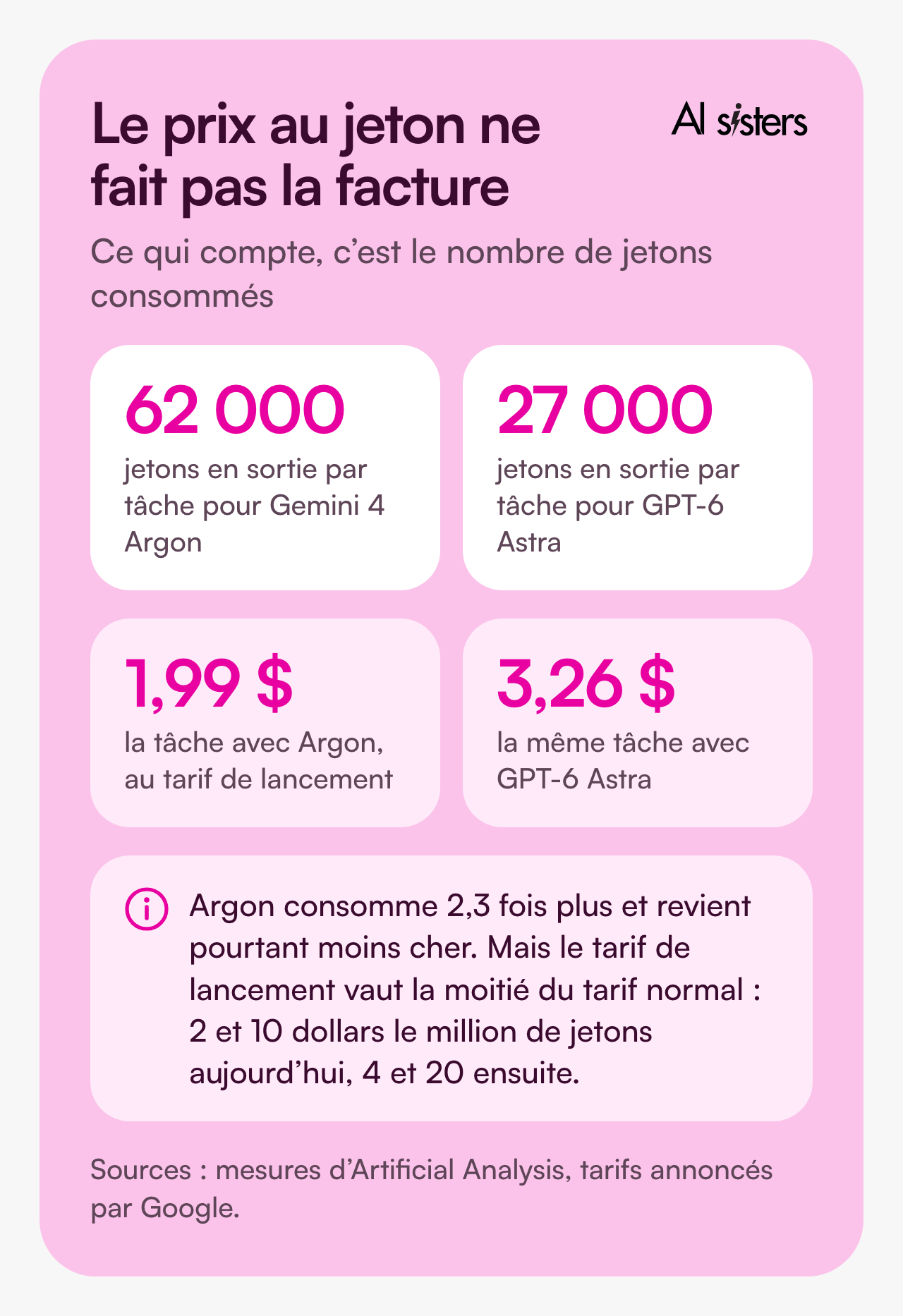
Artificial Analysis measured consumption across the tests in its index. Argon produces an average of 62,000 output tokens per task, against 27,000 for GPT-6 Astra. It thinks out loud, at length, and bills for every word of that thinking.
✅ The maths still works in its favour. At the launch price, a task from this index costs on average $1.99 with Argon and $3.26 with GPT-6 Astra. Its per-token price more than makes up for its consumption.
⚠️ But that price is half the normal price. At the normal price, the same task will rise to about $3.98: more expensive than GPT-6 Astra, at $3.26. Argon’s price advantage lasts only as long as the launch. A wordy model at a doubled price is the cost line to watch, especially if you plug it into an automated process that runs all day.
💡 In plain terms: the price per million tokens is the price shown at the pump. Your bill is the number of miles driven, multiplied by the vehicle’s real fuel consumption. Two models at the same price can differ in cost by a factor of two over a year.
What it could change for four roles
Google names four areas. For each one, here is what the measurements really say and where to start on the day the model becomes available. The conditional is deliberate: none of this can be tested today outside Fairwind.

For a development team: migrations, not demos.
Google says it has migrated more than 800,000 lines of code internally with Argon, and reports 77.9% on DeepSWE. But Terminal-Bench 4, which measures real command-line work, puts it fourth. Read these two figures together: strong on large-scale code transformation, not in the lead at operating a workstation. First task to hand over: a library version upgrade on a secondary code repository, reviewed by a person before it is merged.
For a legal team: review, not final drafting.
The Vals Index, where Argon is first, mixes several areas: its overall ranking does not on its own tell you what the model is worth in law. The clearest legal signal comes from Harvey, which makes an assistant for lawyers: according to figures published by Google, Argon scores 19.6% on its legal agent test, against 6.7% for the next model. The score remains low, which mainly shows that these tasks still resist every AI. First task to hand over: a compliance review of a standard contract you know by heart, so you can compare its output with what you would have written. A point to watch: a contract sent to an API leaves the company, and that is a decision to make before the test, not after.
For a finance team: the checked figure, not the plausible one.
Vals AI’s finance tests require extracting data from a credit agreement, cross-referencing it between comparable companies and producing a recommendation without inventing any amount. This is where Argon’s caution matters: a model that answers “I don’t know” instead of inventing an amount saves checking time. But Argon only finds the right answer in half of cases on the Artificial Analysis test: it does not spare you any checking. First task to hand over: summarising an annual report you have already analysed yourselves, so you can check every figure one by one.
For a security team: the only role served today.
Argon scores 68% on CWE-bench v1, a vulnerability-fixing test, and the vendor Wiz already uses it in its Scan for Good initiative. It is also the only role that has access, through Fairwind, and with the cyber safeguards lifted. If your organisation is not in this programme, there is nothing to test: Google vets every organisation before admitting it, and the programme page sets out the conditions.
Book your 30-minute call now
A no-obligation conversation to build your AI training around your tools.
👉 Tell us about your AI project 👈
What you can do before it arrives
An announced model is not a deployed model. Here is the work that gets done while you wait, and that will not be wasted if Argon disappoints.

Do not rewrite your roadmap. A model you cannot buy changes no decision. Autumn announcements come thick and fast, and teams that change course with each one never deploy anything.
Prepare your own test. Gather ten real tasks from your field for which you already know the right answer: a contract you have reviewed, a report you have summarised, a bug you have fixed. On the day Argon becomes available, you will have a measurement in half a day instead of an impression.
Look at the output cost line, not the advertised price. For the models you already use, work out the average token consumption per task. It is the only basis that will let you compare one offer with another honestly, and our overview of AI tools walks through this calculation for the usual subscriptions.
Settle the data question before the test. Contracts, financial reports, proprietary code: decide what is allowed to leave the company, and write it down. The CNIL, France’s data protection authority, has published practical guides for framing these uses in small and medium-sized businesses, and a rule written once serves for every tool that follows.
Train on what is already there. Knowing how to frame a task, check an output and spot something made up transfers from one model to another. That is the whole principle behind our role-based approach to training, and if you are starting from scratch, we have written a practical guide to bringing AI into a company.
Book your 30-minute call now
A no-obligation conversation to build your AI training around your tools.
👉 Tell us about your AI project 👈
Key takeaways
- Argon is announced, not available: reserved for Fairwind cyber defenders, with no date for what comes next.
- It follows a version 3.5 Pro that was never released (abandoned according to SemiAnalysis, still in development according to Google), which is a reason to wait for real availability rather than the announcement.
- First at Vals AI and on Arena.ai, level with GPT-6 Astra at Artificial Analysis, behind Claude Opus 5.5 and Claude Sonnet 5.5.
- It makes up less when it does not know: 15% hallucinations against 51% for GPT-6 Astra, but 50% correct answers against 63%.
- It is wordy: 62,000 output tokens per task against 27,000. Cheaper at launch, it will overtake GPT-6 Astra on cost once the price doubles.
- The useful work happens now: your in-house test, your data rule, training your teams.
To prepare your teams for these changes, explore our AI workshops by role.
Where does your company stand with AI? Take the free AI maturity assessment in 5 minutes and get your priority actions.
Sources
- Google, Gemini 4 Argon: our next era of frontier intelligence, 30 September 2026.
- OfficeChai, Google has silently canceled Gemini 3.5 Pro, says SemiAnalysis report, 10 August 2026.
- The Decoder, Gemini 4 Argon closes the gap with OpenAI and Anthropic but doesn’t take a clear lead, 1 October 2026, citing Artificial Analysis measurements.
- Artificial Analysis, Gemini 4 Argon: Google is back as one of the top three labs in intelligence achieved, 30 September 2026.
- Google, Proactive cyber defense for governments and enterprises (Fairwind programme), 2 September 2026.
- Vals AI, Vals Index, accessed 8 October 2026.
- TechCrunch, Google releases Gemini 4 Argon, called its most powerful model yet, 30 September 2026.
- CNIL, Using generative AI in small and medium-sized businesses (in French), accessed 8 October 2026.



.avif)
