.svg)

1. Our conviction: effective AI training is “business first”
Generative AI is already transforming the daily lives of teams. But in the majority of companies, the challenge is no longer to “discover” AI.
The challenge is to Ensuring sustainable adoption of AI, in a useful, rigorous and secure manner.
At AI Sisters, we believe in a simple belief:
An AI training that works is personalized training by profession, built on the basis of real challenges, and led by educational experts.
Why?
Because the needs, deliverables and constraints are not the same between a marketing department, an HR team, a sales department or a financial department.
Generic AI training often produces curiosity.
Personalized AI training by profession produces scores.
AI Sisters designs tailor-made AI training by business (marketing, sales, sales, HR, finance, ops) to transform the use of generative AI into sustainable adoption. Our method combines audit, workshops on real documents, frameworks, prompts/ templates, security rules and monitoring.
2. The challenge ahead: moving from intuitive to structured use
Many companies have already tested traditional “AI” training courses. And they come back with the same observation:
- “It was interesting, but not applicable enough to our daily lives.”
- “The examples were too generic.”
- “We learned tips, but not a method.”
- “The adoption came back after a few weeks.”
This is normal: AI is mastered in Practicing on their own cases, with a clear working method.
So the real challenge is not “training in a tool”.
The real challenge is to:
- Structuring uses
- professionalize the quality of prompts
- identify high-impact use cases
- secure practices
- Anchoring adoption over time
3. What we aim for together: impact, adoption, and autonomy
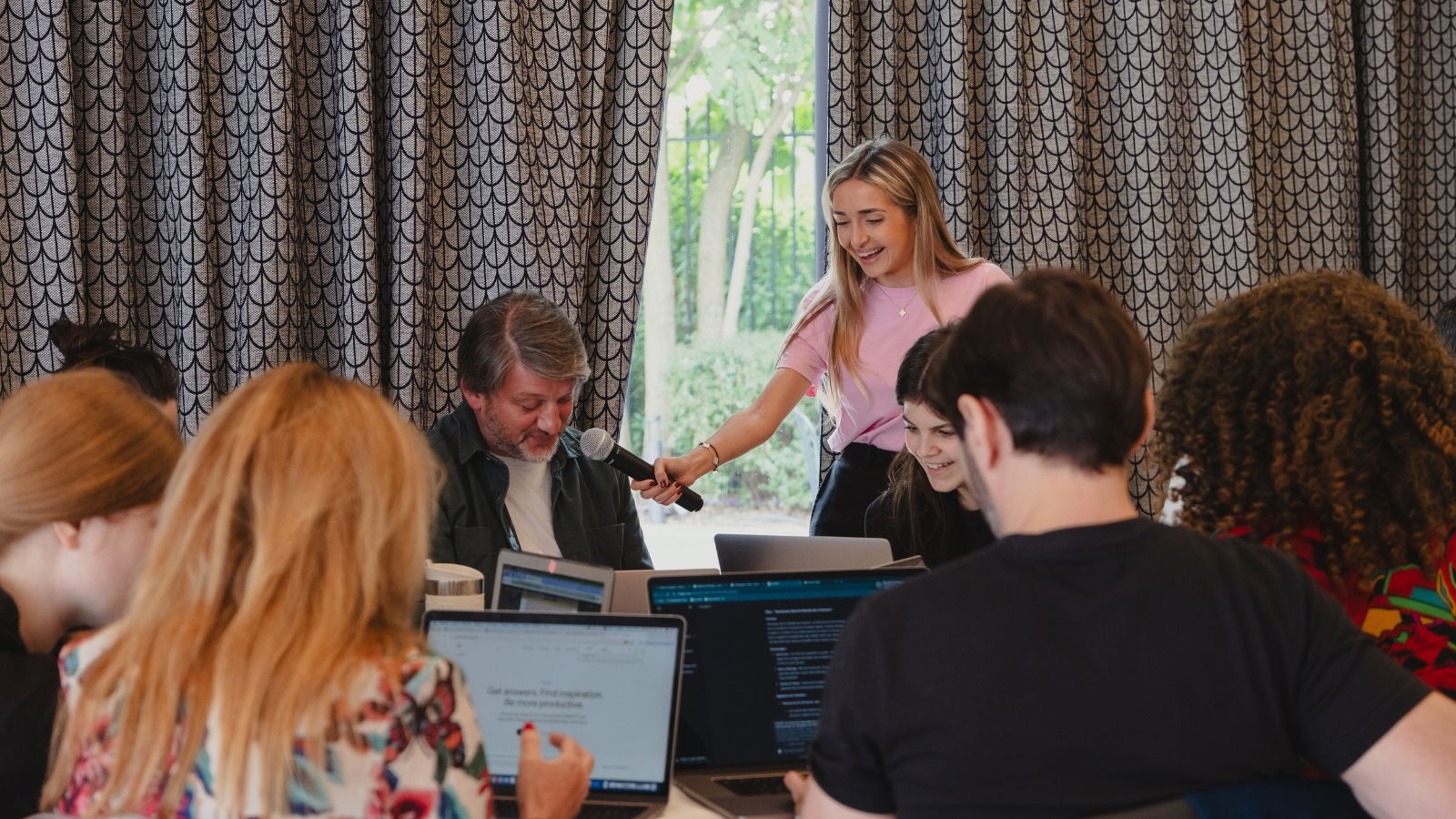
A personalized approach by business aims at three concrete results.
1) A rapid impact from the first days
Save time on repetitive tasks, produce faster and better, improve the quality of deliverables.
2) A professionalization of AI practices
Going from “I'm testing” to “I'm in control”: structured prompts, frameworks, verification methods, templates.
3) Sustainable and secure adoption
Confidentiality, best practices, governance: AI is becoming a reliable tool, not a gray area.
Final objective: to make teams autonomous.
4. Our approach: a tailor-made method, structured by profession
At AI Sisters, we build our devices on 4 pillars.
1) Pre-audit: understand your challenges before training
Before any training, we frame:
- your goals (productivity, quality, innovation, acceleration, compliance)
- your tools (Copilot, ChatGPT, Google suite, CRM, etc.)
- The real level of the participants
- confidentiality and internal data constraints
- the concrete deliverables produced on a daily basis
Our rule: never train “in a vacuum.”
2) Customization by profession: the heart of efficiency
Successful AI training speaks the language of the job.
Because high-value use cases are not the same across teams:
- marketing seeks to accelerate strategy, production and creativity
- Sales want to personalize prospecting and better manage objections
- HR must produce reliable, consistent, and compliant materials
- finance and operations aim at synthesis, reporting, structuring
The “business-first” approach makes it possible to get out of the theory immediately:
participants are working on their own documents, their challenges, their constraints.
3) AI experts + educational engineering: a format designed for adoption
AI training is not about showing demos.
We combine:
- AI experts (practitioners)
- educational experts
- progressive structuring: acculturation → practice → iterations → projection
Objective: to transform AI into work reflex.
4) Deliverables and standardization: prompts, templates, playbooks
For training to become a sustainable driver, you must leave with:
- Prompts structured by business
- reusable templates
- an internal playbook (best practices, rules, verification methods)
- a monitoring logic (depending on the devices) to anchor adoption
We don't just train: we equip.
5. What we have put in place
Day 1 — Advanced acculturation and practice
We start with a Acculturation show to generative AI, designed to lay solid foundations: understand how AI responds, identify limits, adopt good reflexes, and integrate the security rules that are essential in business.
We then switch to personalized workshops by profession, built from your deliverables and your real cases. The objective: to transform AI into a concrete lever for productivity and quality, directly applicable on a daily basis.
According to the teams, the workshops cover for example:
- Marketing : strategy, content, arguments, analysis
- Sales : prospecting, answers, objections, objections, summaries, negotiation
- RH : recruitment, onboarding, internal support, structuring
- Finance/Ops : analysis, synthesis, reporting, clarification
- Support : customer response, knowledge base, productivity
Finally, as an option, we offer a Promptathon : a very effective exercise to make teams progress quickly, improve the quality of rapid teams, and share best practices between participants.
Day 2 — Deepening, frameworks and projection
The second day aims to take a step forward: go from intuitive to use expert, structured and repeatable.
We deepen the techniques of prompting, iteration, the reliability of responses and structuring methods adapted to professional use.
We then introduce business frameworks (marketing, sales, HR, management) to help teams deal with more complex issues: strategy, analysis, decision-making, synthesis and high-value production.
Depending on your level of maturity and your tools, we can finally open up to more advanced devices: simple agents, knowledge bases, task automation and integration into existing workflows.
6. The concrete impacts
A personalized approach by profession immediately changes the quality of training... and especially what happens afterwards.
The most frequent impacts observed:
- A clear increase in competence on the structure of prompts (clearer, more effective, more reliable)
- Better targeted uses, directly aligned with business priorities
- Better control of internal tools (Copilot, ChatGPT, Gemini, office suites) because the teams know what to do with them
- The creation of templates and standards reusable (prompts, checklists, playbooks)
- A better level of rigor : more verification, less approximation, better risk management
- Sustainable adoption, because the teams leave with reflexes and concrete supports
In summary: AI ceases to be an “interesting tool” and is becoming a daily performance driver.
7. What makes a difference (and what teams appreciate)
Businesses that are getting real results on AI haven't simply “trained their teams.”
They put in place a method and a framework.
What teams value the most about an approach AI Sisters :
- Working on their own documents, not on theoretical cases
- Personalization by profession, which makes the training immediately applicable
- A progressive pedagogy, which increases skills without complicating
- The production of concrete deliverables (templates, prompts, playbooks)
- A clear framework for security and privacy
- The ability to reach a new level : moving from intuitive to structured use
8. Perspectives and consequences
Successful training is often the starting point.
Depending on your organization, the most effective suites consist of:
- structure a prompt and template library By team
- formalize a Internal AI playbook (best practices, rules, verification)
- deploy complementary workshops on advanced topics (agents, automation, workflows)
- support adoption through a 30-day follow-up (measurement, anchoring, adjustments)
- clarify governance rules: confidentiality, authorized uses, validation posture
The objective: to move from an increase in individual competence to a collective capacity.
9. What if it was you?
What if your teams also moved from intuitive use of AI to structured control, business by business, with concrete and lasting impacts?
AI Sisters designs tailor-made AI training courses, adapted to your tools, your jobs and your business challenges!



.avif)
